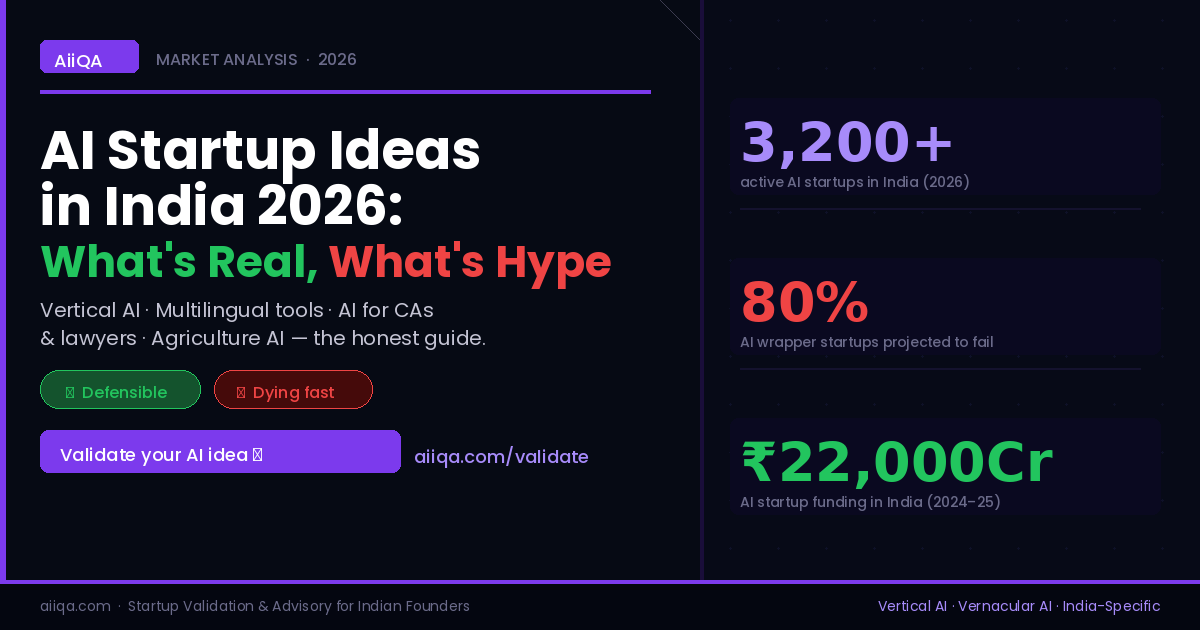
3,200+ AI startups in India. 80% will fail. Discover which AI ideas are genuinely defensible — vertical AI, multilingual tools, AI for CAs and lawyers, agriculture AI — and which are overcrowded hype.
Right now, somewhere in India, a founder is registering a company called something like "BharatAI" or "IndiaGPT" and preparing a pitch deck that says "the AI platform for everything."
That company will not exist in eighteen months.
India's AI startup ecosystem has produced over 3,200 active AI startups as of 2026. It is the third-largest AI startup ecosystem in the world after the United States and China. Total AI startup funding in India crossed ₹22,000 crore in 2024–25.
And yet, funding for generic AI chatbot startups in India fell 53% from FY2023-24 to FY2024-25 — from $305.9 million to just $143.6 million — precisely when global AI funding was hitting $110 billion.
That gap is not a contradiction. It is the most important data point for any founder considering an AI startup in India today.
Investors aren't pulling back from Indian AI. They're pulling back from Indian AI that isn't actually an AI business. And they've become very good at telling the difference.
This article is a forensic split. What's genuinely defensible. What's overcrowded and dying. And how to tell the difference before you spend a year of your life building the wrong thing.
The Graveyard First: What Is Not Working
Before we talk about opportunities, let's be honest about the hype that is actively collapsing. Knowing what to avoid is more valuable than any list of ideas.
1. Generic AI Wrappers
A wrapper startup takes an existing AI model — GPT, Claude, Gemini — adds a user interface, writes a few prompt templates, and sells access to it as a product.
From 2022 to early 2024, this worked. Users didn't know how to use ChatGPT directly. A polished interface for "AI resume writer" or "AI Instagram caption tool" felt like real value.
That window is closed.
In 2024 alone, OpenAI's own feature releases — GPT Store, Operator, Canvas, Tasks, Search — directly cannibalized over 200 funded "GPT wrapper" startups globally. Inference costs dropped 80% between 2023 and 2025, eliminating the margin between API cost and customer price. When the platform gives away your core product for free, you don't pivot. You shut down.
Per CB Insights and Gartner, 80% of AI wrapper startups are projected to fail by the end of 2026. Only 3–5% ever cross ₹8 lakh in monthly recurring revenue.
Builder.ai is India's most expensive lesson in this space. It raised $445–700 million from prominent investors while claiming AI-powered code generation. In 2025, it was exposed for using human developers disguised as AI. Investors wrote off their capital. The company shut down.
⚠️ The wrapper test: If you replaced your AI with a human doing the same task, would your customer notice? If not, you don't have an AI business. You have a service business with an AI-shaped front end.
2. "An Indian ChatGPT"
The pitch sounds national. The economics are brutal.
Building a general-purpose large language model from scratch requires hundreds of millions of dollars in compute, data curation, and research talent. You would be competing against OpenAI, Google DeepMind, Anthropic, and Meta — all of whom have already spent billions and are continuously improving.
Krutrim and Sarvam AI — India's most credible indigenous AI model companies — have raised $50M+ and $41M, respectively, from tier-one global VCs, are founded by former Google Brain researchers and IIT/IISc alumni, and are fighting for traction daily.
If they're finding it difficult, a first-time founder with ₹50 lakh and three engineers is not building India's ChatGPT. They are burning capital to prove a point that has already been proven.
3. Generic B2C AI Tools
AI writing assistants. AI content generators. AI social media schedulers. AI presentation makers.
Every single one of these categories is being absorbed directly into foundation models. ChatGPT generates presentations. Gemini writes emails. Canva's AI designs social posts. Microsoft Copilot does it all inside Office.
The Indian consumer who would pay ₹299/month for a generic AI writing tool is the same person who already has access to ChatGPT's free tier.
Generic B2C AI tools targeting Indian consumers face a specific compounding problem: Indian consumers are price-sensitive, the free tier of global AI tools is exceptionally good, and there is no language or regulatory moat protecting a generic tool from global competition.
4. "AI for HR" Without India-Specific Context
India's labour laws are a patchwork of central and state legislation — PF, ESIC, Shops & Establishments Act, Contract Labour Act, and 29+ other central statutes now consolidated under the Labour Codes. Compliance requirements vary by state, industry, and employee count.
Generic HR AI tools built on global datasets don't understand this. Indian founders who build AI HR tools without deep India-specific labour law training data are building a product that sounds impressive until the first compliance audit.
The opportunity is real. The generic approach isn't.
The Four Tests for a Genuine Indian AI Opportunity
Before we get to the specific opportunities, here's the framework that separates a real AI business from a feature in costume.
| Test | The Question | What a "yes" looks like |
|---|---|---|
| 1. Data moat | Is the value in proprietary Indian data, not the model? | Indian case law, GST filings, crop sensor data, clinical records — data OpenAI doesn't have |
| 2. Indian specificity | Does this fail if you use a generic global tool instead? | Indian tax law, vernacular languages, rural infrastructure constraints, SEBI/RBI regulation |
| 3. Paying customer | Will someone pay ₹X/month for this at Indian price points? | A CA firm paying ₹8,000/month. A hospital paying ₹3 lakh/month. A law firm paying ₹15,000/month. |
| 4. Workflow lock-in | Does switching away require real effort? | The tool is embedded in daily workflow, trained on the firm's own data, and produces outputs no generic tool can replicate |
These are industry averages. Want your idea's actual cost estimate? Get your free personalized estimate →
If your AI startup idea passes all four tests, you have a business. If it fails any one of them, you have a feature that will eventually be absorbed into a platform you're currently trying to compete with.
What Is Actually Real: 6 Genuine AI Opportunities in India (2026)
Opportunity 1: AI for Chartered Accountants
India has over 3.5 lakh practising Chartered Accountants serving 7 crore+ registered GST taxpayers. Every one of them is drowning in documents.
GST alone generates reconciliation complexity that consumes a significant portion of every CA's working month. Add ITR filing, tax audit support, Form 26AS reconciliation, MCA compliance, FEMA reporting, and transfer pricing documentation — and you have a profession that generates enormous amounts of repetitive, India-specific document processing work.
Generic AI tools fail here for a simple reason: Indian tax law changes with every Union Budget, every GST Council meeting, every CBDT circular. A tool trained on global accounting data doesn't know about Section 43B(h) introduced in Budget 2023, or the updated MSME payment compliance requirements.
The opportunity: Vertical AI trained specifically on ICAI standards, GST law, Income Tax Act, and Indian audit frameworks. An AI that drafts the 3CD tax audit report, reconciles GSTR-2A vs purchase register automatically, and flags compliance risks before the deadline.
The moat is the India-specific legal and accounting data — and the ongoing update cycle that requires continuous training. Global tools will never prioritise this deeply enough to compete.
💡 Market signal: Existing tools in this space (like Taxmann, ClearTax) address filing, not intelligence. Nobody has built a genuine AI co-pilot for the CA practice workflow itself. That gap is still open.
Opportunity 2: Legal AI with Indian Case Law Training
India has 1.7 million+ registered advocates and a court system with 5+ crore pending cases. The information problem is severe and India-specific.
Legal AI tools in India have proliferated rapidly: VIDUR AI, BharatLaw.AI, Manupatra AI, CaseMine, LegitQuest, NyayGuru, KanoonGPT, Niyam.ai. The category is no longer empty.
But it is still fragmented and underserved at the critical gap: the solo practitioner and small law firm outside the top 8 metros.
Enterprise legal AI tools price at ₹30,000–₹1,00,000/month — rates that corporate M&A teams in BKC can justify but that the advocate in Nagpur or Lucknow cannot. The solo practitioner with 200 pending matters and no associate needs AI assistance more acutely than the partner at a Tier-1 firm — and has no affordable option today.
The opportunity: Vernacular legal AI at ₹1,500–₹5,000/month. Trained on Indian High Court and District Court judgments in regional languages. Draft petitions, summarise case files, generate notice responses. Built for the practitioner who still maintains physical files and uses WhatsApp more than email.
The moat is in the regional language case law data, the vernacular interface, and the price point that unlocks 1.5 million+ potential users that enterprise tools ignore.
Opportunity 3: Multilingual and Vernacular AI
This is one of the only genuine AI moats available to Indian founders. Not because it's untapped — Sarvam AI and Krutrim have both recognised it — but because it is so large and so fragmented that no single company will own it.
OpenAI, Google, and Anthropic train primarily on English-dominant data. Their models underperform on Indian languages — particularly on transliteration, code-switching between Hindi and English, and regional language idiomatic expression. This isn't a gap they're ignoring. It's a gap that is structurally difficult for a US company to close as fast as an India-native team.
Sarvam AI's Sarvam-1 model supports 10 Indian languages natively. KissanAI, a voice-based agriculture copilot in vernacular languages, reached 100,000 farmers organically within months of launch — not through paid acquisition, but because the interface was the first time many of those farmers could communicate with a digital tool in their own language.
The opportunity is not to build another general Indic language model. The opportunity is to build vertical Indic language tools on top of the infrastructure that Sarvam and Krutrim are creating. Think: vernacular AI customer support for kirana store owners, voice-based AI for ASHA health workers, multilingual AI for small-town insurance agents.
The moat is vertical data plus language plus a distribution channel that global tools cannot reach.
Opportunity 4: Agriculture AI (Voice-First, Vernacular-First)
India has 140 million+ farmers. 86% farm on less than 2 hectares. Average annual income: approximately ₹1,25,000. These are not users who will pay ₹999/month for a SaaS subscription.
Which is why the real agriculture AI opportunity in India is not B2C — it's B2B2C or B2G.
The government's Bharat-VISTAAR initiative, integrating AgriStack records with ICAR-validated practices through a multilingual AI advisory tool, signals where national-scale agriculture AI is heading. Cropin has built AI for farm management, remote sensing, and harvest estimation.
But the infrastructure is still fragmented. The data is scattered across ICAR, state agriculture departments, weather bureaus, and satellite imagery sources. Nobody has cleanly assembled a high-quality, regionally accurate, vernacular-native crop advisory AI that works offline or on 2G networks.
The specific opportunity: voice-first AI advisory tools for specific crops in specific geographies, sold to state agriculture departments or input companies (fertiliser, seed, pesticide distributors) as a farmer engagement tool. The farmer doesn't pay. The state or the input company does — because better farmer advisory means better yield, which means better input sales.
Opportunity 5: Healthcare AI for India's Diagnostic Gap
India has 0.7 doctors per 1,000 people against the WHO-recommended 1 per 1,000. The gap is worse in Tier-2 and rural areas. Qure.ai has already demonstrated that AI radiology interpretation is viable in India — it has deployed across hundreds of public health facilities and achieved clinical-grade accuracy on chest X-rays for TB detection.
That proof of concept opens adjacent opportunities that are still early: AI-assisted pathology for rural diagnostic labs, AI medical scribing in Hindi and regional languages for primary healthcare workers, AI triage tools for telemedicine platforms operating in low-bandwidth environments.
The moat here is clinical training data — specifically, Indian patient data across disease patterns that differ from Western populations. TB is the obvious example. Dengue, malaria, typhoid, and conditions related to India's specific nutritional and environmental context create a data landscape that global healthcare AI companies are not building for.
Opportunity 6: Construction Tech AI
Powerplay, an AI-powered construction management tool for India, crossed $10 million annualised gross run rate in March 2026. Its total addressable market is estimated at $360 billion currently, expanding to $900 billion by 2033.
Construction is India's second-largest employment sector. It is also the least digitised industry of any meaningful scale. Project management is done in spreadsheets. Material procurement is tracked in WhatsApp groups. Labour attendance is managed on paper.
AI tools that can automate material quantity estimation from architectural drawings, flag procurement anomalies, manage subcontractor billing, or predict schedule delays from site photos are genuinely valuable to developers, contractors, and project managers who currently have no comparable tool.
The moat is domain-specific training on Indian construction standards, contractor workflows, and material pricing — and the distribution relationship with developers and PMCs who manage multiple sites simultaneously.
The Spaces Getting Overcrowded: A Warning
Beyond the obvious hype categories, here are three sectors where genuine opportunity exists but is getting crowded fast enough that late entrants without a specific differentiation will struggle:
| Sector | Status | What's still open |
|---|---|---|
| Legal AI (enterprise tier) | Competitive — 8+ funded India players | Vernacular, Tier-2 cities, solo practitioner price points |
| AI recruitment tools | Crowded — global and Indian tools compete | Blue-collar and contract labour hiring with India-specific compliance |
| Fintech AI (credit scoring) | Competitive — banks and NBFCs building in-house | MSME working capital AI, rural credit assessment with alternative data |
| AI chatbots for customer support | Saturated — Haptik, LimeChat handle 95% of queries | Highly specialised domain-specific post-sales workflows in vernacular |
| EdTech AI | Burned by 2021 hype — investor fatigue | Vocational and skill AI, not school curriculum clones |
The Decision Matrix for AI Founders
Use this before you decide what to build:
| If you are... | Build this | Avoid this |
|---|---|---|
| A CA or finance professional | AI co-pilot for Indian tax & audit workflows | Generic accounting AI trained on global data |
| A lawyer or legal professional | Vernacular legal AI for Tier-2 practitioners | Another enterprise legal research tool targeting BKC/Nariman Point |
| A developer with NLP skills | Vertical Indic language tools (on Sarvam/Krutrim APIs) | Another general Hindi chatbot |
| An agri background founder | Voice-first, vernacular crop advisory for B2B2C | Farmer-facing subscription app that charges ₹X/month |
| A healthcare professional | Clinical AI trained on Indian patient datasets | General health chatbot answering symptom queries |
| A construction or real estate background | Site management AI with India-specific standards | AI project management tool without construction domain depth |
| A first-time founder, any background | Validate the specific vertical problem first | Start building before you've confirmed someone will pay |
The Most Important Thing Nobody Says About AI Startups
AI is not a business model.
AI is a capability. And like any capability — whether it's supply chain logistics or cloud infrastructure — it only creates value when it's applied to a specific problem that a specific customer is willing to pay to solve.
The graveyard of 2024–26 is full of founders who built "an AI startup" rather than building a solution to a problem that happened to use AI.
The survivors built something specific. They knew exactly who their customer was. They knew what that customer currently did manually, how long it took, what it cost, and how much pain it caused. They built AI that replaced that specific workflow — and made the replacement so embedded, so accurate, and so India-specific that switching back to the manual process or switching to a generic tool was genuinely painful.
That's the difference between a vertical AI business charging ₹5–10 lakh per month per hospital and a horizontal AI tool that "struggles to get ₹5–10K per month," as one industry analysis put it precisely.
The question is never "should we use AI?" The question is "what specific Indian workflow breaks without it?"
If you can answer that question with precision — the workflow, the customer, the current cost, the willingness to pay — you have a real AI startup idea.
If your answer is "everyone will want this," you have a hope, not a business.
Where AiiQA Fits Into This
At AiiQA, we work with founders who are at exactly the stage where this decision matters most — before the first line of code, before the first hire, before the first ₹10 lakh is committed to a direction.
The AI startup ideas that work in India in 2026 all have one thing in common: the founder understood the market specifically, the competition honestly, and the customer's willingness to pay realistically before building.
That's validation. And it's the step that every failed wrapper startup skipped.
Before you build an AI product for Indian CAs, have you talked to 20 CA firms and understood what they'll pay and what they're already using? Before you build vernacular legal AI, do you know the specific workflows that break for a solo advocate in a Tier-2 city? Before you build agriculture AI, do you understand who pays — the farmer, the state, or the input company?
Those questions have answers. Getting those answers before you build is the difference between a genuine AI business and an expensive experiment.
Validate your AI startup idea for the Indian market before you build.
AiiQA's validation report delivers AI-powered market sizing, India-specific competitor analysis, customer segmentation, viability scoring, and a step-by-step MVP roadmap — so your AI startup is built on data, not assumptions.
Validate Your AI Startup Idea with AiiQA →
India's AI opportunity is enormous. And it's specific.
It isn't in building another ChatGPT or another AI content generator. It's in the 3.5 lakh CA firms processing India-specific tax complexity with manual workflows. In the 1.7 million advocates who have no AI tool built for their practice. In the 140 million farmers who need crop advisory in a language and interface that global companies have no structural incentive to build. In the construction sites running on WhatsApp and spreadsheets. In the rural diagnostic labs where a trained radiologist is six hours away.
Those problems are real. The customers are real. The willingness to pay, when the tool genuinely solves the problem, is real.
The founders who succeed in Indian AI in 2026 are not the ones who are most excited about artificial intelligence. They're the ones who are most honest about which specific Indian problem they are solving, for whom, and whether that customer will pay.
Start with the problem. The AI is just the tool you use to solve it.
Have an AI startup idea for India? Validate it before you build.
AiiQA gives you AI-powered market sizing, India-specific competitor analysis, customer segmentation, viability scoring, and a complete MVP roadmap — built for Indian founders building for Indian customers.
Validate Your AI Startup with AiiQA →
You know what an MVP costs.
Now find out if yours is worth building.
Get your free viability score, top 5 risks, and honest verdict — in 3 minutes.
₹159 for full report · 100+ ideas validated · No credit card for free score
Frequently Asked Questions

Written by