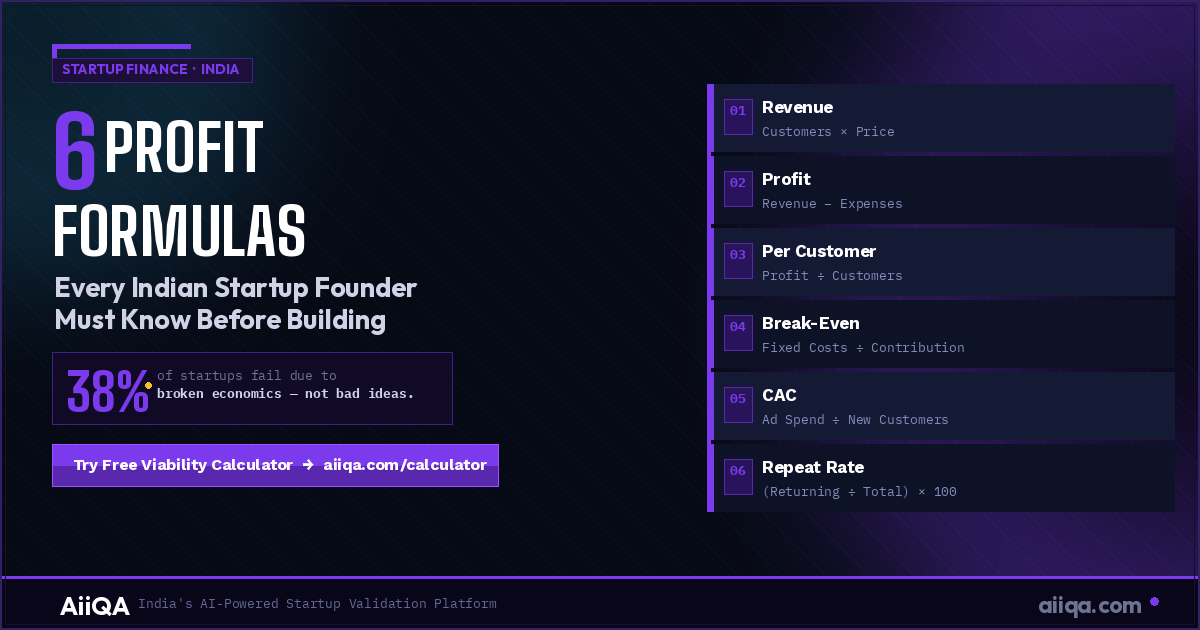
Most startups fail not because of bad ideas — but because founders never understood the numbers behind their business. This guide breaks down the 6 essential profit formulas every founder must know before starting a startup, with real Indian startup examples and step-by-step calculations.
The Brutal Truth Most Founders Ignore
Picture this: two founders. Same idea. Same city. Same market.
One builds a thriving startup within 18 months. The other shuts down after burning through ₹15 lakhs.
What separated them?
It wasn't passion. It wasn't connections. It wasn't even the product.
It was one simple difference — one founder understood their numbers. The other didn't.
According to multiple startup failure analyses, over 38% of startups fail because they run out of cash. Not because they lacked customers, ambition, or talent. Because the economics were broken from Day 1 — and nobody caught it.
Here's the hard reality: a brilliant idea without financial clarity is just an expensive hobby.
Before you hire your first employee, build your first feature, or run your first ad — you need to master six fundamental profit formulas. These aren't MBA-level finance concepts. They are practical, calculation-ready formulas that take less than 30 minutes to learn and can save you years of regret.
This guide breaks each formula down with plain English explanations, real startup examples calculated in Indian Rupees (₹), and actionable founder insights you can apply before your next planning session.
Let's begin.
Why Financial Formulas Matter More Than Your Business Idea
Most aspiring founders ask: "Is my idea good enough?"
The better question is: "Do the numbers behind my idea make sense?"
A startup is not just a product or a service. It is a financial engine — one that must generate more value than it consumes. Understanding your financial metrics before launch helps you answer six critical questions:
- Will this business actually make money?
- How many customers do I need to survive?
- When will I recover my initial investment?
- How much can I safely spend on marketing?
- Can this business grow without the wheels falling off?
- Are customers coming back — or am I on a hamster wheel?
The six profit formulas below answer each of these questions directly. Master them, and you stop guessing. You start calculating.
And if you want a faster way to run these calculations, the AiiQA Startup Viability Calculator does this instantly — giving you a profitability score, break-even projection, and investor-ready insights in minutes.
Now, let's get into the formulas.
Formula 1: Revenue Formula — How Much Money Are You Actually Making?
What Is Revenue?
Revenue is the total income your startup generates from selling products or services — before any expenses are deducted. It sits at the very top of your financial statements, which is why it's called the "top line."
Revenue is your first health signal. But it can be dangerously misleading. High revenue with high expenses means your startup is burning, not earning.
The Formula
Revenue = Number of Customers × Average Selling Price
Or equivalently:
Revenue = Units Sold × Price Per Unit
Real Startup Example (With Calculation)
Imagine you launch a SaaS tool for startup founders — an AI-powered business plan generator.
- Monthly Active Customers: 500
- Monthly Subscription Price: ₹999
Monthly Revenue: 500 × ₹999 = ₹4,99,500 (~₹5 Lakhs/month)
Annual Revenue: ₹4,99,500 × 12 = ₹59,94,000 (~₹60 Lakhs/year)
That looks impressive. But here's the insight most founders miss.
Founder Insight: Revenue Can Grow Without Adding a Single Customer
Most founders obsess over customer count. But revenue can grow in three other ways:
| Growth Lever | Before | After |
|---|---|---|
| More customers | 500 × ₹999 = ₹4.99L | 700 × ₹999 = ₹6.99L |
| Higher pricing | 500 × ₹999 = ₹4.99L | 500 × ₹1,499 = ₹7.49L |
| Upsell to premium | 500 × ₹999 = ₹4.99L | 300 base + 200 premium = ₹5.99L |
These are industry averages. Want your idea's actual cost estimate? Get your free personalized estimate →
Notice: a price increase from ₹999 to ₹1,499 generates ₹2.5 Lakhs extra per month without acquiring a single new customer. That is the power of understanding the Revenue Formula before you set your pricing.
Formula 2: Profit Formula — Revenue Is Vanity, Profit Is Reality
What Is Profit?
Profit is what remains after you subtract every rupee you spend to run the business. It is the true measure of startup success, not revenue milestones.
You can have ₹1 crore in revenue and still be losing ₹10 lakhs a month. Countless startups have folded this way — celebrated for growth while quietly bleeding out.
The Formula
Profit = Revenue − Total Expenses
Total Expenses include:
- Salaries & freelancer payments
- Marketing & advertising
- Software subscriptions & tools
- Hosting & infrastructure
- Office rent & utilities
- Operations & logistics
- Taxes & compliance costs
Real Startup Example (With Calculation)
Continuing with our SaaS startup:
Monthly Revenue: ₹5,00,000
Monthly Expenses Breakdown:
| Expense Category | Amount (₹) |
|---|---|
| Salaries (2 employees) | ₹1,50,000 |
| Digital Marketing | ₹75,000 |
| Software Tools | ₹25,000 |
| Cloud Hosting | ₹20,000 |
| Operations & Admin | ₹30,000 |
| Total Expenses | ₹3,00,000 |
Monthly Profit: ₹5,00,000 − ₹3,00,000 = ₹2,00,000 (~₹2 Lakhs/month)
Annual Profit: ₹2,00,000 × 12 = ₹24,00,000 (₹24 Lakhs/year)
Founder Insight: Profit Margin Determines Your Survival
In this example, your Profit Margin is: ₹2,00,000 ÷ ₹5,00,000 × 100 = 40%
A 40% profit margin is healthy for a SaaS startup. But if your margin is below 10–15%, every dip in revenue threatens survival. Track this number monthly — not quarterly, not annually. Monthly.
Formula 3: Profit Per Customer Formula — Know Who's Actually Valuable
What Is Profit Per Customer?
This metric tells you the average profit generated by a single customer. It's one of the most important — and most overlooked — formulas in early-stage startups.
Knowing your profit per customer tells you: how much you can afford to spend on acquiring the next one.
The Formula
Profit Per Customer = Total Monthly Profit ÷ Total Customers
Real Startup Example (With Calculation)
Using our earlier numbers:
- Monthly Profit: ₹2,00,000
- Total Customers: 500
Profit Per Customer: ₹2,00,000 ÷ 500 = ₹400 per customer
Each customer, on average, puts ₹400 of profit in your pocket every month.
Founder Insight: Not All Customers Are Equal
Here's where this formula becomes a strategic weapon. Suppose your startup serves two customer segments:
| Segment | Monthly Revenue | Monthly Cost to Serve | Profit Per Customer |
|---|---|---|---|
| SMB Founders (Starter Plan) | ₹999 | ₹599 | ₹400 |
| Corporate Innovation Teams (Pro Plan) | ₹4,999 | ₹1,999 | ₹3,000 |
Which segment deserves 80% of your marketing budget?
Obviously the Pro Plan segment. Without this formula, you'd likely spend equally on both — or worse, focus on raw customer count and optimize for the less profitable segment.
Increase profit per customer by introducing premium tiers, add-on services, upsell paths, and annual plan discounts. Even pushing ₹400 to ₹600 per customer, at 500 customers, adds ₹1 lakh extra profit per month without acquiring anyone new.
Formula 4: Break-Even Formula — How Many Customers Do You Need Just to Survive?
What Is Break-Even?
The break-even point is where your total revenue exactly equals your total costs. No profit. No loss. You're simply keeping the lights on.
Every founder must calculate this before launch. It answers: "How few customers can I afford to have?" — which is exactly what early-stage startups need to know.
The Formula
Break-Even Customers = Fixed Costs ÷ Contribution Per Customer
Where:
Contribution Per Customer = Selling Price − Variable Cost Per Customer
Fixed Costs are costs that don't change with sales volume: salaries, rent, software subscriptions.
Variable Costs are costs that scale with each new customer: payment gateway fees, customer support time, per-user infrastructure costs.
Real Startup Example (With Calculation)
Product Price: ₹1,000 per customer/month
Variable Cost per Customer: ₹300 (infrastructure + support + payment fees)
Contribution Per Customer: ₹1,000 − ₹300 = ₹700
Monthly Fixed Costs:
| Fixed Cost | Amount (₹) |
|---|---|
| Salaries | ₹1,00,000 |
| Office / Co-working | ₹20,000 |
| Software & Tools | ₹30,000 |
| Total Fixed Costs | ₹1,50,000 |
Break-Even Customers: ₹1,50,000 ÷ ₹700 = 214.28 ≈ 215 customers
Interpretation
| Customers Acquired | Business Status |
|---|---|
| Fewer than 215 | ? Loss — burning cash |
| Exactly 215 | ? Break-even — surviving |
| More than 215 | ? Profit — building value |
Founder Insight: Ask This Before You Quit Your Job
The break-even formula is the most grounding calculation a founder can run. Before leaving a stable job, before raising funds, before going all-in — ask: "Can I realistically get 215 customers in 6 months?"
If yes, proceed. If not, revisit your pricing or cost structure first.
The AiiQA Startup Calculator computes your break-even point automatically — factoring in your real cost structure and pricing — so you can get this clarity in under 5 minutes.
Formula 5: Customer Acquisition Cost (CAC) — Are You Paying Too Much to Grow?
What Is CAC?
Customer Acquisition Cost (CAC) is the total amount of money you spend in marketing and sales to acquire one paying customer. It is one of the most critical metrics for startup sustainability.
A business can grow fast and still collapse if its CAC is higher than the profit each customer generates.
The Formula
CAC = Total Marketing & Sales Spend ÷ Number of New Customers Acquired
Real Startup Example (With Calculation)
- Monthly Marketing Spend: ₹1,00,000
- New Customers Acquired in that Month: 200
CAC: ₹1,00,000 ÷ 200 = ₹500 per customer
The CAC-vs-Profit Stress Test
This is where most startups either succeed or silently fail.
Scenario A — The Trap:
- Profit Per Customer = ₹400
- CAC = ₹500
- Net Result: -₹100 per customer
You are paying ₹500 to earn ₹400. Every new customer makes you poorer. Scaling this model is catastrophic.
Scenario B — The Engine:
- Profit Per Customer = ₹1,500
- CAC = ₹500
- Net Result: +₹1,000 per customer
Now every new customer adds ₹1,000 net. Scaling this model creates compounding growth.
The Golden Rule: LTV Must Be 3× CAC
LTV (Customer Lifetime Value) = Profit Per Customer × Average Months a Customer Stays
If a customer stays for 12 months on average: ₹400 × 12 = LTV of ₹4,800
With a CAC of ₹500: LTV ÷ CAC = ₹4,800 ÷ ₹500 = 9.6×
Anything above 3× is considered healthy. Below 1× is a death spiral.
Founder Insight: Reduce CAC Before You Scale
Many founders try to solve a high CAC by spending more on ads. That only amplifies the problem. Instead, lower CAC by:
- Investing in SEO and organic content (like this blog)
- Building referral and word-of-mouth programs
- Using WhatsApp and email marketing for warm leads
- Creating a community around your product
At AiiQA, for example, the startup viability calculator serves as a top-of-funnel tool — bringing in highly relevant founders organically, dramatically reducing CAC compared to paid ad-only strategies.
Formula 6: Repeat Business Formula — The Hidden Profit Engine
What Is Repeat Business Rate?
Acquiring a new customer costs money. Selling to an existing customer costs almost nothing.
The Repeat Business Rate measures what percentage of your customers return to buy again. This single metric can be the difference between a startup that scrapes by and one that quietly prints money.
The Formula
Repeat Customer Rate (%) = (Returning Customers ÷ Total Customers) × 100
Real Startup Example (With Calculation)
- Total Customers in a Month: 1,000
- Customers Who Returned / Renewed: 350
Repeat Customer Rate: (350 ÷ 1,000) × 100 = 35%
Benchmarks to Know
| Repeat Rate | Business Health |
|---|---|
| Below 20% | ? Weak retention — something is broken |
| 20% – 40% | ? Average — room to improve |
| 40% – 60% | ? Strong — good product-market fit |
| Above 60% | ? Excellent — you have a loyal base |
The Profit Math Behind Repeat Business
Here's why retention changes everything:
New Customer Economics:
- CAC: ₹500
- First Purchase Profit: ₹700
- Net Profit from First Purchase: ₹200
If That Same Customer Returns (Without Another ₹500 CAC):
- Second Purchase Profit: ₹700
- Cumulative Profit: ₹200 + ₹700 = ₹900
A customer who buys twice generates 4.5× more net profit than one who buys once. At scale, across 1,000 customers, improving retention from 20% to 35% can add ₹10–15 Lakhs in monthly profit without spending a single rupee on new acquisition.
Founder Insight: Build Retention Systems Before Scaling Acquisition
Many founders race to acquire new customers while ignoring existing ones. This creates a leaky bucket — you pour customers in, and they drain out faster than you can fill.
Build these retention systems before scaling:
- Subscription or Membership Model — recurring revenue with built-in retention
- Email Marketing Sequences — onboarding flows that activate and re-engage
- WhatsApp Community — branded community building for Indian founders
- Loyalty & Referral Programs — reward customers for returning and referring
- Proactive Customer Success — check in before customers consider leaving
At AiiQA, the approach is to turn first-time calculator users into repeat visitors through value-packed blog content, email nurture sequences, and a growing founder community — keeping acquisition costs low while maximizing lifetime value.
Your Startup Profit Dashboard: Track These 6 Numbers Every Month
Stop guessing. Start measuring. Here is the complete dashboard every founder should review on the 1st of every month:
| # | Metric | Formula | Healthy Target |
|---|---|---|---|
| 1 | Revenue | Customers × Price | Growing MoM |
| 2 | Profit | Revenue − Expenses | Positive & improving |
| 3 | Profit Per Customer | Profit ÷ Customers | Increasing each quarter |
| 4 | Break-Even Point | Fixed Costs ÷ Contribution | Crossed and widening |
| 5 | CAC | Marketing Spend ÷ New Customers | LTV ≥ 3× CAC |
| 6 | Repeat Business Rate | Returning ÷ Total × 100 | Above 40% |
If all six numbers are improving month-over-month, your startup is genuinely moving in the right direction — regardless of what the press, your investors, or your competitors are saying.
Calculate All 6 Metrics in Minutes — Not Hours
Manually calculating these formulas across spreadsheets is fine when you're just starting out. But as variables multiply — pricing tiers, marketing channels, customer segments — manual tracking becomes unreliable and time-consuming.
The AiiQA Startup Viability Calculator is built specifically for Indian founders who want fast, clear financial clarity on their startup idea.
Enter your numbers. Get a free Viability Score instantly.
The calculator helps you:
- ✅ Estimate startup costs and burn rate
- ✅ Calculate monthly and annual profitability
- ✅ Forecast revenue growth across scenarios
- ✅ Pinpoint your exact break-even customer count
- ✅ Understand your customer economics (CAC, LTV, profit per customer)
- ✅ Build investor-ready financial projections
→ Try the Free AiiQA Startup Calculator Now
And if you're looking for end-to-end startup support — from idea validation to MVP development to finding co-founders on an equity model — explore everything AiiQA has to offer for non-technical Indian founders.
Final Thoughts: Successful Founders Calculate Before They Build
The difference between a startup that survives and one that doesn't rarely comes down to the idea. It comes down to the economics behind the idea.
The six formulas in this guide are not optional extras. They are the financial foundation of every business that has ever scaled past the survival stage.
Let's recap what you now know:
- Revenue Formula — How much income your startup generates before costs
- Profit Formula — What actually remains after paying every expense
- Profit Per Customer — The true value each individual customer brings
- Break-Even Formula — The minimum number of customers to stop losing money
- Customer Acquisition Cost — Whether your growth is profitable or a trap
- Repeat Business Rate — How well you retain customers and multiply lifetime value
These numbers aren't just useful — they're essential.
A startup that doesn't understand its own economics is like a pilot flying blind in a storm. No matter how good the aircraft is, a crash is coming.
Know your numbers. Trust your data. Build with clarity.
And when you're ready to validate whether your startup idea is financially viable before you invest another rupee or another month — run your free viability check at AiiQA.
Start calculating before you start building.
You know what an MVP costs.
Now find out if yours is worth building.
Get your free viability score, top 5 risks, and honest verdict — in 3 minutes.
₹159 for full report · 100+ ideas validated · No credit card for free score
Frequently Asked Questions

Written by