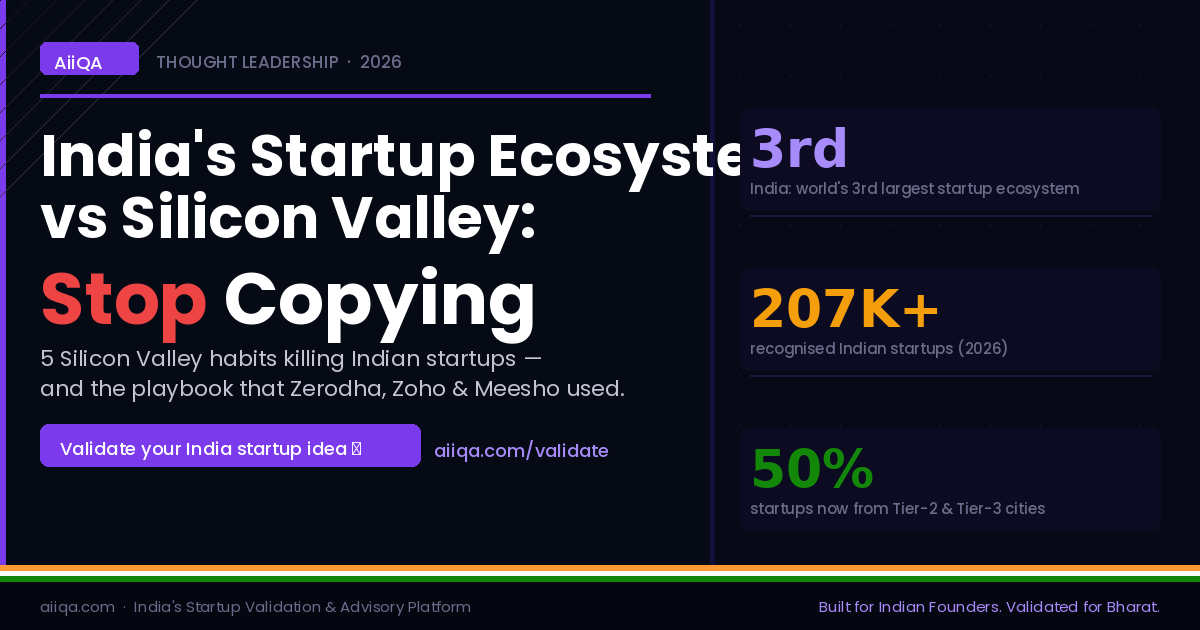
Blitzscaling doesn't work in Bharat. Discover 5 Silicon Valley habits killing Indian startups, 5 things that actually work, and the India-specific playbook that Zerodha, Zoho, and Meesho used to win.
Every year, thousands of Indian founders open a pitch deck from a Silicon Valley startup, fall in love with the idea, and start building an Indian version of it.
Most of them fail.
Not because they lacked talent. Not because they didn't work hard enough. Not because the Indian market isn't ready.
They fail because they inherited a playbook written for a fundamentally different country — and never questioned whether it applied to theirs.
Silicon Valley built its startup culture on cheap capital, high consumer spending power, a credit-card economy, and a relatively homogeneous English-speaking customer base. India has none of those things in the same form.
India has 207,000+ recognised startups. 131 unicorns. A startup economy valued at over $350 billion. It is the third-largest startup ecosystem in the world.
And in 2026, after a brutal funding correction that wiped out dozens of companies that blindly copied the Silicon Valley playbook, the Indian founders who are winning have quietly adopted a completely different set of rules.
This article names what to stop copying — and what to build instead.
First, Understand What You're Actually Comparing
Silicon Valley and India's startup ecosystem are not competitors. They are different systems solving different problems under different constraints.
| Dimension | Silicon Valley | India (2026) |
|---|---|---|
| Recognised startups | 96,000+ | 207,000+ |
| Unicorns | 630+ | 131 |
| VC funding (2025) | ~$200B+ | ~$12B |
| Avg consumer income | $80,000+ per year | ~$2,800 per year |
| Credit card penetration | ~320 cards per 100 people | ~10 cards per 100 people |
| Primary payment method | Card / digital wallet | UPI (5B+ transactions/month) |
| Startup activity from non-metro cities | Concentrated in Bay Area / NYC | ~50% from Tier-2/3 cities |
| Languages (official) | 1 | 22 |
| Dominant investor mindset (2026) | Scale first, profit later | Unit economics first, always |
Those aren't just numbers. Every single row in that table changes how you should build, price, acquire customers, and scale.
When you ignore those differences and copy a Silicon Valley model anyway, you're not being ambitious. You're being reckless.
5 Things Indian Founders Should Stop Copying
1. Blitzscaling
Blitzscaling — the Reid Hoffman strategy of prioritising speed over efficiency to capture market before anyone else — is the most dangerous idea ever exported from Silicon Valley to India.
It worked in the United States during a very specific window: near-zero interest rates, abundant venture capital, and consumers with both the income and the habit of spending freely on new products.
In India, none of those conditions existed in the same form. And the Indian market exposed it brutally.
GoMechanic reported inflated revenues and collapsed. Koo tried to blitzscale into a Twitter alternative and couldn't retain users. BluSmart scaled an EV ride-hailing fleet on borrowed capital and halted operations when governance issues unravelled the parent company. Dunzo burned ₹1,800 crore in a single year chasing quick-commerce scale it couldn't sustain.
In 2023 — after the global funding correction hit India — only two Indian startups became unicorns the entire year. The era of growth-at-all-costs didn't end gracefully. It ended with founders unpaid, investors writing off billions, and the ecosystem finally having the conversation it should have had five years earlier.
By 2026, startup funding in India fell 17% to $10.5 billion in 2025 before recovering. The investors who came back came back with a new question: not "how fast can this grow?" but "does this make money, and can it keep making money at scale?"
That question was always the right one. It just took a very expensive correction to make it mainstream.
⚠️ The blitzscaling trap: It requires abundant, cheap capital to sustain. Indian startups rarely have access to that capital at the quantity Silicon Valley does. Companies that blitzscale on Indian VC funding without a clear path to unit economics don't build a business. They build a countdown timer.
2. The "Build for the Top 10% First" Strategy
Silicon Valley startups regularly build premium products for affluent early adopters and then gradually move down-market as they scale.
iPhone started at $499 in 2007. It was a luxury product. Apple used that premium positioning to build a brand that eventually served mass markets.
That strategy can work in the US because the top 10% of American consumers represent a large, lucrative, and accessible market. They have credit cards. They're online. They have disposable income and they spend it freely.
In India, the top 10% is roughly 140 million people — still an enormous number. But there's a structural problem that Indian founders consistently underestimate.
The 90% who come to your platform because of subsidies, discounts, and free offers are not your customers. They are your burn rate.
Dozens of Indian consumer startups discovered this exact lesson between 2021 and 2024. They acquired tens of millions of users through cashbacks and discounts. When the discounts ended, the users left. The retention numbers were catastrophic. The unit economics never worked.
India is fundamentally a price-driven market, not a convenience-driven one. The consumer who will pay ₹500 per month for your SaaS product without being pushed is a genuinely different person from the one who downloaded your app for a free trial. Building for both simultaneously rarely works.
The founders who win in India identify the customer who will pay and build specifically and relentlessly for that customer — without trying to simultaneously acquire a 100x larger audience they're subsidising into existence.
3. VC Funding as a Validation Signal
Silicon Valley created a culture where raising money from a prestigious VC is treated as market validation. Sequoia invests → the idea must be good. Y Combinator accepts → the startup has a future.
Indian founders absorbed this culture completely. Ask a founder how their startup is doing and they'll tell you the funding round they closed, not their revenue, not their retention, not their customer count.
Funding is not validation. Funding is fuel.
Fuel without a destination is just accelerated motion toward wherever you happen to be pointed. And many Indian startups were pointed at an imaginary market.
The healthiest companies in India's ecosystem in 2026 didn't use VC funding as validation. They used paying customers. Zerodha built India's largest retail brokerage without raising a single rupee of VC funding. Zoho built a $1 billion+ global SaaS company from Chennai, bootstrapped, and profitable. Both validated through revenue, not through term sheets.
That's a fundamentally different — and more honest — form of market validation.
4. The "Get Big, Figure Out Revenue Later" Model
Instagram reached 13 million users before anyone seriously discussed how it would make money. WhatsApp hit 450 million users with a team of 55 people and no advertising revenue. Both were acquired for billions.
Those stories became Silicon Valley mythology. Grow the user base. Revenue will follow.
In India, that mythology killed hundreds of startups.
The companies that got acquired for billions in Silicon Valley had two things Indian equivalents rarely had: a captive, paying-adjacent audience that platforms like Facebook and Google needed to protect their ad revenue, and acquirers with the capital and strategic motivation to buy distribution at any price.
Indian startups chasing user growth without revenue don't get bought by Indian conglomerates at 100x multiples. They run out of money.
Revenue is not a milestone for later. In India, it is proof of life.
5. Ignoring Bharat While Building for India
There is a difference between "India" and "Bharat" that every founder building in this country needs to understand deeply.
"India" is the English-speaking, urban, Metro-dwelling consumer who is already comfortable with apps, subscriptions, and digital payments. They are the early adopter. They are also — at roughly 80–100 million people — a fraction of the actual market.
"Bharat" is the 900 million people in Tier-2 cities, small towns, and rural areas. They speak Hindi, Tamil, Telugu, Marathi, Bengali, and dozens of other languages. They use UPI because a banker explained it to them, not because they read a TechCrunch article. They price-compare obsessively. They trust people, not platforms.
In 2026, roughly 50% of India's 207,000 recognised startups are now emerging from Tier-2 and Tier-3 cities. The startup ecosystem itself is moving toward Bharat even if the funding conversation hasn't fully caught up.
The founders who built for Bharat without compromising — Meesho's WhatsApp commerce model, PhonePe's vernacular-first UPI push, Jio's affordable data revolution — created the most durable consumer businesses of the last decade.
Building a product that requires English fluency, urban infrastructure, and premium pricing to work is not building for India. It is building for a small, already-served subset of India.
5 Things That Actually Work in India
The good news is that the India-specific playbook is not complicated. It's just different.
1. Solve a real Indian problem — not an Indian version of an American problem
The biggest startup opportunities in India are not clones. They are original. UPI did not exist in the US before Venmo — but Venmo didn't work in India. UPI was built for India's specific banking infrastructure, merchant density, and trust dynamics. It became one of the most successful payment systems in the world.
What uniquely painful, uniquely Indian problem does your target customer face today? That is the starting point. Not "what did we see in a Y Combinator batch."
2. Make the unit economics work at Indian price points
If your product only makes money when a customer pays ₹2,000/month or more, your addressable market in India is small. If it makes money at ₹199/month, it is enormous.
The constraint forces creativity. Many of India's best-designed SaaS products are cheap to customers and profitable because the cost to serve was engineered out rather than papered over with VC funding.
3. Build for trust, not for acquisition
India's consumer doesn't trust platforms by default. Trust is earned through referrals, word of mouth, local credibility, and community. The Kirana store owner trusted his supplier of 15 years more than any app telling him to switch.
Indian startups that built community — Zerodha's trading education content, Razorpay's developer ecosystem, UrbanCompany's service quality guarantees — retained customers at rates that pure-acquisition models couldn't match.
4. Revenue first, scale second
The 2026 Indian investor is not impressed by MAU counts. They are impressed by ARR, gross margins, and customer retention.
Get to ₹1 crore ARR with good retention before raising a Series A. Not because you have to — because it proves the model is real and gives you negotiating power when you do raise.
5. Use AI to do the work that headcount used to require
The structural advantage Indian startups now have that they didn't have in 2019 is this: AI tools have collapsed the cost of building. A two-person Indian founding team in 2026 can build what required a 12-person team in 2021.
That changes the capital efficiency calculus entirely. Indian startups can now reach proof-of-concept, first revenue, and even Series A readiness at a fraction of the historical cost — if they use AI tools aggressively from day one.
The Indian Founders Who Wrote Their Own Playbook
They didn't follow the Silicon Valley script. They wrote their own.
Zerodha built India's largest retail brokerage on zero funding, zero marketing spend, and an education-first approach to customer acquisition. In a market where everyone was burning cash on celebrity endorsements, Zerodha taught people how to invest and earned their loyalty permanently.
Zoho bootstrapped from Chennai into a global SaaS company competing with Salesforce and Microsoft. No VC. No Silicon Valley office. No Silicon Valley playbook. Just excellent product, Indian pricing, and patient capital from their own revenue.
Meesho understood that the Indian woman in a Tier-3 town doesn't want an e-commerce app — she wants to run a business from her phone through a platform she already trusts, which is WhatsApp. Building for that insight unlocked a customer base that Amazon and Flipkart had systematically missed.
PhonePe didn't build a digital wallet and wait for adoption. It integrated with UPI, built for vernacular users, and made digital payments feel as simple and familiar as handing over cash.
None of these companies copied a Silicon Valley playbook. All of them studied the Indian customer deeply and built from that understanding outward.
The Question Before Every Decision
Before you adopt any business model, growth strategy, or product decision, the question Indian founders should ask is not:
"What did this work for in San Francisco?"
The question is:
"Does my specific Indian customer — at their income level, in their language, in their city, with their trust barriers — actually want this and will they pay for it?"
That question doesn't get answered by reading TechCrunch. It gets answered by talking to real customers, studying real market data, and validating the demand honestly before committing capital to it.
This is exactly where most Indian founders rush. They know the idea. They feel the opportunity. They want to build. Slowing down to validate feels like losing time to a competitor.
But the founders who validated first — who understood the Indian customer deeply before the first line of code — are the ones still operating in 2026. The ones who skipped validation and blitzscaled into assumptions are the cautionary case studies.
Before you build for India, understand India's market specifically.
AiiQA's validation report delivers AI-powered market analysis, competitor mapping, customer segmentation, viability scoring, SWOT analysis, and a full MVP roadmap — built specifically to answer whether your idea works in the Indian market at Indian price points for Indian customers.
Validate Your Startup Idea for the Indian Market →
India's startup ecosystem does not need to graduate from being Indian.
The founders who built companies trying to appear like Silicon Valley startups — the pitch decks designed for Sequoia, the growth metrics imported from US benchmarks, the premium positioning borrowed from Y Combinator batch companies — built for the investors they wanted, not the customers they had.
The founders who built for India — genuinely, specifically, honestly — built some of the most durable consumer and B2B businesses of the last decade. And in 2026, as the blitzscaling era's wreckage settles, their approach has stopped being contrarian.
It has become the only approach that works.
Silicon Valley built the world's most valuable technology companies by solving Silicon Valley's problems with Silicon Valley's resources.
The next generation of Indian founders will build India's most valuable companies by solving India's problems with India's resources.
Those are different companies. They deserve a different playbook. And the first step to that playbook is understanding your market honestly — before you build a single feature.
Stop borrowing assumptions. Start with India-specific validation.
AiiQA delivers an AI-powered market validation report for Indian founders — covering real market size, India-specific competitor analysis, customer segmentation, viability scoring, and a step-by-step MVP roadmap designed for the Indian market.
Validate Your India Startup Idea with AiiQA →
You know what an MVP costs.
Now find out if yours is worth building.
Get your free viability score, top 5 risks, and honest verdict — in 3 minutes.
₹159 for full report · 100+ ideas validated · No credit card for free score
Frequently Asked Questions

Written by