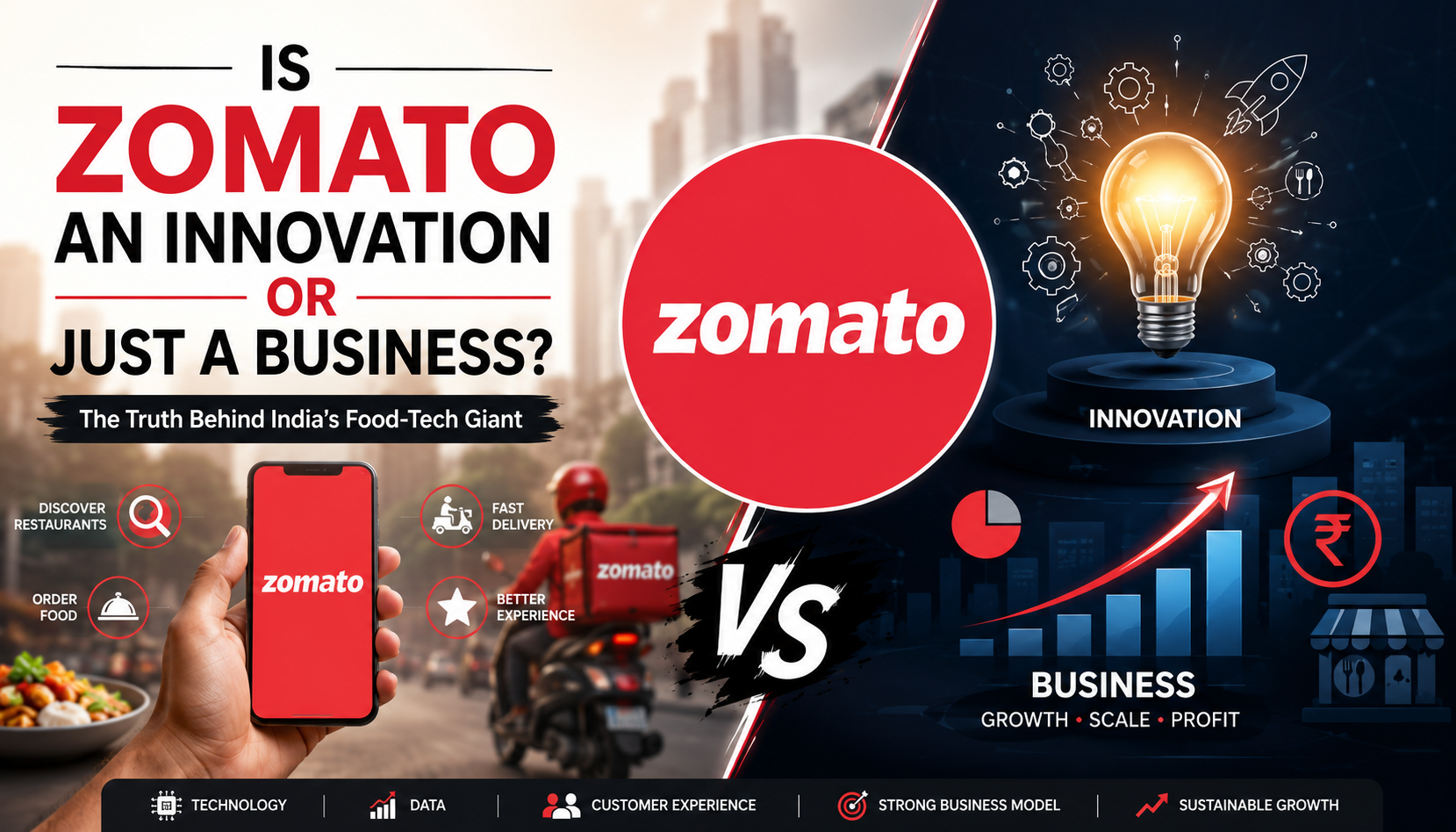
Zomato didn't invent food delivery. So why is it considered one of India's greatest startup innovations? The answer reveals a lesson every founder building in 2026 needs to understand before they write a single line of code.
Why Execution Almost Always Beats the Original Idea
There is a myth that follows startup culture everywhere.
It says that the idea is the most valuable thing a founder has.
Protect the idea. Guard the idea. Build walls around it so nobody steals it.
That myth is responsible for more failed startups than any bad market condition.
Ideas are common. Execution is rare.
Zomato's founding idea — digitising restaurant menus — wasn't patentable, wasn't secret, and wasn't technically complex. Any developer with a laptop and a few months could have built the same thing.
Several competitors did.
Most of them no longer exist.
What separated Zomato wasn't the idea. It was the thousand decisions that followed it.
Which cities to expand to first. How to onboard restaurant owners who had never used the internet. How to handle fake reviews. When to add delivery and when not to. How to price subscriptions. When to enter grocery. When to exit grocery. How to rebuild trust after a PR crisis.
None of those decisions are glamorous. None of them look like innovation on a slide deck. But each one determined whether the company survived the next quarter.
Execution is the unglamorous twin of innovation. It never gets the credit. It does most of the actual work.
So Is Zomato an Innovation or Just a Business? The Honest Verdict
Here is the answer that makes most people uncomfortable:
It is both. And that combination is exactly why it succeeded.
Innovation alone doesn't create lasting companies. The tech landscape is full of genuinely brilliant products that went bankrupt because the business model was never figured out.
Business acumen alone doesn't create category leaders. Companies that only copy and execute reach limits quickly because they have no proprietary advantage to defend.
What Zomato built — deliberately or instinctively — was a feedback loop between the two.
Every time the product improved, the business model got stronger. Every time the business generated more revenue, it funded the next product improvement. Restaurants relied on the platform. Customers expected it. Delivery partners needed it.
That interdependence created something that competitors couldn't easily dismantle. Not because the technology was impossible to replicate. Because the ecosystem around it had become genuinely valuable to everyone inside it.
That is the real innovation. Not any single feature. Not any single decision. The system itself.
Five Lessons Every Indian Startup Founder Should Take From Zomato
Zomato's journey is a case study in decisions. Here's what founders building anything in 2026 should absorb from it.
Lesson 1: Start with a real problem, not a unique idea
Zomato didn't start by asking "what can we invent?" It started by asking "what genuinely frustrates people right now?" That orientation is the difference between building a product people search for and building a product you have to explain.
Before writing any code, founders should be able to answer: Who is experiencing this problem today? How are they currently solving it? Why is the current solution failing them?
If those answers aren't based on real conversations with real people, everything that follows is a guess.
Lesson 2: Your version 1 should be embarrassingly simple
Scanned menus. No delivery. No AI. No app.
That was version 1 of what is now a company valued at tens of thousands of crores.
Most founders spend six months building a product they're proud to show off. The founders who survive spend six weeks building a product that tests whether anyone cares. There is a significant difference between the two approaches.
Lesson 3: Innovation is a habit, not a launch event
Zomato didn't have one big innovation moment. It had hundreds of small ones across fifteen years. Ratings. Photos. Reviews. Tracking. Subscriptions. Grocery. Quick commerce.
Each addition came from listening to what users were still frustrated by. That practice of continuous improvement is what separates companies that grow from companies that plateau.
Lesson 4: Your business model is as important as your product
A product that users love but nobody pays for is a charity project, not a startup.
Zomato built multiple revenue streams that reinforced each other. Restaurant visibility fees brought in supply. Customer delivery fees brought in demand. Subscriptions created loyalty. Advertising generated incremental revenue from an existing user base.
Founders who only think about the product often discover too late that they never thought about the business.
Lesson 5: The company that validates fastest wins
Zomato's early expansion wasn't a global rollout. It was city by city. Delhi first. Then Mumbai. Then Bangalore. Each new city was a validation test before the next commitment.
That discipline — validate before you scale, test before you commit — is what allowed the company to course-correct without catastrophic consequences.
The founders who skip validation don't get to course-correct. They run out of money on the wrong course.
What This Means for Founders Building in 2026
The most common mistake we see at AiiQA has nothing to do with technology choices or hiring decisions.
It's founders building confidently in the wrong direction.
They've identified a problem. They've convinced themselves it exists. They've built a product around it. Six months and ₹20 lakhs later, they discover the problem wasn't as painful as they assumed, the customers they imagined weren't willing to pay, or a competitor already owns the space they thought was open.
Zomato avoided this because the problem it started with — finding restaurant information — was visibly, obviously, painfully real. The early team could see it happening around them every day. The validation was almost built into the founding observation.
Most founders don't have that clarity. And that's completely normal.
What isn't acceptable is building without trying to find it.
Before you decide whether to build, buy, use no-code, or leverage AI — before you pick a tech stack or write a single line of code — the most important question is the same one Zomato answered by accident in 2008:
"Is this problem real, is it painful enough to pay to solve, and am I the right person to solve it?"
That question deserves a serious answer. Not a gut feeling. Not what your friends told you. Not what a competitor's funding announcement made you assume.
Data. Market signals. Competitor analysis. Customer behaviour. A realistic look at your own differentiation and risk profile.
That's what AiiQA was built to help founders do — before they make the expensive decisions.
Get an AI-powered validation report for your startup idea:
Market analysis. Competitor landscape. SWOT breakdown. Startup viability score. MVP roadmap. Feature prioritisation. Step-by-step launch plan — all before you commit a single rupee to development.
Validate Your Idea with AiiQA →
Frequently Asked Questions
Is Zomato truly innovative or just a copycat business?
Zomato is genuinely both. It didn't invent food delivery, but it innovated continuously in how the problem was solved — through UX, logistics, business model design, and ecosystem building. The most successful companies rarely invent industries. They transform them. Zomato transformed restaurant discovery and food delivery in India in ways that created lasting value for customers, restaurants, and delivery partners simultaneously.
What is Zomato's core business model?
Zomato operates across multiple revenue streams: restaurant advertising and visibility fees, customer delivery charges, subscription programs like Zomato Gold, platform fees on orders, and data and analytics services. This multi-stream approach means the company isn't dependent on any single revenue source — a model that became a significant competitive advantage as the market matured.
Why did Zomato succeed when competitors failed?
Several factors contributed: early mover advantage in digital restaurant discovery, consistent product iteration based on real user behaviour, disciplined geographic expansion, and a business model that aligned the incentives of all stakeholders. Importantly, Zomato survived multiple market downturns and a global pandemic because it had built genuine ecosystem dependency — restaurants, customers, and delivery partners all needed the platform to function.
What can startup founders learn from Zomato's journey?
Five lessons stand out. Start with a real, observable problem. Build the simplest possible first version. Treat innovation as a continuous habit rather than a launch moment. Design your business model with the same care as your product. And validate before you scale — test in one context before committing to expansion. These principles apply whether you're building a food-tech platform or a B2B SaaS product.
Is the food delivery market still a good startup opportunity in India?
The food delivery market is highly consolidated in India, with Zomato and Swiggy dominating platform-based delivery. However, adjacent opportunities remain strong — cloud kitchen infrastructure, specialised cuisine verticals, B2B food supply chains, and health-focused meal services. The lesson from Zomato isn't to copy the model. It's to find the adjacent problem that the dominant player's success is creating or leaving unsolved.
How did Zomato validate its idea in the beginning?
Zomato's initial validation was almost accidental — the founders observed a real problem in their own daily lives and solved it in the simplest possible way (scanning menus). The market responded with immediate adoption, which became their validation signal to continue. Modern founders have better tools available: structured user interviews, landing page tests, prototype feedback sessions, and AI-powered market analysis platforms like AiiQA that compress months of research into days.
The Final Word
Zomato is neither purely an innovation nor simply a good business.
It is proof that those two things are not opposites.
The most enduring companies combine genuine problem-solving with rigorous business thinking. They validate before they scale. They iterate instead of assuming. They build ecosystems instead of just products.
The founders studying Zomato from the outside often focus on the wrong things — the valuation, the IPO, the brand recognition.
The more useful study is the ten years before any of that happened. The scanned menus. The city-by-city expansion. The pivot from discovery to delivery. The thousand decisions made with incomplete information.
That's where the real lessons are.
And the most important lesson is also the simplest: validate the problem before you build the product.
The next Zomato won't be built by someone with a revolutionary idea. It will be built by someone who found a real problem, confirmed it was worth solving, and then executed better than everyone else.
If you're at the beginning of that journey, start with clarity.
Don't build on assumptions. Build on data.
AiiQA's startup validation report gives you AI-powered market analysis, competitor intelligence, a viability score, SWOT breakdown, and a full MVP roadmap — so your first major decision is the right one.
Validate Your Startup Idea with AiiQA →
Validate what you're building.
Get your free viability score, top risks, and honest verdict — in 3 minutes.
Get my free verdict
Praveen Yadav