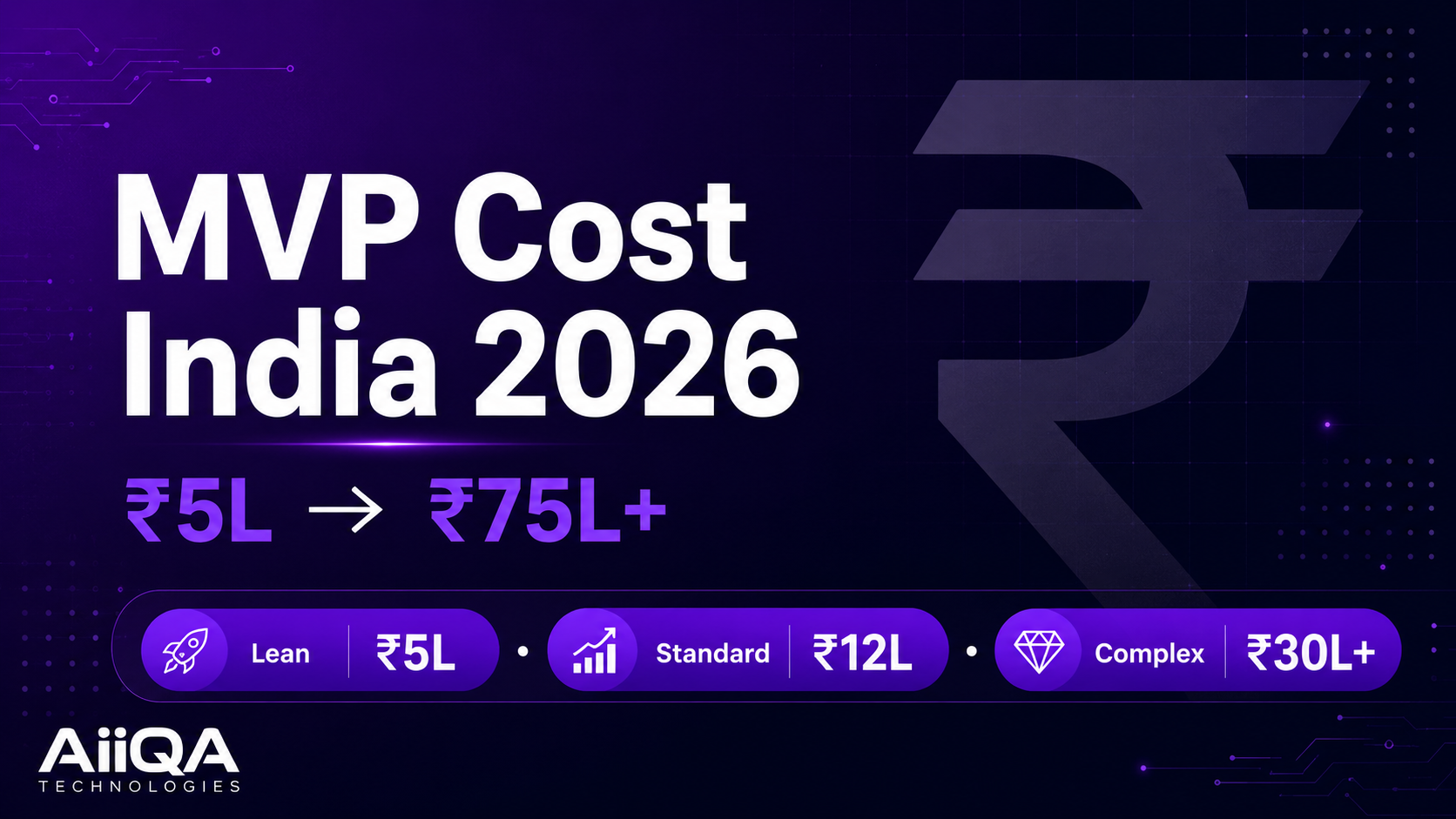
Planning an MVP in India in 2026? Lean: ₹5L ($5,300). Standard: ₹12L. Complex: ₹30L+. Line-item budgets, INR↔USD, case studies & hidden costs — all in one guide.
MVP Development Cost in India 2026: What Founders Actually Pay
A lean validation MVP in India in 2026 starts around ₹5 lakh ($5,300). An investor-ready MVP lands between ₹12–₹30 lakh ($12,600–$31,500). Feature-rich MVPs with mobile apps, compliance requirements, or heavy integrations can cross ₹75 lakh ($79,000)+. This guide breaks down every rupee, line by line.
India remains cost-efficient compared to the US (where median engineering pay is $150,000), but it's not "cheap" the way many founders imagine. Median compensation for Indian engineering and data roles fell 40% to $22,000 in 2025 (≈₹20.9 lakh at ₹95/$1), while product and design roles settled at $23,000 (≈₹21.9 lakh). This shift is good news for founders — but only if you plan your budget correctly.
Whether you're a first-time founder checking your runway, a technical founder stress-testing a vendor quote, or an investor validating a startup's budget, this article gives you a transparent, line-item breakdown for every MVP band — with INR↔USD conversions at the current ₹95 ≈ $1 rate, timeline estimates, real case studies, and the hidden costs that catch 80% of startups off guard.
Why India's MVP Costs Changed in 2025–2026
The Compensation Drop That Made India More Competitive
Two structural shifts explain today's pricing landscape:
| Factor | 2024 | 2025–2026 | Impact on MVP Cost |
|---|---|---|---|
| Median engineering pay (India) | $36,000 | $22,000 | −40% talent floor |
| Median product/design pay (India) | ~$38,000 | $23,000 | −39% talent floor |
| Rupee vs USD | ₹83–₹88 | ₹95/$1 (June 2026) | USD costs appear higher for foreign founders |
| South Asia outsourcing rates | Baseline | −16% (2025 Accelerance data) | Vendor quotes down across the board |
| Hi-tech & IT salary increments | ~12–15% | 9.1% (EY Future of Pay 2026) | More disciplined growth, stable costs |
These are industry averages. Want your idea's actual cost estimate? Get your free personalized estimate →
Salary Growth Is Moderate, Not Booming
EY's 2026 Future of Pay report projects 9.1% average salary increments in India — positive but disciplined compared to the 2021–2023 boom cycle. The report emphasises that AI skills, performance, and sector choice will drive sharper pay differentiation going forward. TeamLease forecasts 6.2–11.3% hikes across industries in FY 2025–26, with city- and role-specific peaks up to 13.8%.
Importantly, AI, GenAI, ML, cybersecurity, and cloud skills now command 30–40% pay premiums. If your MVP requires custom AI/LLM integration, factor in that cost premium from the start.
Why Outsourcing Rates Are Down
The 2025 Accelerance Global Software Outsourcing report documented a global decline in developer hourly rates, with decreases of 9–16% across South Asia. This downward pressure helps explain why India remains the world's most competitive destination for MVP builds — even as the rupee has depreciated. The net result: you get more engineering hours per rupee today than you did in 2023.
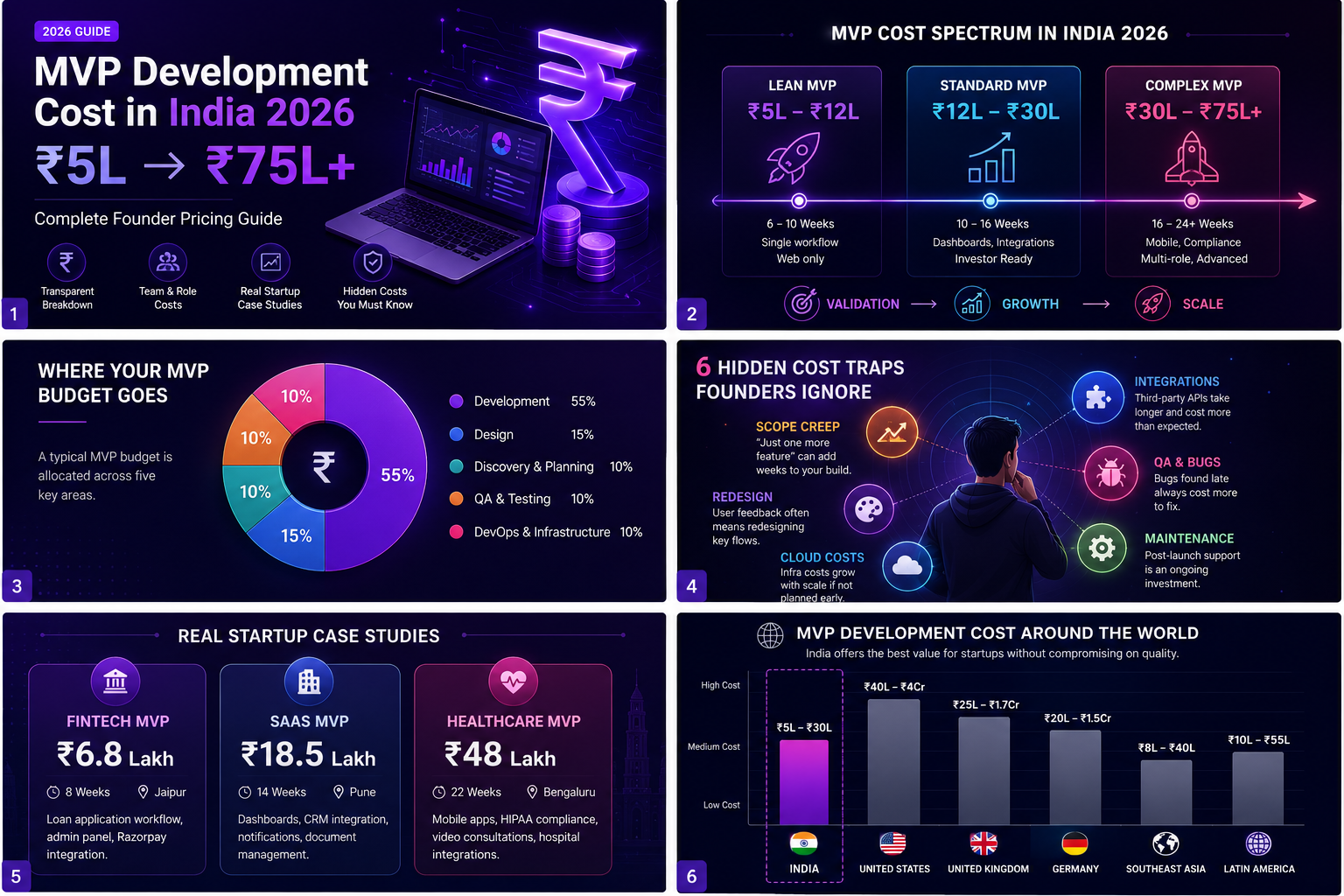
The Real Cost of an MVP — Four Layers You Must Price
A transparent MVP budget is separated into four cost layers plus a buffer. Understanding this framework helps you decode vendor quotes and spot what's been left out.
Layer 1 — Discovery & Product Definition (5–10% of budget)
What it includes: Scope definition and feature prioritisation, user flow mapping, wireframes and low-fidelity prototypes, backlog creation (Jira, GitHub Issues), and architecture decisions (database, tech stack, deployment strategy).
Why it matters: Skipping this layer leads to scope creep, rework, and missed deadlines. A well-defined backlog reduces development waste by 20–30%.
Layer 2 — Design (10–20% of budget)
What it includes: High-fidelity UI/UX screens, design system (colours, typography, components), interactive prototype in Figma or Adobe XD, annotated developer handoff.
Why it matters: A good designer defines the interaction model upfront, cutting wasted dev cycles. Poor UX discovered post-launch requires expensive redesigns — often more than the original design cost.
Layer 3 — Development (45–60% of budget)
What it includes:
- Frontend: React.js, Next.js, Vue, or mobile (React Native, Flutter)
- Backend: Node.js, Python (Django/FastAPI), Go, or Java
- Database: PostgreSQL, MongoDB, MySQL, or Redis
- APIs: REST or GraphQL endpoints
- Admin panel: Internal dashboard for operations
- Integrations: Payment gateways, CRM, ERP, third-party APIs
- Testing support: Unit tests, integration tests, bug fixes
Why it matters: This is the biggest cost centre. Complexity here — multiple user roles, real-time features, heavy integrations — drives most of the budget variance between vendors.
Layer 4 — DevOps & Launch (5–10% of budget)
What it includes: Cloud setup (AWS, Google Cloud, Azure), CI/CD pipeline (GitHub Actions, GitLab CI), staging environment, monitoring (logging, error tracking, uptime), security hardening (SSL, authentication, data encryption), production release and rollback strategy.
Why it matters: For early-stage products, DevOps can be part-time — but skipping it entirely is a mistake. Without it, you have no staging environment, no automated backups, no uptime monitoring, and no rollback plan when things go wrong at 2 AM.
Plus: Buffer (10–15% of budget)
What it covers: Scope changes after the first demo, bug-fix cycles, user feedback-driven redesigns, unexpected API issues, and communication delays.
⚠️ Never skip the buffer. A budget that looks safe on paper becomes underfunded the moment the MVP is treated like a full product launch. The buffer is your insurance against surprises — and it almost always gets used.
Practical MVP Budget Bands in India (2026)
These ranges are based on the current compensation floor, the 2026 salary-growth environment, and the reality that client billing must cover overhead, management, risk, and profit on top of raw talent cost.
Lean MVP
₹5–₹12 Lakh ($5,300–$12,600)
🧑💻 1 full-stack dev + part-time designer⏱ 6–10 weeks🎯 Single workflow, web-only
Best for: A very focused web product with one primary workflow, basic admin, and limited integrations. Choose this when the feature set is narrow and you're optimising for speed over polish.
Line-Item Budget — Lean MVP
| Line Item | ₹ Min | ₹ Max | % of Budget | USD Min | USD Max |
|---|---|---|---|---|---|
| Product thinking + scoping | ₹37,500 | ₹90,000 | 5–10% | $395 | $947 |
| UI/UX design | ₹75,000 | ₹2,40,000 | 10–20% | $789 | $2,526 |
| Frontend + backend development | ₹2,25,000 | ₹7,20,000 | 45–60% | $2,368 | $7,579 |
| QA / testing | ₹75,000 | ₹1,80,000 | 10–15% | $789 | $1,895 |
| DevOps / cloud/release | ₹37,500 | ₹1,20,000 | 5–10% | $395 | $1,263 |
| Buffer | ₹75,000 | ₹1,80,000 | 10–15% | $789 | $1,895 |
| Total | ₹5,00,000 | ₹12,00,000 | 100% | $5,263 | $12,632 |
Exchange rate: ₹95 = $1 (June 2026).
What this gets you: A single-core workflow (e.g., loan application, product checkout), one user type, basic admin panel, 1–2 integrations max (payment gateway + email), standard email/password authentication, and web-only delivery.
Standard MVP
₹12–₹30 Lakh ($12,600–$31,500)
🧑💻 1 frontend + 1 backend dev + designer + part-time QA/DevOps⏱ 10–16 weeks🎯 Most common band for funded teams
Best for: Startups needing stronger UX, cleaner engineering, reliable authentication, dashboards, notifications, and 1–2 integrations. This is the most common band for pre-seed or funded teams.
Line-Item Budget — Standard MVP
| Line Item | ₹ Min | ₹ Max | % of Budget | USD Min | USD Max |
|---|---|---|---|---|---|
| Product thinking + scoping | ₹90,000 | ₹2,25,000 | 5–10% | $947 | $2,368 |
| UI/UX design | ₹1,80,000 | ₹6,00,000 | 10–20% | $1,895 | $6,316 |
| Frontend + backend development | ₹5,40,000 | ₹18,00,000 | 45–60% | $5,684 | $18,947 |
| QA / testing | ₹1,80,000 | ₹4,50,000 | 10–15% | $1,895 | $4,737 |
| DevOps / cloud/release | ₹90,000 | ₹3,00,000 | 5–10% | $947 | $3,158 |
| Buffer | ₹1,80,000 | ₹4,50,000 | 10–15% | $1,895 | $4,737 |
| Total | ₹12,00,000 | ₹30,00,000 | 100% | $12,632 | $31,579 |
Exchange rate: ₹95 = $1 (June 2026).
What this gets you: Polished UX with a design system, reliable authentication (email + OAuth, optionally SSO), user dashboards with data visualisation, email/SMS notifications, 1–2 third-party integrations, admin panel with role-based access, and a CI/CD pipeline with staging environment. Web-only or web + basic React Native mobile.
Complex MVP
₹30–₹75 Lakh+ ($31,500–$79,000+)
🧑💻 2–4 developers + designer + QA engineer + part-time DevOps/security⏱ 16–24+ weeks🎯 Mobile + compliance + heavy integrations
Best for: Products with multiple user roles, mobile apps (iOS + Android), payment flows (escrow, subscriptions, multi-currency), compliance needs (GDPR, PCI-DSS, HIPAA, RBI guidelines), custom analytics, or heavy backend integrations (ERP, banking APIs, hospital systems).
Line-Item Budget — Complex MVP
| Line Item | ₹ Min | ₹ Max | % of Budget | USD Min | USD Max |
|---|---|---|---|---|---|
| Product thinking + scoping | ₹2,25,000 | ₹5,62,500 | 5–10% | $2,368 | $5,921 |
| UI/UX design | ₹4,50,000 | ₹15,00,000 | 10–20% | $4,737 | $15,789 |
| Frontend + backend development | ₹14,25,000 | ₹45,00,000 | 45–60% | $15,000 | $47,368 |
| QA / testing | ₹4,50,000 | ₹11,25,000 | 10–15% | $4,737 | $11,842 |
| DevOps / cloud/release | ₹2,25,000 | ₹7,50,000 | 5–10% | $2,368 | $7,895 |
| Buffer | ₹4,50,000 | ₹11,25,000 | 10–15% | $4,737 | $11,842 |
| Total | ₹30,00,000 | ₹75,00,000 | 100% | $31,579 | $78,947 |
Exchange rate: ₹95 = $1 (June 2026).
Role-by-Role Cost Logic for a Founder-Friendly MVP Team
Developers — The Biggest Cost Centre
Using the 2025 India compensation medians as the baseline floor:
- Engineering/data talent: ~₹20.9 lakh/year (≈$22,000)
- Product/design talent: ~₹21.9 lakh/year (≈$23,000)
Normalised to 160 working hours per month, the implied compensation floor is approximately ₹1,090/hour for an engineer (₹20.9L ÷ 12 months ÷ 160 hours). This is not a client billing rate — it's the underlying cost a vendor must cover. A vendor's actual billing rate will be higher to account for non-billable time, management overhead, and delivery risk. Realistic billing rates in India:
- Freelancers: ₹1,500–₹4,000/hour
- Agencies: ₹2,000–₹5,000/hour
- Senior/lead engineers: ₹3,500–₹6,000/hour
If a vendor quotes significantly below ₹1,500/hour, ask them how — it usually means cut corners on QA, DevOps, or experience level.
Designer — Reduces Development Waste Dramatically
A good designer can reduce development waste by 20–30% by defining the interaction model before a single line of code is written. Budget 10–20% of the total cost for design. Without it, developers build features that users reject — and redesigns post-launch cost more than the original design contract would have.
DevOps — Don't Skip It Entirely
For early-stage products, DevOps is often part-time. But skipping it entirely is a mistake if you need staging environments, secure SSL deployment, automated backups, logging, error tracking, and uptime monitoring. Skip DevOps now, and runaway cloud bills plus post-launch bugs will cost you significantly more later.
QA/Testing — The Most Underestimated Line Item
QA/testing typically consumes 10–15% of the budget. This covers unit tests for critical functions, integration tests for APIs, manual UX testing, and bug-fix cycles before launch. Founders who ignore QA until the final week routinely discover cascade bugs that delay launch by 2–4 weeks, which directly translates to burned runway.
Real Case Studies — What Founders Actually Paid
Case Study 1: Fintech Validation MVP — Lean Band
📍 Jaipur🏦 Banking & Finance⏱ 8 weeks💰 ₹6.8 lakh ($7,200)
Scope: One core workflow (loan application for small retailers), basic admin panel, no mobile app, Razorpay payment gateway integration only.
Team: 1 full-stack developer (React.js + Node.js) + part-time designer.
| Line Item | Cost |
|---|---|
| Product scoping | ₹50,000 |
| Design | ₹1,10,000 |
| Development | ₹3,80,000 |
| QA | ₹90,000 |
| DevOps | ₹60,000 |
| Buffer | ₹90,000 |
| Total | ₹6,80,000 |
Lessons learned: Narrow scope kept it firmly in the lean band. Staying web-only avoided the ₹8–12L cost of adding a mobile app. The team validated the core workflow with 150 real users within 3 months of launch.
Case Study 2: B2B SaaS for Real Estate — Standard Band
📍 Pune🏠 Real Estate⏱ 14 weeks💰 ₹18.5 lakh ($19,500)
Scope: User authentication, dashboards, email/SMS notifications, HubSpot CRM integration, document uploads, admin panel with role-based access.
Team: 2 developers (1 frontend React + 1 backend Python) + 1 designer + 1 QA engineer.
| Line Item | Cost |
|---|---|
| Product scoping | ₹1,20,000 |
| Design | ₹3,50,000 |
| Development | ₹10,50,000 |
| QA | ₹2,40,000 |
| DevOps | ₹1,30,000 |
| Buffer | ₹2,10,000 |
| Total | ₹18,50,000 |
Lessons learned: The single HubSpot CRM integration added ₹2.5L versus a no-integration build. Polished UX pushed it into the mid-band — but it paid off: the startup secured $500K pre-seed funding after the investor demo. Email notifications required a SendGrid setup (additional ₹50K). No integration is truly "simple" — always add ₹2–3L per integration in your planning.
Case Study 3: Healthcare Compliance MVP — Complex Band
📍 Bengaluru🏥 Healthcare / Telehealth⏱ 22 weeks💰 ₹48 lakh ($50,500)
Scope: HIPAA compliance, 3 user roles (patient, doctor, admin), React Native mobile app (iOS + Android), custom analytics dashboard, hospital API integrations (HL7/FHIR), video consultations (WebRTC), prescription management.
Team: 4 developers (1 frontend, 1 backend, 1 mobile, 1 QA) + 1 designer + part-time DevOps/security specialist.
| Line Item | Cost |
|---|---|
| Product scoping | ₹3,20,000 |
| Design | ₹8,50,000 |
| Development | ₹28,00,000 |
| QA | ₹6,00,000 |
| DevOps / security | ₹3,50,000 |
| Buffer | ₹6,80,000 |
| Total | ₹48,00,000 |
Cost breakdown of complexity add-ons:
- HIPAA compliance (encryption, audit logs, data retention): +₹10–15L
- Mobile app for iOS + Android: +₹8–12L vs. web-only
- 3 hospital API integrations (HL7/FHIR): +₹6–8L
- Video consultations (WebRTC): +₹3–4L
Key lesson: Skipping HIPAA would have saved ₹10–15L — but it would have made the product uninvestable for any US healthcare partner. Compliance is not optional once your market demands it.
What Founders Usually Underestimate — 6 Hidden Cost Traps
1. Scope Creep After the First Demo
Why it's expensive: Stakeholders see the MVP and immediately want to add features. Each addition requires design, development, QA, and re-testing.
Typical impact: +15–30% budget increase. One fintech startup added "multi-currency support" after a demo — it required backend changes, database schema updates, and new UI components, adding ₹4L to the bill.
How to avoid: Freeze scope before coding starts. Use a formal change-request process for anything added after kickoff.
2. Third-Party Integrations
Why it's expensive: API documentation is often outdated, authentication flows break unexpectedly, and error handling requires custom code. Each integration realistically adds 2–4 weeks of dev time.
Typical impact: +₹1–5L per integration. A real estate MVP integrating Zoho CRM hit API rate limits that caused data sync failures — fixing it required a custom queue system, adding ₹3.5L.
Common traps: Razorpay/Stripe webhook failures, HubSpot/Salesforce auth token expiration, ERP systems with custom data formats, banking APIs with RBI compliance requirements.
How to avoid: Budget ₹2–3L per integration as a hard rule of thumb.
3. Redesign After User Feedback
Why it's expensive: Real users interact very differently from how founders imagine. UX changes cascade across frontend, backend logic, and database schema.
Typical impact: +10–20% dev time. A lending MVP's "quick apply" form had 12 fields — 80% of users dropped off. Redesigning to 6 fields required rebuilding the entire flow, adding ₹2.8L.
How to avoid: Run usability tests before finalising design. Prototype early; redesign on Figma, not in production code.
4. QA and Bug-Fix Cycles
Why it's expensive: Bugs multiply near launch. Developers spend 30–40% of late-stage time fixing issues instead of shipping features.
Typical impact: +10–15% budget. A SaaS MVP had 47 open bugs in the final week, requiring 3 test-and-fix cycles before launch, adding ₹2.1L.
How to avoid: Start QA in week 3, not the final week. Allocate 12.5% of your budget to testing from day one.
5. Uncontrolled Cloud Bills
Why it's expensive: Untuned database queries, missing caching, and absent monitoring lead to runaway infrastructure costs.
Typical impact: ₹20,000–₹2,00,000/month. A telehealth MVP's unindexed database queries caused AWS bills to spike from ₹35K/month to ₹1,80,000/month — an extra ₹1.45L every single month.
How to avoid: Set up monitoring (CloudWatch, Datadog), implement caching (Redis), and index database queries before launch.
6. Post-Launch Maintenance
Why it's expensive: Founders routinely forget they need 3–6 months of maintenance after launch — security patches, bug fixes, minor feature tweaks, and server updates.
Typical impact: +15–25% of the build cost. A fintech MVP spent ₹1.2L on post-launch support over 4 months.
How to avoid: Budget an additional 20% of your build cost specifically for the first 6 months of post-launch support.
💡 Key insight: The cheapest quote is often the most expensive mistake. Vendors who skip discovery, buffer, or QA look cheaper upfront but deliver more scope creep, more bugs, and more surprises at launch.
Quick Rule of Thumb for 2026 India Builds
| MVP Type | INR Range | USD Range | Use Case |
|---|---|---|---|
| Validation MVP | ₹5L–₹12L | $5,300–$12,600 | Test one workflow, learn from real users |
| Investor-Ready MVP | ₹12L–₹30L | $12,600–$31,500 | Pre-seed / funded teams, polished UX, clean engineering |
| Feature-Rich MVP | ₹30L–₹75L+ | $31,500–$79,000+ | Mobile + compliance + heavy integrations + deep infra |
The exact cost within each band depends on: team composition (1 developer vs. 4), number of screens (10 vs. 100), workflow complexity (a simple form vs. a multi-step approval engine), number of integrations, and how production-ready the release must be (private beta vs. investor demo vs. public launch).
INR ↔ USD Conversion Reference (June 2026)
Current exchange rate: ₹95 ≈ $1 (the rupee closed at ₹95.29 on June 2, 2026).
| INR | USD | Context |
|---|---|---|
| ₹5,00,000 | $5,263 | Lean MVP minimum |
| ₹12,00,000 | $12,632 | Lean MVP maximum / Standard MVP minimum |
| ₹30,00,000 | $31,579 | Standard MVP maximum / Complex MVP minimum |
| ₹75,00,000 | $78,947 | Complex MVP maximum |
| ₹1,00,00,000 | $1,05,263 | Enterprise MVP |
| ₹2,00,00,000 | $2,10,526 | Full product launch |
Global Comparison (June 2026)
| Region | Median Engineering Pay | Lean MVP Cost | Standard MVP Cost |
|---|---|---|---|
| India | $22,000 (₹20.9L) | $5,300–$12,600 | $12,600–$31,500 |
| US | $1,50,000 | $50,000–$1,50,000 | $1,50,000–$5,00,000 |
| UK | ~$70,000 | $30,000–$80,000 | $80,000–$2,00,000 |
| EU (Germany) | ~$65,000 | $25,000–$70,000 | $70,000–$1,80,000 |
| Southeast Asia | ~$28,000 | $8,000–$18,000 | $18,000–$40,000 |
| Latin America | ~$32,000 | $10,000–$25,000 | $25,000–$55,000 |
✅ India is still approximately 85% cheaper for talent than the US. South Asia outsourcing rates dropped a further 16% in 2025, making India the world's leading price-competitive destination for MVP builds in 2026.
Cost ranges in this article are estimates based on India market data as of June 2026, including Deel/Carta compensation benchmarks, the 2025 Accelerance Global Software Outsourcing report, EY Future of Pay 2026, and TeamLease FY 2025–26 salary forecasts. Actual costs vary by team composition, feature complexity, integration count, and vendor. Exchange rate: ₹95 = $1 (Reuters, June 2, 2026). This article is for informational purposes only and does not constitute a binding quote.
You know what an MVP costs.
Now find out if yours is worth building.
Get your free viability score, top 5 risks, and honest verdict — in 3 minutes.
₹159 for full report · 100+ ideas validated · No credit card for free score

Written by