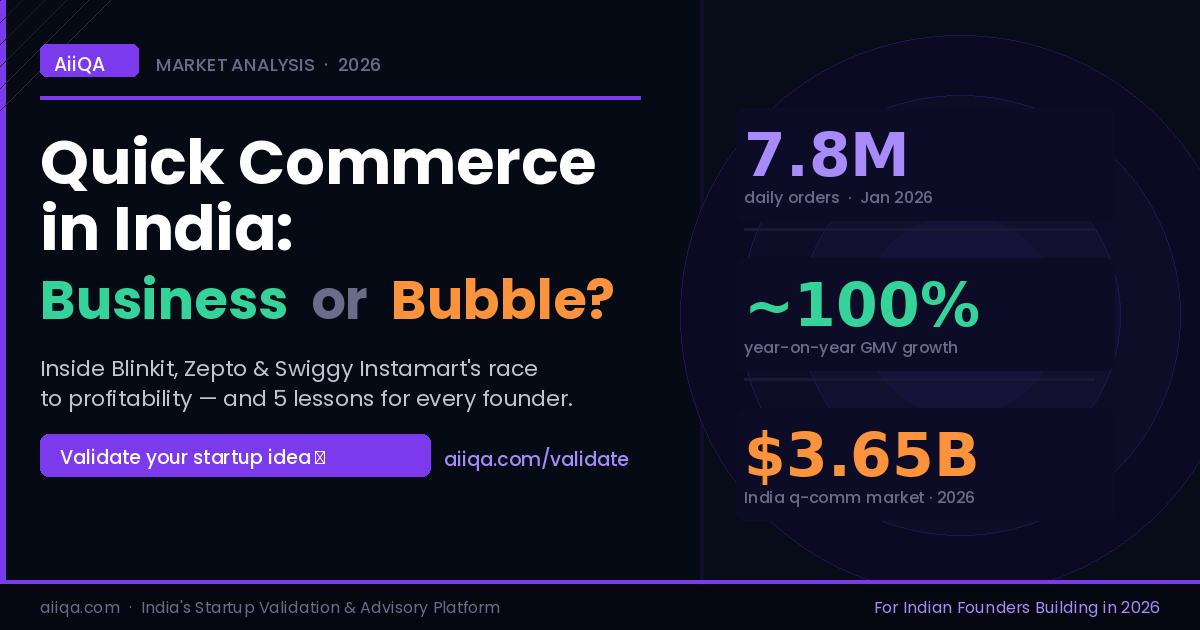
Is India's quick commerce boom a real business or an expensive illusion? Real data on Blinkit, Zepto, and Swiggy Instamart profitability, dark store economics, Dunzo's collapse, and 5 lessons every founder needs to know.
Here is the thing about quick commerce that nobody says plainly enough.
The exact same business model that destroyed Gorillas, Getir, and Jokr in Europe — bankrupting billions of dollars in venture capital — is right now creating India's fastest-growing retail category.
In Europe, 10-minute delivery was a bubble. In India, it has become a consumer habit.
So which is it? Is quick commerce a genuine business or an elaborate illusion kept alive by investor cash?
The honest answer is: it depends on who you are. For Blinkit, it's becoming a real business. For most others, the economics are still deeply uncertain. For Dunzo, it became a fatal mistake.
And for the tens of thousands of founders watching from the sidelines — wondering whether there's an opportunity here — the question isn't whether quick commerce works. The question is what it reveals about building any high-frequency, logistics-heavy business in India.
This article breaks it all down. The real numbers, the honest economics, the cautionary stories, and five lessons every Indian founder should extract from the quick commerce experiment.
First, What Is Quick Commerce?
Quick commerce — or q-commerce — is the delivery of everyday groceries, essentials, and household products within 10 to 30 minutes of ordering. Not same-day. Not two-hour. Minutes.
The infrastructure that makes this possible is the dark store: a small, neighbourhood-level micro-warehouse stocked with 2,000 to 8,000 SKUs, positioned within a 2–3 kilometre radius of its target customers. No retail storefront. No walk-in customers. Pure fulfilment.
When you order on Blinkit and your chips arrive in eight minutes, a rider picked them from a dark store 1.4 kilometres away, not a distant warehouse in Bhiwandi.
That's the model. Simple to describe. Brutally complex and expensive to operate at scale.
The Market in 2026: Numbers That Demand Attention
Whatever you think about the profitability debate, the growth data is impossible to dismiss.
| Metric | Figure | Source |
|---|---|---|
| India q-commerce market size (2026) | $3.65 billion (₹30,000+ crore) | Mordor Intelligence |
| Projected market size by 2031 | $6.64 billion | Mordor Intelligence |
| GMV — January 2026 alone | ₹11,000 crore (~$1.3B in a single month) | Redseer |
| Daily orders across industry | 7.8 million orders per day | Redseer, Jan 2026 |
| Year-on-year GMV growth | ~100% | Redseer |
| Dark stores added Apr–Jul 2026 | 900 new stores in 3 months | Whalesbook, Jul 2026 |
| Total dark stores (industry, Jul 2026) | 6,650–6,750 locations | Whalesbook, Jul 2026 |
| Projected CAGR 2025–2031 | 12.74% | Mordor Intelligence |
These are industry averages. Want your idea's actual cost estimate? Get your free personalized estimate →
Doubled year-on-year. 7.8 million orders every single day. 900 new dark stores in 90 days. This is not a bubble in the making — it is a category that has already been made.
The debate isn't whether the demand is real. The demand is clearly real. The debate is whether the business model behind fulfilling that demand is sustainable.
Who Is Winning and Who Is Bleeding
The quick commerce market in India is dominated by three platforms, which together control over 85% of GMV.
| Platform | Market Share | Dark Stores (Jul 2026) | Avg Order Value | Profitability Status |
|---|---|---|---|---|
| Blinkit (Eternal / Zomato) | ~45–50% | 2,511 | ₹547–₹709 | EBITDA positive (Q4 FY26: ₹37 crore profit) |
| Swiggy Instamart | ~20–25% | 1,100+ | ~₹619 | Still loss-making (EBITDA loss ₹840 crore in Q4 FY25) |
| Zepto | ~20–25% | ~1,000+ | ₹300–₹450 est. | Revenue ₹11,110 crore in FY25 (150% growth), path to profitability unclear |
| Flipkart Minutes | Growing | 800+ | ₹750+ | Focused on unit economics over volume |
One pattern emerges from this table immediately.
Blinkit — the market leader with the highest average order value and deepest network density — is the only player that has crossed into EBITDA profitability. Every other platform is still burning cash at significant scale.
That pattern is not a coincidence. It is the story of quick commerce.
Why the Same Model That Killed Europe Is Working in India
Between 2020 and 2024, every major quick commerce startup in Europe collapsed.
Gorillas was absorbed by Getir. Getir — once valued at $12 billion — pulled out of Germany, the UK, the Netherlands, and the US, then sold its entire delivery business to Uber for $335 million in early 2026. A 97% collapse in valuation. Jokr and Flink faced similar fates.
Critics used this to argue that 10-minute delivery is fundamentally broken.
India ignored those critics. And India was right — for structural reasons, not despite them.
Reason 1: Labour costs are structurally different
A gig delivery rider in India earns a fraction of what an equivalent rider earns in London or Berlin. Delivery labour is the largest variable cost in quick commerce, typically 40–80% of the per-order cost. When that cost is dramatically lower, the per-order economics transform entirely.
The model that was mathematically impossible in Europe is merely difficult in India.
Reason 2: Indian city density is exceptional
A single dark store in Mumbai's Andheri can serve 40,000 households within a 2-kilometre radius. The same footprint in suburban Dallas serves a fraction of that. Density drives order volume per dark store, which is the primary lever for profitability.
Indian cities are among the densest in the world. That density is a structural economic advantage for q-commerce.
Reason 3: Indian grocery behaviour is fundamentally different
Indian households historically shop frequently and in small quantities. The kirana store model — daily top-ups rather than weekly big-basket shops — is deeply embedded in Indian consumer behaviour. Quick commerce didn't have to change consumer habits. It digitised an existing one.
European consumers were trained to do large weekly grocery runs. 10-minute delivery had to change those habits. In India, quick commerce accelerated an existing pattern.
The Dark Store Economics: An Honest Breakdown
Understanding quick commerce profitability requires understanding what makes a dark store work — or fail.
A dark store's economics improve as order density increases. The fixed costs — rent, refrigeration, inventory holding, staffing — are spread over more and more orders. The key metrics are:
- Orders per day per dark store: Blinkit's average is around 1,200 daily orders per store. Flipkart Minutes runs about 1,100. Below 300–400 orders per day, the store doesn't cover its costs.
- Average order value (AOV): Higher AOV means more revenue per delivery. Blinkit has pushed AOV toward ₹700+ through private label products, premiumisation, and broader category expansion. Most platforms are still fighting at ₹300–₹450 AOV.
- Delivery cost per order: Ranges from ₹40 to ₹80 per order depending on distance, density, and batching efficiency. Dark store operations add another 7–10% of AOV on top.
The path to profitability in a single dark store looks like this: enough orders per day to spread fixed costs, an AOV high enough that the delivery cost is a small percentage of revenue, and enough operational density to reduce the per-delivery distance.
Blinkit is achieving this in top clusters. Most competitors are still far from it.
⚠️ The critical number: 80–85% of India's quick commerce GMV comes from just the top 4–5 cities. The economics that work in South Delhi and Bandra are still deeply unproven in Indore and Coimbatore.
The Cautionary Stories: What Failure Actually Looks Like
Dunzo: India's First Big Quick Commerce Casualty
Dunzo was launched in 2014 as a WhatsApp-based errand service. By 2017, it was India's first startup to receive direct investment from Google. For several years, it was a beloved hyperlocal brand with a cult following in Bengaluru.
Then it entered quick commerce.
It launched Dunzo Daily, built dark stores, and tried to compete head-on with Blinkit and Zepto. Reliance Retail invested ₹1,645 crore. By FY23, revenues reached ₹226 crore — but losses had exploded to ₹1,800 crore.
By January 2025, the app had gone dark. Operations ceased. More than 400 employees went unpaid. Reliance wrote off its entire investment. The company that had once turned its brand into a verb — "Dunzo it" — was gone.
What killed Dunzo was not the quick commerce model itself. It was the attempt to enter a capital-intensive model without the balance sheet to compete, while losing the core identity that had made it different.
Europe: The Cautionary Tale India Chose to Ignore Correctly
Gorillas and Getir didn't fail because 10-minute delivery was a bad idea. They failed because the underlying economics — European labour costs, sprawling suburban delivery distances, large-basket grocery habits — made the math unworkable. The same product in a structurally different market had different outcomes.
India's founders and investors understood the structural difference. That's not arrogance. That's market analysis done correctly.
So Is It a Bubble or a Business?
Here is the honest answer, split by participant:
| Who | Verdict | Why |
|---|---|---|
| Blinkit | Becoming a real business | EBITDA positive, dominant market share, highest AOV, parent company backing |
| Zepto | Ambitious bet — unproven yet | Explosive revenue growth but unit economics still negative; IPO ambitions create pressure to perform |
| Swiggy Instamart | Race against time | GOV doubled, but EBITDA losses widened sharply as they opened 316 stores in one quarter |
| New entrants / Tier-2 expansion | High risk | Unit economics outside top metros are largely unproven; lower density breaks the model |
| The consumer demand itself | Real and durable | 7.8 million daily orders do not lie. Habit formation is complete in top metros. |
Quick commerce in India is not a bubble in the way WeWork was a bubble or crypto was a bubble. The demand is structurally real. But most of the businesses trying to capture that demand are still operating at a loss, and only the best-capitalised market leader has cracked the economics.
The bubble, if it exists, is in the assumption that the third, fourth, and fifth players can all achieve profitability at scale.
Five Things Every Founder Should Take From the Q-Commerce Story
Lesson 1: Market size alone does not validate a business model
Quick commerce GMV in India is massive, doubling every year, and growing. None of that stopped Dunzo from going bankrupt or European players from losing billions.
A large market that you cannot profitably serve is not an opportunity. It is a trap. Before chasing any high-growth sector, the question to ask is not "how big is this market" but "can I make money serving this market, at my scale, with my cost structure?"
Lesson 2: Unit economics must be solved before you scale
The defining discipline of quick commerce's survivors is that they solved per-order economics at the dark store level before aggressively expanding. Blinkit's path to EBITDA profitability came from density and AOV optimisation at the cluster level, not from opening more stores faster.
This applies to every startup. Prove the economics at small scale. Then scale. Scaling a losing unit economics model doesn't fix it — it amplifies it.
Lesson 3: Speed is a positioning strategy, not a business model
"10-minute delivery" is a consumer promise, not a business model. The business model is the dark store, the inventory, the logistics, the AOV, the delivery cost, and the contribution margin. Startups that lead with the promise before solving the model are selling excitement, not a business.
Lesson 4: Market structure matters more than market size
The same quick commerce model failed catastrophically in Europe and succeeded in India. The difference wasn't execution. It was structural economics — labour costs, density, and consumer behaviour.
Before entering any market, the honest question is: "Do the structural conditions support this business, or am I assuming they will once I reach scale?"
Lesson 5: Capital is not a competitive moat
Dunzo raised over ₹1,645 crore from Reliance. It still failed. Getir raised billions. It still collapsed. Capital buys time to solve the model. It cannot replace solving the model.
The founders who survive capital-intensive markets are the ones who use funding to fix unit economics, not to defer the question.
Where Are the Real Opportunities for Founders in 2026?
The obvious observation is that trying to build a fourth general quick commerce platform in India in 2026 is a losing proposition. Three funded, well-entrenched players with thousands of dark stores already dominate the space.
But the quick commerce wave has created real, adjacent opportunities that are still wide open:
- Vertical q-commerce: Quick delivery for specific categories — medicines, pet supplies, baby products, auto parts. The generalist platforms cannot go deep enough in any one category to match a specialist.
- Dark store infrastructure and technology: Inventory management software built specifically for micro-fulfilment, cold chain optimisation, demand forecasting for hyperlocal assortment.
- Tier-2 q-commerce with right-sized economics: Not 10 minutes, but 45-minute delivery with significantly lower cost structures. The hyperlocal demand exists beyond metros — the infrastructure model needs to be different.
- Kirana enablement technology: The 12 million kirana stores in India are q-commerce's greatest threat and greatest opportunity. Platforms that help kiranas become dark stores are building on existing real estate, existing inventory knowledge, and existing customer trust.
- B2B quick commerce: Restaurant supply, office pantry replenishment, hospitality supply chains. Same model, different customers, potentially better AOV and margin profiles.
The lesson from quick commerce's growth isn't to copy the model. It's to identify the infrastructure gaps and customer problems that the dominant platforms are too broad to solve.
💡 The founder question to ask: "What problem does quick commerce's success create that nobody is solving yet?" That's where the next opportunity lives.
What This Means for Founders Considering Logistics-Heavy Businesses
At AiiQA, we work with founders at the earliest stage of deciding what to build. Quick commerce comes up more often than you might expect — not as a direct competitor concept, but as the inspiration for similar high-frequency, delivery-dependent models.
The pattern we observe repeatedly is this: founders see the growth numbers, get excited about the category, and start planning a business without first answering the structural economics questions that determine whether the model is viable.
Quick commerce in India works because of very specific structural conditions — dense cities, low labour costs, frequent small-basket purchase behaviour. Remove any one of those conditions and the model degrades quickly.
Before building any logistics-heavy, delivery-dependent startup, the AiiQA framework pushes founders to validate three things before anything else:
- Is the demand real and frequent enough to generate the order density required for dark store or fulfilment hub economics to work?
- Do the structural conditions in your specific market support the cost structure you're assuming? Urban density, labour costs, and consumer behaviour vary significantly even within India.
- What is your unit economics at minimum viable scale — not at 1,000 dark stores, but at 3 dark stores in one neighbourhood?
The biggest mistake isn't building something nobody wants. In logistics-heavy categories, the biggest mistake is building something people want but that cannot be profitably delivered to them.
Before you commit capital to any high-frequency, delivery-dependent business model — validate the market, the unit economics, and the competitive landscape first.
AiiQA delivers an AI-powered startup validation report that includes market size analysis, competitor mapping, SWOT breakdown, viability scoring, and a detailed MVP roadmap — so your first major decision is based on data, not assumptions.
Validate Your Startup Idea with AiiQA →
The Final Word
Quick commerce in India is not a bubble.
7.8 million orders per day, ₹11,000 crore GMV in a single month, and 900 new dark stores opened in 90 days — that is not a mirage. That is a category that has fundamentally reshaped how urban India shops for daily essentials.
But quick commerce is also not a simple business.
It is a capital-intensive, logistics-heavy, margin-thin model that rewards scale, density, and operational discipline above everything else. Only the market leader has cracked profitability. The rest are still in a race against their own burn rates.
The lesson for founders is not that quick commerce is good or bad. The lesson is that market size and consumer demand are not sufficient conditions for a profitable business. The structural economics — the cost of delivering, the density of your customers, the value of each order, the frequency of repurchase — determine whether the model works.
Those questions are answerable before you build.
The founders who answer them before committing capital make better decisions. The ones who skip straight to building discover the hard way what Dunzo and the European players already proved.
Validate the economics before you build the infrastructure. Every time.
Don't build on assumptions about market demand, unit economics, or competitive gaps.
AiiQA's AI-powered validation report gives you market analysis, competitor intelligence, viability scoring, and a step-by-step MVP roadmap — before you spend a rupee on development or operations.
Validate Your Startup Idea with AiiQA →
You know what an MVP costs.
Now find out if yours is worth building.
Get your free viability score, top 5 risks, and honest verdict — in 3 minutes.
₹159 for full report · 100+ ideas validated · No credit card for free score
Frequently Asked Questions

Written by