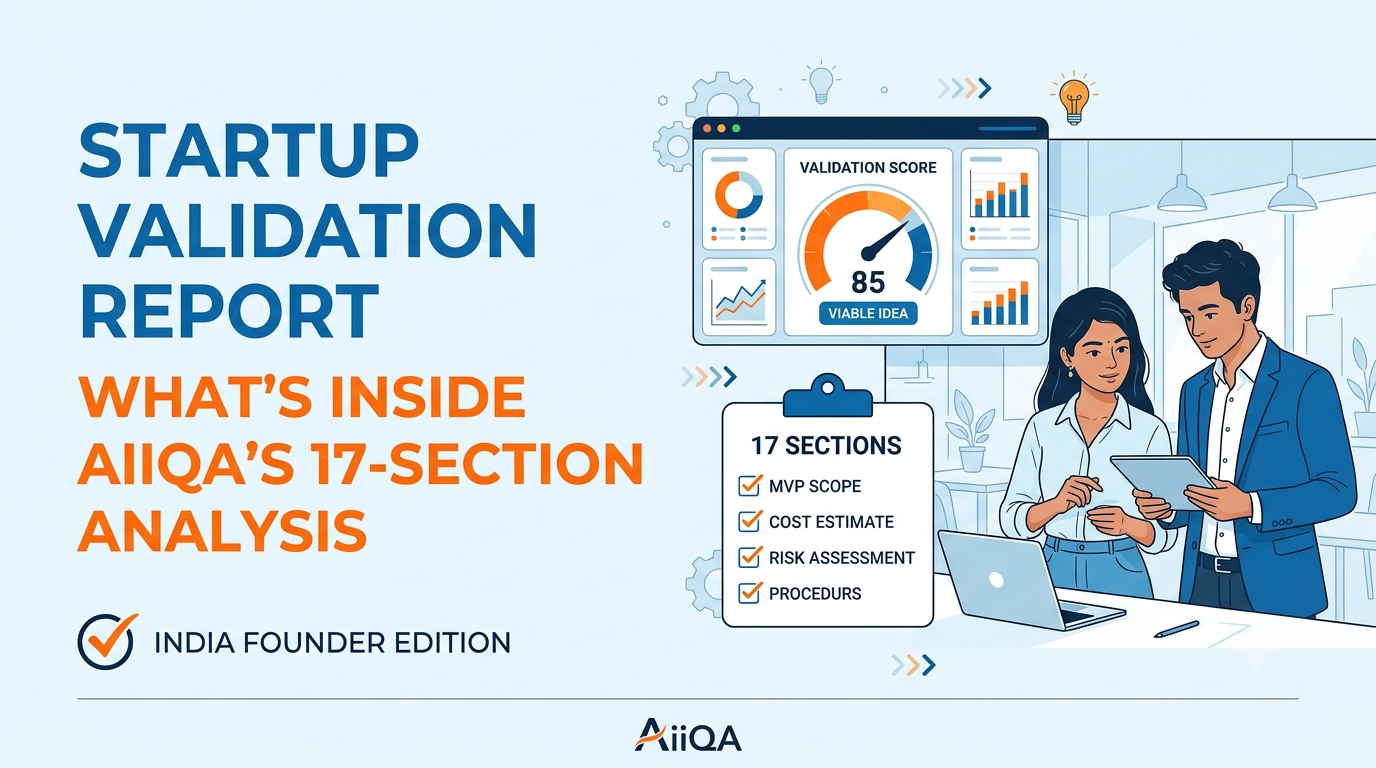
A deep-dive guide into AiiQA’s 17-section startup validation report, explaining how Indian founders can use data-driven insights to reduce risk and refine their MVP scope.
Startup Validation Report: What’s Inside AiiQA’s Full 17-Section Analysis
Launching a startup in India is an exhilarating journey, but the excitement often hits a wall of critical questions: Is this idea actually viable? How much will it cost to build? What should we prioritise for the MVP? Most startup failures don't occur because the idea was fundamentally bad. They happen because the founder built too much, too soon, without a clear plan, a realistic budget, or a validated scope. AiiQA’s startup validation report is designed to answer these questions before founders burn precious time, capital, and momentum.
If you are searching for a startup validation report in India that translates a rough concept into a concrete, execution-ready plan, this guide explains exactly what the report includes, why each section matters, and how it helps reduce expensive guesswork before development begins.
Why Validation Matters Before Building
In the Indian startup ecosystem, where budget discipline is often the difference between scaling and shutting down, startup idea validation is not a luxury—it is a survival skill.
Many founders fall in love with their "perfect" product vision, only to realise months later that the market needs something entirely different. Validation forces you to fall in love with the problem rather than the solution. When you validate your concept early, you gain the agility to pivot, simplify, or phase your build instead of committing to an MVP blindly.
The True Cost of "Guesswork"
Founders often spend months and lakhs of rupees building features nobody asked for. AiiQA’s calculator and reporting framework are built to solve that problem by providing:
-
Decision Clarity: Turning abstract ideas into costed, actionable plans.
-
Investor Readiness: Having a clear, professional document to present to co-founders, advisors, and early-stage investors.
-
Risk Mitigation: Identifying potential market or technical bottlenecks before you write a single line of code.
What AiiQA’s Report Delivers
AiiQA positions this report as more than a simple estimate. While our online calculator provides an immediate AI-generated cost range and timeline, the full report acts as a comprehensive startup feasibility report. It provides a broader startup blueprint, including tech guidance, risk analysis, and expert recommendations.
In essence, the report helps founders answer five core questions:
-
Is this idea viable?
-
What should we build first?
-
How much will it cost?
-
How long will it take?
-
What are the biggest risks?
Inside the 17 Sections: The Founder’s Blueprint
AiiQA’s full report is structured to move you from idea-level ambiguity to build-level execution. Below is the breakdown of each section, written in founder-friendly language.
Phase 1: Conceptual Alignment
1. Project Summary: An executive snapshot that explains the core idea, the report’s conclusions, and the confidence level of the analysis. It is your "elevator pitch" on paper.
2. Idea Overview: A plain-language definition of your concept. This section ensures that you, your co-founders, and any external partners are perfectly aligned on what exactly you are building.
3. Problem Statement: A critical deep dive into the pain point you are solving. If the problem isn't painful enough to warrant a solution, the report highlights this early, saving you from building a "solution in search of a problem."
4. Target Audience: Clarifying your primary user segment and buyer type. Product, pricing, and messaging all depend on this, making it a foundational element of your business.
5. Market Opportunity: Insights into the scale and relevance of the opportunity. We help you understand whether you are serving a niche use case or a broader commercial space.
Phase 2: Strategic Positioning
6. Competitor Lens: Every startup has alternatives. This section identifies obvious substitutes and existing workflows that users already trust, helping you see where your product can differentiate.
7. Unique Value Proposition (UVP): Why should someone choose your product over the alternatives? Vague differentiation usually leads to weak positioning; we help turn your idea into a sharp market story.
8. Feature Prioritisation: Founders often want to build everything at once. We use proven frameworks to separate "must-haves" from "nice-to-haves," focusing your MVP on what actually validates demand.
Phase 3: The Build & Execution Plan
9. MVP Scope: The smallest version of the product worth launching. This includes the core workflow, key screens, and essential logic needed to test the idea effectively.
10. Tech Stack Direction: Choosing the wrong stack creates unnecessary complexity. We recommend tools and frameworks based on project type, scale, and execution needs.
11. Cost Estimate: As one of the most important aspects for any startup, cost estimate in India, we expand the calculator’s range into a structured planning view to align your budget before hiring developers or agencies.
12. Timeline Estimate: A realistic roadmap is more valuable than a fast one. We break the build into logical phases or sprints so you can plan fundraising and marketing milestones accurately.
13. Risk Assessment: We make market, technical, and execution risks visible. Transparency here helps you avoid the dreaded "scope creep" later.
Phase 4: Scoring & Future-Proofing
14. Validation Score: A quantitative signal on the strength of your idea based on your inputs. It’s a fast, data-backed way to decide whether to pivot or proceed.
15. Action Plan: The bridge between analysis and execution. We recommend what to validate first, what to build next, and what to avoid spending on during the initial phase.
16. Funding Readiness: Even if you are bootstrapping, you need "fundability." This section clarifies whether your startup is ready for angels, grants, or accelerators.
17. Final Recommendation: Our closing judgment. We may suggest you proceed, refine the concept, or pause entirely. Our goal is to save you from spending capital on the wrong build.
Why Founders Use AiiQA
Founders don’t buy a report because they want more documents; they buy it because they want fewer mistakes. By using AiiQA to validate your startup idea online, you are purchasing a planning system that brings order to the chaos of early-stage entrepreneurship.
The report also serves as a professional artefact. When you walk into a meeting with a potential developer or investor, showing a structured 17-section analysis signals that you are a serious founder who has done your homework.
Who is this report for?
-
First-time founders: Testing an idea and needing a roadmap.
-
Startup teams: Struggling to define their MVP scope and prioritise features.
-
Non-technical founders: Who need a clear, non-jargon explanation of their execution path.
-
Agencies & Product Teams: Scoping a client project with high precision.
Getting Started: From Idea to Execution
AiiQA’s calculator experience is specifically designed to be the first step in your founder workflow. You describe your idea, receive an AI-powered estimate, and review the blueprint—giving you the confidence to move forward.
Stop guessing. Start building with confidence.
If your startup idea is at the “should we do this?” stage, the smartest next step is a structured validation report.
[Validate your startup idea in 3 minutes – Get the full report for ₹1,499]
You know what an MVP costs.
Now find out if yours is worth building.
Get your free viability score, top 5 risks, and honest verdict — in 3 minutes.
₹159 for full report · 100+ ideas validated · No credit card for free score
Frequently Asked Questions

Written by