Discover what AiiQA learned after evaluating 100+ startup ideas using AI. Explore winning industries, founder mistakes, market trends, MVP insights, and practical lessons to build a startup with greater confidence.
We Analysed 100+ Startup Ideas Using AI: What Actually Wins in 2026
Every startup begins with a simple question: "Is this idea worth building?"
It sounds straightforward, but it is one of the hardest questions any founder will ever answer. Passion can make every idea feel revolutionary. Friends and family often encourage you. AI can generate business plans in seconds. Social media is full of overnight success stories. Yet, behind every successful startup are hundreds of ideas that never found product-market fit.
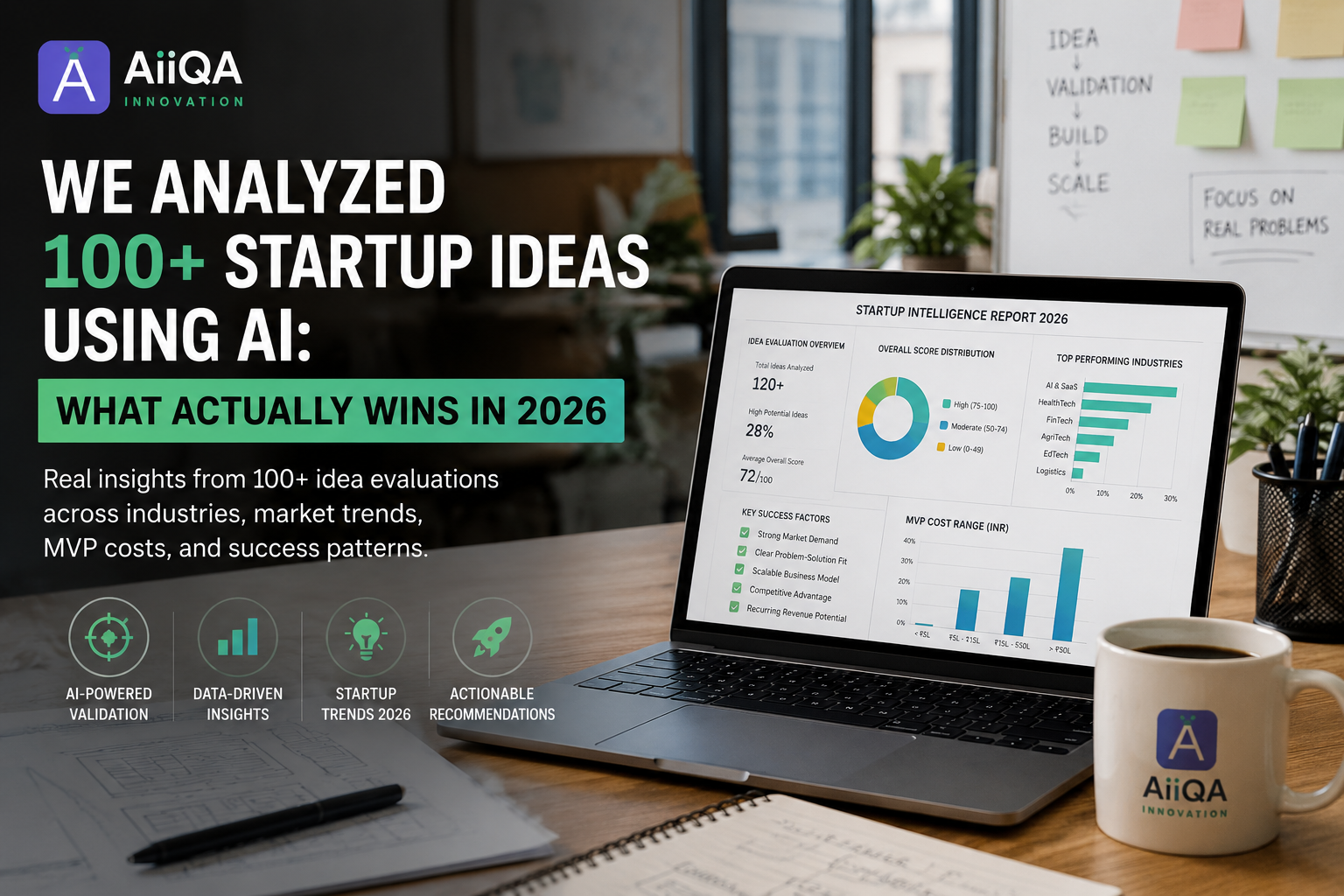
At AiiQA, we wanted to understand what separates ideas that have real business potential from those that are likely to struggle. Instead of relying on assumptions, we evaluated 100+ startup ideas submitted by founders, entrepreneurs, students, and business owners using our AI-powered startup validation framework.
This wasn't about predicting the next unicorn. No AI can accurately forecast which startup will become a billion-dollar company. Success depends on execution, timing, leadership, funding, and persistence. What AI can do exceptionally well is identify patterns, uncover hidden risks, and evaluate whether an idea solves a meaningful problem in a viable market.
After analysing more than 100 startup ideas across industries including AI, Healthcare, FinTech, Agritech, SaaS, Manufacturing, EdTech, Logistics, and E-commerce, one conclusion became impossible to ignore:
Great startups don't begin with great technology. They begin with solving a real problem.
Why Most Startup Ideas Never Become Successful Businesses
Many first-time founders believe innovation is the key to success. In reality, innovation without customer demand rarely creates a sustainable business.
During our analysis, we found that many ideas looked impressive at first glance. They used the latest AI models, promised automation, and included long lists of features. However, once we evaluated customer pain points, market demand, competition, pricing potential, and business scalability, the weaknesses became clear.
Some founders were solving problems that very few people actually experienced. Others entered highly saturated markets without any meaningful differentiation. Several ideas depended on customers changing existing habits, something that is far more difficult than most entrepreneurs expect.
The strongest ideas, however, shared a common characteristic. They focused less on technology and more on reducing cost, saving time, increasing efficiency, or eliminating repetitive work for customers.
Technology was simply the tool—not the business itself.
Our Startup Evaluation Framework
Every startup idea submitted to AiiQA goes through a structured evaluation process rather than receiving a simple "good" or "bad" verdict.
Each submission is reviewed across multiple business dimensions, including market demand, customer pain, competition, scalability, revenue opportunities, pricing model, technical feasibility, MVP complexity, AI adoption potential, and long-term sustainability.
Instead of asking, "Is this idea innovative?", we ask questions that investors and experienced founders ask.
Is the problem painful enough for customers to pay for a solution?
Can competitors easily copy the product?
Is the target market growing?
Can the business generate recurring revenue?
Can the first version of the product be launched within a reasonable budget?
Can AI genuinely improve the product, or is it being added only because it is trendy?
These questions consistently revealed opportunities that founders often overlooked during the early stages of planning.
The Startups That Consistently Performed Better
One of the most interesting findings was that industry alone did not determine success. Instead, successful ideas solved expensive problems.
Healthcare startups that reduced administrative work or improved patient management generally performed well because hospitals actively search for efficiency improvements.
Agritech solutions that helped farmers optimise crop planning, inventory management, and supply chains also demonstrated strong potential because they addressed operational challenges rather than introducing unnecessary complexity.
Business automation platforms designed for small and medium-sized enterprises consistently ranked among the strongest concepts. Many SMEs still rely on spreadsheets and manual workflows, creating significant opportunities for affordable digital solutions.
Artificial Intelligence was another recurring theme, but not in the way many founders expected.
The highest-rated AI startups were not trying to replace humans completely. Instead, they enhanced existing workflows by helping professionals work faster, make better decisions, and reduce repetitive tasks.
This distinction proved important.
Businesses rarely purchase AI simply because it is AI. They invest because it delivers measurable value.
The Biggest Mistakes Founders Repeated
Across more than one hundred evaluations, several mistakes appeared again and again.
The first was building products before validating customer demand.
Many founders invested months designing features, developing mobile applications, or creating complex dashboards before speaking to potential customers. Validation should always come before development. A single customer interview can uncover insights that months of coding cannot.
The second mistake was trying to solve too many problems at once.
Successful startups usually begin with a focused solution. They dominate one niche before expanding into adjacent markets. Founders who attempted to serve every industry, customer type, or business size generally produced products without a clear value proposition.
Another common issue involved pricing.
Many entrepreneurs spent considerable time designing features but very little time understanding how customers would actually pay. Without a realistic pricing strategy, even technically impressive products struggle to become sustainable businesses.
Finally, many founders underestimated competition.
Having competitors is not necessarily bad. In fact, competition often validates market demand. The real challenge is offering a meaningful reason for customers to switch.
Why AI Alone Is Not a Competitive Advantage
Artificial Intelligence has transformed how startups build products, but it has also created a misconception.
Adding AI to a product does not automatically create innovation.
Customers care about outcomes, not algorithms.
An accounting firm wants faster financial reporting.
A hospital wants improved patient management.
A retailer wants better inventory forecasting.
A manufacturer wants fewer production delays.
AI becomes valuable only when it solves a measurable business problem.
The strongest startup ideas we analysed treated AI as an enabling technology rather than the entire business model.
What Investors Often Notice First
Founders frequently believe investors focus primarily on product features. While features matter, investors often evaluate broader business fundamentals first.
Is there evidence of customer demand?
Can the business scale efficiently?
Does the revenue model generate recurring income?
How large is the addressable market?
Can the founding team execute consistently?
Can competitors easily replicate the solution?
These questions matter long before advanced product capabilities.
Building a technically excellent product without validating the business model remains one of the fastest ways to exhaust time and capital.
Lessons Every Founder Should Remember
The most valuable insight from evaluating more than one hundred startup ideas is surprisingly simple.
Successful businesses rarely begin with extraordinary ideas.
They begin with an extraordinary understanding of customer problems.
Founders who spend time interviewing users, validating assumptions, testing pricing, studying competitors, and refining their positioning consistently create stronger businesses than those who rely solely on inspiration.
Every startup idea evolves.
The businesses that survive are usually the ones willing to adapt based on evidence rather than emotion.
Instead of asking, "How quickly can we build this product?", founders should first ask, "How confidently do we know customers need this product?"
That single shift in mindset can save months of development, reduce unnecessary spending, and significantly improve the chances of building a business that customers genuinely value.
The Future Belongs to Founders Who Validate Before They Build
The startup ecosystem is becoming more competitive every year. AI has reduced development time, cloud infrastructure has lowered technical barriers, and launching a product has never been easier. Ironically, this means validation has never been more important.
Execution will always matter, but execution built on incorrect assumptions rarely succeeds.
The founders who consistently outperform others are not necessarily those with the biggest ideas—they are the ones who learn the fastest, validate continuously, and build products around real customer needs.
At AiiQA, our mission is to help founders make smarter decisions before they invest significant time, money, or resources into development. Every startup idea deserves objective evaluation, constructive feedback, and actionable insights before becoming a product.
If you're planning to launch your next startup, don't rely on intuition alone. Validate your assumptions, understand your market, and build with confidence.
Because the most successful startups aren't built on hope.
They're built on evidence.
Validate what you're building.
Get your free viability score, top risks, and honest verdict — in 3 minutes.
Get my free verdict
Praveen Yadav