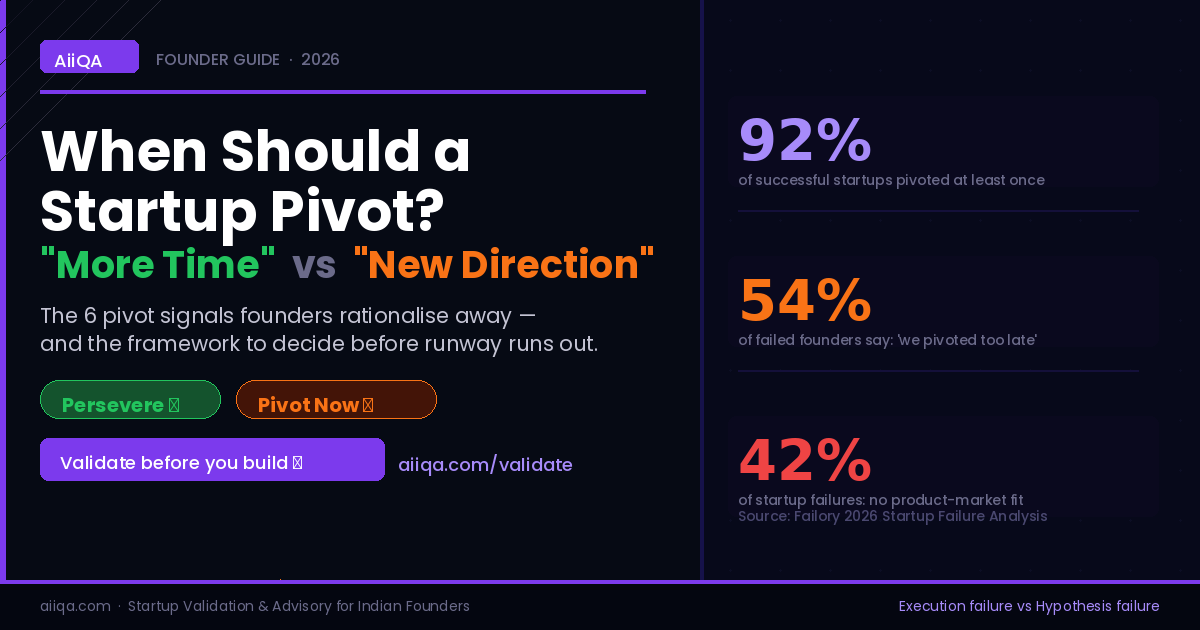
54% of failed founders say they pivoted too late. Learn the 6 pivot signals most founders rationalise away, the 4 signals that mean persevere, and the framework to decide before runway runs out.
Every founder eventually sits in the same room with the same question.
The metrics aren't moving. The team is working harder than ever. Another month has passed. Another explanation has been rehearsed. And somewhere in the back of their mind — the thought they won't say out loud yet:
"Is this a problem we haven't solved yet — or a problem we were wrong about from the beginning?"
That question is the most important one in a startup's life. And most founders answer it wrong — or worse, avoid answering it until the bank account forces the conversation.
According to Failory's 2026 startup failure analysis, lack of product-market fit is the number one reason startups fail, cited in 42% of cases. Research from 2025 shows that 54% of founders who failed admit they should have pivoted earlier — but didn't. And 92% of startups that eventually succeed pivot at least once before finding the right direction.
The data is unambiguous. Most founders need to pivot and don't. The question is how to know when you're one of them.
This article gives you the diagnostic. Not a list of vague signs. The actual framework for telling the difference between "we need more time" and "we need a different direction" — before you run out of runway to choose.
First, Understand Why This Decision Is So Hard
Pivoting is not technically difficult. Recognising when you need to is.
Three forces work against every founder's ability to read the signals clearly.
Sunk cost bias. You have put months — sometimes years — of your life into this direction. Every week you don't pivot, the weight of that investment makes the next pivot decision harder. This is not a character flaw. It is a cognitive pattern that affects everyone.
Identity fusion. For most founders, the startup is not just a product. It is a public commitment. A personal brand. Something they've told their family, their investors, their LinkedIn followers they are building. Pivoting feels like admitting you were wrong — in public. Indian founders face this with particular intensity. The cultural expectation to "stick it out" sits directly in the path of the rational pivot decision.
The adjacent explanation trap. When metrics don't move, the founder's brain is exceptionally creative at finding reasons that don't implicate the core hypothesis. "We just need more distribution." "The sales cycle is long in this market." "We need to fix onboarding first." Sometimes those explanations are correct. More often, they are elaborate defences of an idea the market has already quietly rejected.
Recognising these three forces in yourself is the first step to reading the signals clearly.
The Core Distinction: Execution Failure vs Hypothesis Failure
This is the most important framework in this entire article.
Every startup problem is one of two types.
An execution failure is when the idea is right but the implementation is wrong. The customer needs the solution. The problem is real and painful. But your team hasn't built it well enough, distributed it to the right people, priced it correctly, or explained it clearly.
Execution failures are fixable. They respond to iteration, better hires, improved GTM, and more time.
A hypothesis failure is when the idea itself is wrong. Either the problem isn't as painful as you assumed, the customer isn't who you thought, they won't pay what your model requires, or a structural constraint makes the business unworkable at any level of execution.
Hypothesis failures do not respond to iteration. No amount of better onboarding fixes a product the market doesn't want. No amount of marketing spend fixes a customer who was never going to pay.
The pivot question is always: Is this an execution failure or a hypothesis failure?
If it's execution — persevere and fix the execution.
If it's hypothesis — pivot before you run out of time to pivot well.
6 Signals That Mean You Need to Pivot (Not Just Persevere)
These are the signals most founders rationalise away. Don't.
Signal 1: High acquisition, high churn
Getting users is not the problem. Keeping them is.
This is the single most important pattern to distinguish. If you have strong acquisition — whether through ads, referrals, or word of mouth — but users consistently leave within 30 to 90 days, you have almost certainly confirmed a hypothesis failure, not an execution one.
Acquisition means your marketing is working. Churn means the product doesn't deliver what the marketing promised — or what the customer actually needed.
The specific threshold to know: D90 retention below 15% is considered pivot territory by most product benchmarks. If 85 out of every 100 users who joined three months ago are gone, and this pattern has held across multiple cohorts despite iteration, the hypothesis is failing.
Acquisition can be fixed with better messaging. Retention cannot be bought with better messaging. Retention is the product's honest verdict.
Signal 2: Users are repurposing your product
This is the most underrated signal in startup building — and the one most often dismissed.
When your power users consistently use your product for something adjacent to what you built it for, they are telling you something more valuable than any survey: they came for X, found nothing worth keeping, but found Y along the way — and Y is actually solving a real problem.
Slack was built as an internal tool for a gaming company. The game failed. But the team noticed their communication tool was genuinely useful. They followed that signal instead of doubling down on the original idea.
Instagram's founders built Burbn — a location check-in app with gaming elements and photo sharing. Users ignored the check-ins. They ignored the games. They loved the photo sharing. The team stripped everything else away and launched what they actually had: a photo app.
If you consistently see power users repurposing your product, ask this: "What are they actually using it for, and is that a better product than the one we intended to build?"
Signal 3: Explaining the product is getting harder, not easier
When a product has genuine product-market fit, something specific happens in sales conversations. The explanation gets shorter. Prospects say "oh, so it's like..." and complete the sentence themselves. They find the language for it before you do.
When a product doesn't have product-market fit, the opposite happens. Every sales conversation requires more context. The pitch deck gets longer. The explanation gets more elaborate. Founders add more slides trying to "help people get it."
If you are six months in and still struggling to explain what your product does in two sentences that land cleanly — that is a signal. Not about your communication skills. About whether the problem-solution match is clear enough to survive without explanation.
Signal 4: The same objection, from different customers, repeatedly
Exit interview analysis is one of the most underused tools in early-stage startups. Most founders track who leaves. Very few systematically analyse why.
The specific metric to watch: if 70% or more of your churned customers cite the same core objection — not a request for a feature, but a fundamental statement about whether the product solves their problem — that is a pivot signal.
The distinction matters. "I wish you had X feature" is a persevere signal. Users want what you built; they just want more of it. "This doesn't actually solve the problem I have" from 70% of your churned users is a hypothesis signal. The value proposition is failing at the foundation, not the feature level.
Signal 5: Revenue is concentrated in one or two customers
A startup with 80% of its revenue from one customer is not a product business. It is a consulting business with a product roadmap.
When revenue is concentrated, it typically means: the market is not as large as assumed, the problem is specific to this customer's unusual context rather than a widespread need, or the product requires so much customisation per customer that it cannot scale.
This is not always fatal. But it is a signal that the hypothesis about the breadth of the problem — how many people have it and how acutely — may be wrong.
Signal 6: Flatlined metrics after multiple genuine iterations
Three months of flatlined metrics after launch is normal. Most ideas need time to find their footing. Conversion improves as messaging improves. Retention improves as the product matures.
Three months of flatlined metrics after multiple substantive iterations — after you've changed the onboarding, the pricing, the target segment, the core feature — is different. That's the market telling you something structural.
Per industry research, a sustained plateau after multiple iterations is a structural signal, not an execution one. If the trajectory isn't improving despite genuine changes, the hypothesis itself needs re-examination.
⚠️ The red-zone threshold: If you have three or more of these six signals simultaneously, and they've persisted for more than 60 days despite active iteration, you are likely in hypothesis failure territory. The pivot conversation cannot wait another quarter.
4 Signals That Mean Persevere — Not Pivot
Pivoting too early is as damaging as pivoting too late. These signals mean the direction is right and the work is worth continuing.
Signal A: A specific customer segment is retaining strongly
Even if overall metrics are modest, if a clearly defined group of users keeps coming back — and you can describe who they are specifically — you have something real. The pivot is not away from the product. It's a focus pivot toward the segment that's already responding.
Signal B: Organic and referral growth exists, even if small
Organic growth is the most honest signal in early-stage startups. Users who come because other users sent them represent genuine value being perceived, not marketing creating an illusion of demand.
Even 10–15% of growth coming organically or from referrals, at early stage, is a meaningful signal that the product is delivering enough value that people recommend it without being asked.
Signal C: Users pull you forward with specific requests
When users get frustrated when the product breaks — not because they're upset at you, but because they genuinely need it to work — that's a signal. When users ask for specific, coherent feature extensions rather than questioning the fundamental value, that's a signal.
Customers who are engaged enough to have an opinion about what to build next are customers who have accepted the core value proposition.
Signal D: Your execution gaps are specific and fixable
If you can name the exact execution gap that's causing the metric shortfall — "our activation flow loses users at step three because X" — and you can fix that specific gap, you likely have an execution problem, not a hypothesis problem.
When the problem is named, locatable, and solvable, persevere and fix it. When the problem is vague and pervasive — "users just don't seem to get the value" — that is harder to fix because it may not be fixable at the execution level.
The Pivots That Changed Everything
The most important pivots in startup history share a common pattern: the founders followed a signal the market was already sending, rather than inventing a new direction from scratch.
Twitter started as Odeo — a podcast directory. When Apple integrated podcasts into iTunes, Odeo's core hypothesis was destroyed overnight. One team member, Jack Dorsey, had been experimenting with a side idea: 140-character status updates sent by SMS. The team followed that internal signal and launched what became Twitter. The pivot wasn't a creative leap. It was following a clear signal that already existed.
Slack was the communication byproduct of a failed game. Stewart Butterfield's team spent years building Glitch, an online multiplayer game that never found its audience. But while building the game, they had built an internal communication tool for their distributed team. When Glitch shut down in 2012, Butterfield chose to productise the tool they had built for themselves. Slack launched in 2013. Eight thousand companies signed up within 24 hours. It was acquired by Salesforce for $27.7 billion.
YouTube launched as a dating site where users could upload videos describing their ideal partner. Nobody used it that way. But the team noticed people were uploading all kinds of videos — and watching them. They followed the signal and removed the dating framing entirely. The rest is history.
Flipkart (India) started as an online bookstore in 2007, deliberately imitating Amazon's early model. It recognised that the Indian consumer's relationship with books was not the scalable entry point. It expanded into electronics, fashion, and general merchandise — following where genuine demand existed in the Indian market.
Every one of these pivots had one thing in common: the founders were already seeing the signal before they acted on it. The pivot didn't create the opportunity. It followed an opportunity the market was already revealing.
The Pivot Decision Framework
Stop making this decision by feel. Make it by process.
| Step | Action | What to look for |
|---|---|---|
| 1. Set a timeline | Agree with your co-founder/team: "If X metric doesn't improve by [date], we pivot." | Removes ego from the decision. Forces clarity on what "working" looks like. |
| 2. Interview churned users | Talk to 10–15 users who left. Ask: "What were you trying to do? Did it work?" | Look for whether 70%+ cite the same core problem. Pivot signal vs persevere signal. |
| 3. Map your retention curve | Pull D30, D60, D90 retention by cohort. | D90 below 15% across multiple cohorts = pivot territory. Any cohort above 30% = signal worth following. |
| 4. Find the repurposing signal | Ask your 5 most engaged users: "How are you actually using this day-to-day?" | If their answer is different from your intended use case, the market is showing you a better product. |
| 5. Name the execution gaps | List every problem in the product. Can you name where exactly the failure is? | Specific and fixable = execution problem. Vague and pervasive = hypothesis problem. |
| 6. Apply the honest test | If you had to start over with everything you know now, would you build the same thing? | If the answer is genuinely yes — persevere. If it's no, the pivot conversation is overdue. |
These are industry averages. Want your idea's actual cost estimate? Get your free personalized estimate →
The Pivot Trap: When Pivoting Becomes the Problem
Not every founder who should pivot actually needs to. Some founders have the opposite problem.
A founder who pivots four times in eighteen months hasn't tested any hypothesis properly. Each pivot resets the learning clock. Each reset means the next direction starts with less runway than the last.
The pattern — pivot at the first sign of difficulty, pivot again when the second direction feels hard, pivot again because someone at a networking event suggested a better idea — is not agility. It is avoidance.
Research suggests successful startups pivot an average of two to three times before finding product-market fit. But each pivot is substantive and data-driven, not reactionary.
The rule: don't pivot before you have given a direction three to four months of genuine execution effort and have clear data on why it isn't working. Burnout is not a pivot signal. Investor pressure alone is not a pivot signal. A competitor launching is not a pivot signal. Only market evidence justifies a pivot.
💡 The serial pivot warning sign: If you can't clearly articulate what hypothesis the current pivot is testing, and what evidence would confirm or deny it within a specific timeframe, you're not pivoting strategically. You're avoiding the hard work of staying with something long enough to learn from it.
The Question Before the Pivot: Did You Validate in the First Place?
Here is the uncomfortable truth that most pivot articles skip entirely.
Many pivots are not pivots. They are corrections to decisions that should never have been made in the first place.
A pivot caused by discovering that customers won't pay for the solution is painful. A pivot caused by discovering that the problem wasn't real to begin with is devastating — because the evidence was available before a single line of code was written.
At AiiQA, we work with founders at the pre-build stage specifically because the validation questions — Is the problem real? Who has it? How much does it cost them? What are they doing about it today? Will they pay for a better solution? — all have answers. Not perfect answers, but directional ones.
Founders who validate before building don't eliminate the need to pivot. Markets shift. Assumptions get refined. The first version is never the right version. But they enter the market with a much sharper hypothesis — and they know exactly which metrics to watch to know when that hypothesis is being confirmed or denied.
The difference between a founder who pivots well and one who flails is often not intelligence, experience, or work ethic. It is clarity about what they were testing in the first place — and honesty about what the data is saying.
Validation gives you that baseline. It makes the pivot decision data-driven rather than gut-driven. And it means you're reading signals against a hypothesis you deliberately chose, not hoping that something sticks.
Before you build, know what you're testing — and what would tell you to change direction.
AiiQA's validation report gives you AI-powered market analysis, competitor mapping, a realistic viability score, customer segmentation, and a step-by-step MVP roadmap — so your first build is anchored to evidence, and your pivot decision, if it comes, is grounded in data you collected from day one.
Validate Your Startup Idea with AiiQA →
The founders who pivot well are not the ones who abandon ideas easily. They're the ones who distinguish quickly between what the execution is failing at and what the hypothesis got wrong.
Those are different problems. They have different solutions.
Execution failure is fixable. It rewards the founder who iterates with discipline, gathers specific data, and makes targeted improvements. Those founders deserve more time.
Hypothesis failure is not fixable by working harder. It rewards the founder who reads the market's verdict honestly, preserves enough runway to change direction meaningfully, and builds the next hypothesis from what the first one actually taught them.
The founders who ran out of runway without pivoting didn't lack resilience. Most of them had too much of it — applied to the wrong direction.
The founders who pivoted too early didn't lack conviction. They lacked a clear enough hypothesis to know what the data was actually saying.
Both problems have the same root: building without enough clarity about what you're testing and what would tell you to stop.
Validate the hypothesis before you build. Read the data honestly when you do. And have the courage to act on what it says — in either direction.
The best time to prepare for a pivot is before you need one — and that starts with a validated hypothesis.
AiiQA's startup validation report gives you AI-powered market sizing, competitor analysis, viability scoring, and a clear MVP roadmap — so you build with evidence from day one and know exactly which signals to watch.
Validate Your Idea Before You Build →
You know what an MVP costs.
Now find out if yours is worth building.
Get your free viability score, top 5 risks, and honest verdict — in 3 minutes.
₹159 for full report · 100+ ideas validated · No credit card for free score
Frequently Asked Questions

Written by