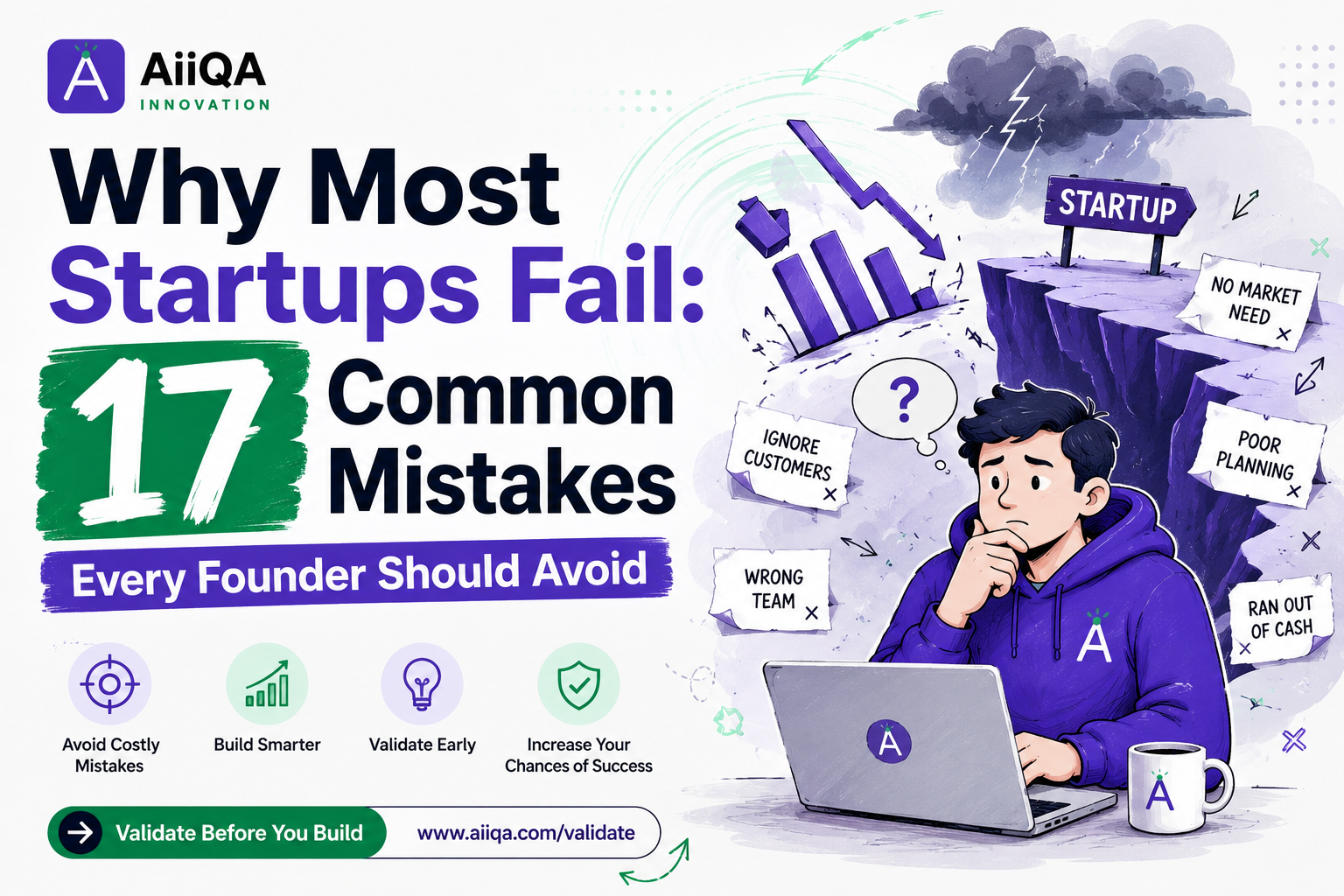
AiiQA analyzed 1,000 failed startups to uncover 17 deadly mistakes killing early-stage ventures — with real data, founder insights, and step-by-step guidance to help you avoid the same fate.
📋 What You'll Learn in This Article
- The Story Behind This Research — Praveen's Wake-Up Call
- The Data: What 1,000 Failures Taught Us
- Category 1 — Validation & Research Mistakes (1–3)
- Category 2 — Team & Co-Founder Mistakes (4–5)
- Category 3 — Finance & Operations Mistakes (6–8)
- Category 4 — Product & Technology Mistakes (9–11)
- Category 5 — Market & Growth Mistakes (12–14)
- Category 6 — Leadership & Mindset Mistakes (15–17)
- Quick Reference Summary Table
- Praveen's Vision for Indian Startups
- Frequently Asked Questions
Every week, another startup shuts down in India. Another WhatsApp message: "We're winding up operations. Thank you for your support." Another founder, sleepless and humbled, watches their dream dissolve into silence. What went wrong? Was it bad luck? Bad timing? Or was it a set of completely avoidable mistakes that no one warned them about?
At AiiQA, we've spent the last two years doing something no one else has — systematically analyzing over 1,000 failed Indian startups across fintech, edtech, D2C, SaaS, agritech, and health tech. We combed through post-mortems, founder interviews, investor notes, and shutdown announcements. And what we found will change how you think about building.
This isn't theory. This isn't a Stanford case study. This is raw Indian startup data — from ideas born in Ahmedabad chai stalls and Bengaluru co-working spaces that never made it past Year 2. If you're building right now, this article may be the most important 14 minutes you'll spend this month.
"In 2022, I watched three of my close founder friends shut down businesses they had sacrificed everything for. One had invested ₹18 lakhs of his family savings. Another had quit a ₹22 LPA job at a top MNC. The third had relocated from Pune to Mumbai, separated from his newborn child for months. All three failed for reasons that were completely predictable — and preventable."
Those three failures changed Praveen's life. Instead of rushing to build AiiQA's first product, he spent six months doing something radical — he studied failure. He reached out to founders who had shut down. He asked the uncomfortable questions. He looked for the patterns hidden inside pain.
What started as personal research to help his network became something bigger: a systematic dataset of over 1,000 failed Indian startups, categorized by mistake type, industry, city, founder profile, and timeline to failure. The result is what you're reading right now — and the engine powering AiiQA's Startup Viability Calculator.
"The Indian startup ecosystem doesn't need more inspiration," Praveen says. "It needs honest data. Because aspiration without validation is just gambling with your savings — and your family's trust."
What 1,000 Failures Taught Us: Failure Breakdown by Category
Percentage of failed startups where each category of mistake was a primary contributor
Source: AiiQA Startup Failure Analysis — 1,000 Indian startups (2018–2024)
50% of all startup failures trace back to just two categories: validation failures and financial mismanagement. Both are entirely preventable with the right framework before you start building.
Validation & Research Mistakes
The single biggest killer. Founders spend months writing code, designing apps, and pitching investors — all before confirming that a real market exists for their solution. Passion is not validation. A problem that frustrates you is not automatically a problem a market will pay to solve. We found that 87% of failed startups in our dataset never ran a structured validation exercise before spending money.
Founders fall in love with their solution before confirming the problem's severity. A "vitamin" business (nice to have) gets funded and built as if it's a "painkiller" (must have). The Indian market is especially unforgiving — users will not pay for incremental convenience; they pay for acute pain relief. 74% of failed startups solved problems that users acknowledged but were not willing to pay money to fix.
"We have no competition" is the most dangerous sentence in a pitch deck. It means one of two things: either the market doesn't exist, or you haven't done your research. Successful founders obsess over competition — not to copy, but to find the gap they can own. Underestimating well-funded incumbents or ignoring low-tech alternatives (jugaad solutions) kills startups fast.
Team & Co-Founder Mistakes
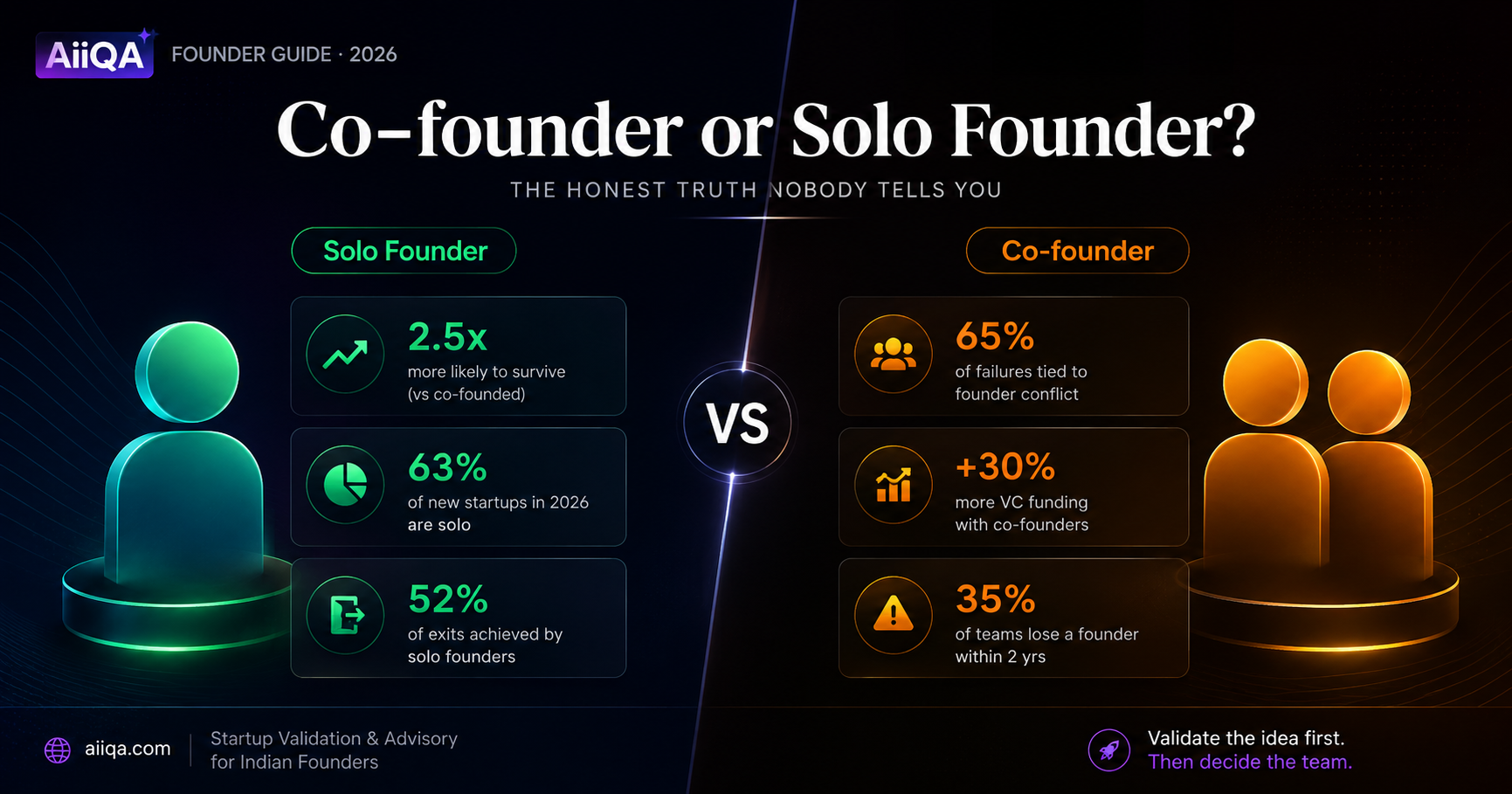
Co-founder conflicts are the silent killer of promising startups. Two college friends who get along over chai become enemies over equity, roles, and vision in Month 8. Conversely, solo founders who needed a technical co-founder struggled to ship product while burning through consultant fees. The co-founder relationship is essentially a professional marriage — and most Indian founders treat it like a casual arrangement. 65% of failed startups in our dataset had co-founder tension as a contributing factor.
Hiring feels like progress. A 10-person team in a co-working space looks like a real company. But payroll before revenue is a countdown clock. Indian founders often hire sales teams before they have a product to sell, and marketing managers before knowing who their customer actually is. The right time to hire is after your core unit economics are proven — not before. Premature hiring accelerated runway burn for nearly half of startups we analyzed.
Finance & Operations Mistakes
Cash is oxygen for a startup. The moment you can't breathe, everything else — your vision, your team, your customers — becomes irrelevant. 71% of the failed startups we analyzed ran out of cash within 18 months, often because founders underestimated burn rate, overestimated revenue timelines, or failed to raise their next round before runway hit 3 months. In India, where family savings are often the source of seed capital, this isn't just a business failure — it's a personal one.
If you don't know your CAC (Customer Acquisition Cost) and LTV (Lifetime Value), you are flying blind. Indian D2C startups in particular grew GMV (Gross Merchandise Value) without ever understanding that they were losing money on every order. Profitable unit economics must be visible from Month 1, even if the numbers are initially poor. The direction of improvement matters more than the starting point.
Scaling a broken model just means failing faster and more expensively. Founders who land a big media feature or secure early funding often interpret momentum as product-market fit. They expand to 10 cities before they've mastered one. They hire 30 people before they have 300 happy customers. The startup graveyard is full of companies that scaled the wrong thing. True scale begins after repeatability — when you can acquire, retain, and monetize customers predictably.
% of Failed Startups Affected by Each Mistake
Horizontal bar chart — AiiQA analysis of 1,000 failed Indian startups (2018–2024)
% of 1,000 failed Indian startups affected by each mistake
Product & Technology Mistakes
"We're not ready to show anyone yet" is code for "we're afraid of feedback." Indian founders, especially non-technical ones, have a deep fear that someone will steal their idea. But ideas are cheap — execution and learning are everything. Every month in stealth is a month without real user data, without feedback loops, and without the market signals you need to build the right thing.
Launching is not the finish line — it's the starting pistol. Yet 57% of failed founders admitted they stopped actively seeking customer feedback after launch, believing that the product was "done." Customers who churn silently are the most dangerous signal of all. They don't complain; they just leave. And every cohort that drops off tells you exactly where your product is broken — if you're listening.
An MVP with 40 features is not an MVP — it's a half-built product that took 8 months to ship. Feature creep kills speed, drains engineer attention, and delays the most important milestone of all: your first real user. The best Indian startup MVPs launched with one core function done exceptionally well. Everything else is a distraction until users tell you what they actually need.
Market & Growth Mistakes
Indian founders have a cultural instinct to underprice: "The market won't pay more than ₹99." This self-limiting belief kills margins before the business even starts. On the other extreme, SaaS startups without proven value charge enterprise prices and wonder why the pipeline is dry. Pricing is a signal of confidence. Users who get your product for free don't respect it — and users who pay ₹4,999 instead of ₹499 often churn less because the value perception is higher.
"We'll market on Instagram and get organic traffic" is not a GTM strategy. A real GTM plan answers: Who is your first 100 customers? Where do they spend time? What message will make them act today? Without this clarity, startups spray marketing rupees across channels, get mediocre results on all of them, and conclude "marketing doesn't work for us" — when the real problem is the lack of strategy.
Filling a leaky bucket with more water is not growth — it's waste. Yet 31% of failed startups invested aggressively in user acquisition while ignoring that users were churning within 30 days. Retention is the multiplier on every acquisition rupee you spend. A startup with 60% Day-30 retention and 500 users compounds faster than one with 5% retention and 5,000 users.
Leadership & Mindset Mistakes
The hardest thing for a founder to say is "I was wrong." When 18 months of work and ₹20 lakhs of savings are tied to an idea, admitting it isn't working feels like personal failure. But the data is clear: founders who pivot based on market signals survive; founders who defend their original vision in the face of contradictory evidence do not. Pivoting is not quitting — it is the intelligent application of learning.
Legal issues rarely kill startups directly — but they make them unacquirable, uninvestable, and unscalable. Founders who don't register as a private limited company early, don't file for trademarks, or don't put proper employment agreements in place find themselves blocked at critical junctures. One startup we analyzed lost a ₹1.2 crore acquisition offer because the founders hadn't documented IP assignment properly for a key engineer.
Startups that can only articulate "what they're building today" struggle to attract co-founders, top talent, and investors. People don't join missions — they join visions. A founder who can paint a vivid, credible picture of the world they're building toward — even if the path is uncertain — inspires commitment. Absence of vision leads to high early-team attrition, which is one of the most overlooked killer of Indian early-stage startups.
All 17 Mistakes — At a Glance
| # | Mistake | Category | % Affected | Severity | Avg. Loss |
|---|---|---|---|---|---|
| 01 | Building Without Validation | Validation | 87% | Critical | ₹9–18L |
| 02 | Solving the Wrong Problem | Validation | 74% | Critical | ₹5–25L |
| 03 | Cash Flow Mismanagement | Finance | 71% | Critical | ₹15–60L |
| 04 | Co-Founder Conflict | Team | 65% | High | ₹3–12L |
| 05 | Ignoring Unit Economics | Finance | 63% | High | ₹10–40L |
| 06 | Premature Scaling | Finance | 59% | High | ₹25–1.5Cr |
| 07 | Ignoring Customer Feedback | Product | 57% | High | ₹8–20L |
| 08 | Scaling Without PMF | Product | 54% | High | ₹20–80L |
| 09 | Too Long in Stealth | Product | 51% | High | ₹6–18L |
| 10 | Underestimating Competition | Market | 49% | High | ₹12–35L |
| 11 | Premature Hiring | Team | 46% | High | ₹8–22L |
| 12 | Pricing Mistakes | Market | 44% | Medium | ₹5–15L |
| 13 | No GTM Strategy | Market | 42% | Medium | ₹4–10L |
| 14 | Founder Ego / Refusing to Pivot | Leadership | 39% | Medium | ₹10–30L |
| 15 | Legal / Compliance Gaps | Leadership | 35% | Medium | ₹2–15L |
| 16 | Feature Creep in MVP | Product | 33% | Medium | ₹6–20L |
| 17 | No Retention Strategy | Market | 31% | Medium | ₹4–12L |
Praveen's Vision for Indian Startups
"India is producing 100,000+ startups a year. But we're not yet producing the culture of validation that turns ideas into businesses that last. My vision for AiiQA is simple: every non-technical founder in India should have access to the same intelligence that Silicon Valley investors use to evaluate startups — before they spend a single rupee. We're building the operating system for the Indian founder's journey."
Validate First, Build Second
A culture where no Indian founder ships product without data-backed confidence in market demand.
Democratize Co-Founding
Non-technical founders deserve technical partners — AiiQA's Equity Vault makes it structured and safe.
Data Over Gut Feeling
Every startup decision should be supported by real market intelligence, not founder optimism bias.
India's Startup Survival Rate
From 10% success to 40% success — that's the change we're here to make in the Indian ecosystem.
⚡ The 17 Mistakes in 17 Seconds
Final Thoughts: Failure Is a Dataset, Not a Destiny
Every failed startup in this analysis represented a real human story — a founder who sacrificed time, money, and often family harmony in pursuit of something they believed in. We owe it to those founders to extract every possible lesson from their journey. Not to celebrate failure, but to make it matter.
The Indian startup ecosystem is at an inflection point. Capital is available. Talent is abundant. Infrastructure — from UPI to GST — is startup-friendly. What's missing is the cultural muscle of structured validation. The habit of testing before investing. The discipline of data over conviction.
At AiiQA, we built our Viability Calculator not as a product feature — but as the answer to a question we ask ourselves every day: How do we make sure the next 1,000 startups we work with don't appear in the next version of this article?
If you're a founder — validate first. Build second. And know that the bravest thing you can do is not just start a startup, but start the right startup for the right market at the right moment. That clarity is exactly what AiiQA is here to give you.
Run your startup idea through AiiQA's free Viability Calculator at aiiqa.com/calculator and get an AI-powered assessment in under 10 minutes. No jargon. No fluff. Just honest data to help you build smarter.
Validate what you're building.
Get your free viability score, top risks, and honest verdict — in 3 minutes.
Get my free verdict
Praveen Yadav