Validate IdeaBlogAbout

Language

Co-founder or Solo Founder? The Honest Truth Nobody Tells You
Thought Leadership

Co-founder or Solo Founder? The Honest Truth Nobody Tells You

Praveen Yadav17/08/202615 min read
Tags:#aiiqa#indian-founders#startups

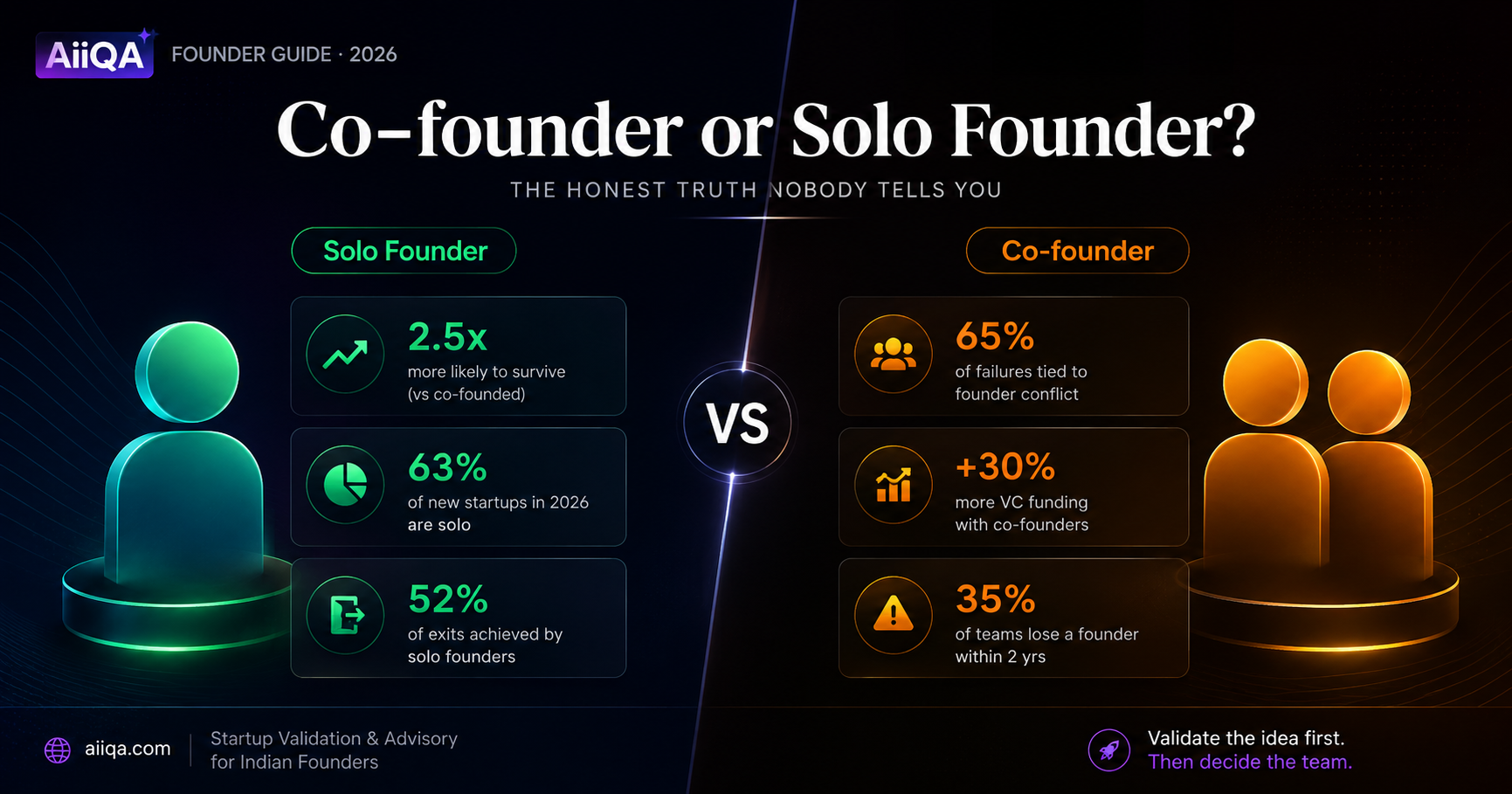
65% of high-potential failures trace to co-founder conflict. But solo founders now drive 52% of successful exits. The data, the decision framework, and what nobody says out loud — for Indian founders in 2026.

The advice is everywhere. In accelerator programmes. On LinkedIn. At startup events. From investors, from mentors, from the successful founders you study.

"You need a co-founder."

It's delivered with the confidence of a rule. As though building alone is a fundamental strategic error. As though the history of great companies is built exclusively by pairs.

It isn't.

And in 2026, the data has moved sharply enough that repeating this advice without nuance is genuinely misleading to the founders who hear it.

The honest truth about co-founding vs solo founding is not a verdict. It's a framework. And it starts with data that most people giving you this advice haven't read.


The Numbers on Both Sides (Because This Is Actually Complicated)

Before the framework, the evidence. Both sides of it.

The case for having a co-founder

  • Harvard Business School research (Noam Wasserman) found that up to 65% of high-potential startup failures trace back to conflict among founders — not the market, not the product, not the technology. The people at the top. This is sometimes misread as an argument against co-founding. It isn't. It's an argument for choosing and managing co-founder relationships with far more rigour than most founders apply.
  • Startup Genome data shows startups with two co-founders raise 30% more funding than solo-founded ventures, all else equal.
  • First Round Capital's 10-Year Project found that teams with more than one founder outperformed solo founders by 163%, and solo founders' seed valuations were 25% lower.
  • 37% of VC-backed companies have two founders — the most common configuration — against 20% with solo founders.

The case for going solo

  • Stripe Atlas data (Q2 2026): 63% of all new C corps formed are solo-founded — an all-time high. The solo founder is not an exception in 2026. It is the majority.
  • Among companies with $1M+ ARR, the most common number of founders is one — 42% — ahead of two-founder teams at 33%. Venture capital backs teams. Revenue validates products. And solo founders are building more of those products.
  • 52.3% of successful startup exits (acquisitions or IPOs) were achieved by solo founders, per Carta data — contradicting the popular VC narrative that teams are essential for exits.
  • Solo-founded for-profit ventures are approximately 2.5x more likely to survive than team-founded startups — largely by avoiding co-founder conflict that kills the team before it kills the company.
  • Solo founders retain 75% more equity at exit than lead founders in multi-founder teams.

Read those two lists together and the story becomes clear: the "co-founder is essential" advice was built on VC funding metrics, not on company survival or revenue generation. When you measure by funding rounds, co-founders win. When you measure by actual business outcomes, the picture is far more complicated.

Neither path is universally superior. Both have genuine advantages. Both carry real costs. The question is which set of costs fits your specific situation.


Why the "You Need a Co-Founder" Advice Is Outdated

The conventional wisdom was formed in a specific historical window. Between roughly 2008 and 2018, the canonical startup required a technical founder and a business founder. One to build. One to sell.

This made structural sense in that era. Building a software product required dedicated engineering talent. Marketing required different skills entirely. A single person covering both was genuinely stretched, and the skills gap between "can build" and "can sell" was wide enough that bridging it alone was exceptional.

Three things changed that calculus fundamentally.

AI coding tools. A non-technical founder in 2026 can build a functional prototype using Claude Code, Cursor, or Lovable without a technical co-founder. A technical founder can generate marketing copy, run ad campaigns, and manage customer communications without a marketing hire. The skills gap that made co-founding structurally necessary has narrowed dramatically.

No-code infrastructure. For validated ideas that don't require proprietary technology, the build-phase no longer requires a developer at all. The co-founder whose primary contribution was "they can build what I can't" is, in many product categories, replaceable by a ₹5,000/month platform subscription.

AI as a thinking partner. One of the real values of a co-founder is cognitive — a second brain to pressure-test decisions, catch blind spots, and provide accountability. Sophisticated AI tools now provide meaningful (though imperfect) versions of this function. They don't replace human co-founder judgment. But they reduce the cost of not having it.

Midjourney — $200M ARR, multi-billion dollar valuation — was built by David Holz with approximately 11 employees and no traditional co-founder structure. Zoho has built $2 billion in ARR from Chennai, bootstrapped. The solo-founded startup is no longer a scrappy exception. It is increasingly the archetype.

💡 The 2026 reality: Solo-founded startups launched in 2025 numbered over 48,000 — up 140% from 2024. The share of new startups with solo founders has risen from 23.7% in 2019 to 36.3% in 2025. AI didn't just help solo founders compete. It restructured who can build what alone.


The Honest Costs of Going Solo

💡

These are industry averages. Want your idea's actual cost estimate? Get your free personalized estimate →

Before anyone concludes that solo is the obvious choice in 2026, here are the costs nobody talks about clearly enough.

The loneliness is real and underestimated

35% of solo founders report high stress levels, compared to 26% of founders with employees. 13% report significant feelings of isolation that materially affect their decision-making. Building alone means carrying every decision — the product decisions, the commercial decisions, the financial decisions, the people decisions — without a peer who shares the same stakes.

An investor, an advisor, or a mentor can help. But none of them have the same skin in the game. The weight of being the only person responsible for everything is not a minor operational inconvenience. For many founders, it becomes the primary reason they stop.

Blind spots compound without a genuine peer check

A co-founder who genuinely challenges your thinking — who questions the pricing model, pushes back on the GTM assumption, or calls out the product decision that feels right but isn't — is irreplaceable. AI tools can simulate this function to a degree. They cannot replicate the accountability of a person who has as much to lose as you do saying: "I think you're wrong about this."

Investor bias is real and has a cost

Solo founders secure only 14.7% to 17% of priced venture capital rounds despite founding 36.3% of new startups. If your startup requires institutional venture capital to succeed, going solo materially reduces your access to that capital. This is not fair. It is the current reality of the VC institutional bias.

If your path to success runs through multiple VC rounds, the co-founder question has a funding dimension that cannot be ignored.

Energy bandwidth is a structural constraint

The AI advantage is real. One person with the right tools can output what previously required three or four. But those tools require direction, context, and quality oversight. Every minute you spend managing AI agents is a minute not spent on strategy, customer relationships, or the highest-leverage decisions that only you can make.

Solo founding works exceptionally well for focused, well-defined problems with a clear monetisation path. It gets harder — not impossible, but harder — as complexity scales.


The Honest Costs of Co-Founding

Now the side nobody is writing on LinkedIn because it feels disloyal to the narrative.

65% of high-potential failures trace to co-founder conflict

This is the Wasserman data. Not 10%. Not 30%. Up to 65% of the startups that should have succeeded — that had the product, the market, the capital — failed because the people at the top stopped working as a unit.

Co-founder conflict is not a small risk. It is the single largest identifiable cause of preventable startup failure. And it is overwhelmingly underestimated at the founding stage — precisely because founding is exciting, the relationship is new, and disagreements feel hypothetical until they're not.

35% of funded founding teams lose a founder within 2 years

A co-founder departure is not just a relationship loss. It is a legal, structural, cap table, and operational crisis. Depending on the vesting schedule and the founders' agreement (if one exists), a departing co-founder may leave with significant equity. They may take intellectual property. They may create restrictions on the company's fundraising.

And 73% of co-founders lock in their equity split within one month of starting — before they have demonstrated what either person is actually worth to the business.

Equal splits cause the most damage

45.9% of two-founder startups use a 50-50 equity split. This sounds fair. It often isn't.

A 50-50 split without a clear decision-making tiebreaker creates structural deadlock at every consequential decision. When founders agree, it's invisible. When they disagree — on a hire, a pivot, an investor offer, a product direction — 50-50 has no resolution mechanism. The company cannot move.

The most frequent cause of founder disputes after a Series A in India is a 50-50 split without a designated tiebreaker. Not because either founder is unreasonable. Because the structure creates conflict by removing any mechanism to resolve it.

The wrong co-founder is worse than no co-founder

This is the truth nobody says in the room when someone is excited about their co-founder choice.

A co-founder chosen for the wrong reasons — because they were available, because they're a friend, because the accelerator said you needed one, because going solo felt lonely — is not a structural asset. They are a structural liability with equity.

Parting ways with the wrong co-founder costs legal fees, time, cap table complexity, and — if not handled carefully — investor confidence. The damage is not theoretical. It is measurable and often fatal.


The Decision Framework: 6 Questions Before You Decide

Stop asking "should I have a co-founder?" Start asking these six questions.

Question Solo founder signal Co-founder signal
1. Is there a genuine skill gap I cannot close with AI tools, hiring, or learning? No — I can build and sell this alone, especially with AI tools Yes — the product requires deep technical or domain expertise I don't have and cannot acquire
2. Am I building for venture scale or for a profitable business? Profitable, sustainable business — co-founder not structurally required for funding Venture scale — multiple VC rounds likely required; co-founder improves access
3. Do I have a specific person in mind whose skills genuinely complement mine — or am I looking for one? Looking — don't force it; go solo until you find the right person Have someone specific who has proven complementary — proceed with a formal agreement
4. Have I worked with this person under pressure before? No evidence of how they handle conflict, stress, or failure Yes — I have data on how this person behaves when things go wrong
5. Is the business inherently complex enough that one person cannot hold it? Focused, well-scoped — AI + right tools can cover most functions Multi-disciplinary deep tech, regulated industry, or enterprise sales where relationship breadth matters
6. Can I handle the cognitive and emotional load of being the only decision-maker? Yes — I have strong systems, advisors, and community for accountability No — I need a genuine peer partner, not just advisors or investors

If your answers consistently point toward solo — go solo. With discipline, AI tools, and a strong advisory network, the solo path is more viable in 2026 than at any previous point in startup history.

If your answers consistently point toward co-founding — go find the right person. But read the next section first.


If You Choose to Co-Found: What You Must Get Right

Most co-founder relationships fail not because the people were wrong for each other in principle — but because they skipped the structural conversations that prevent predictable conflicts from becoming fatal ones.

Have the uncomfortable conversations before you start

What does each founder consider a successful outcome — and on what timeline? Are those the same? What happens if one founder wants to raise VC and the other wants to bootstrap? What happens if an acquisition offer comes at ₹10 crore — does one founder want to sell and the other doesn't?

These conversations feel premature at the beginning. They are the only time you can have them cleanly — before money, conflict, and ego make them impossible.

Never split equity before establishing vesting

Equity earned over time (a four-year vesting schedule with a one-year cliff is the standard) is one of the most important structural protections a co-founding team can have. It means that if a co-founder leaves in month eight — for any reason — they leave with the equity they earned, not all the equity they were promised.

In India, this is enforceable as a contract under Section 10 of the Indian Contract Act. But it only protects you if you sign it before anything of value is contributed — code, capital, or IP.

Designate a tiebreaker before you need one

On a 50-50 split, designate one founder as the operational tiebreaker for day-to-day decisions. For strategic decisions — major pivots, acquisition offers, founder departures — establish a clear process in writing. The options include a third board member vote, a "shotgun" clause, or a pre-agreed independent director.

This conversation feels unnecessary when you agree on everything. It is the only thing that saves the company when you don't.

Assign roles before assuming them

The majority of co-founder conflict in India does not stem from a weakness in the idea. It stems from an unwritten understanding between two people that is remembered differently six months later.

Who is the CEO? Who owns the product? Who owns sales? Who decides when to hire? These are not discussions for later. They are conversations for day one, recorded in writing.


The Indian Context: What Makes This Decision Different Here

In India, the co-founder conversation carries dimensions that are specific to the cultural and social context.

The most common co-founding pairs in India are college friends or family members — often chosen for trust and proximity rather than complementary skills. This is understandable. Building with someone you trust is safer than building with a stranger. But trust and complementarity are different qualities. A co-founder who is trustworthy but duplicates your skill set adds headcount, not capability.

Family pressure to "have a partner" or "not go alone" is a real force in the Indian startup context. Founders choose co-founders to satisfy external expectations rather than genuine strategic need — and find six months later that they're managing a relationship instead of building a company.

Indian VC bias toward multi-founder teams is also stronger than many founders realise. If you intend to raise from Indian institutional VCs, arriving as a solo founder requires stronger traction evidence to compensate for the structural bias. It's not impossible — it happens — but it requires more proof before the meeting.

The India-specific advice: don't choose a co-founder to satisfy a social expectation or an investor checklist. Choose one because there is a genuine, specific, demonstrable capability gap that this specific person fills — and you have evidence of how they perform under pressure.


The Question You're Not Asking — But Should Be

Here is the honest observation from working with founders at AiiQA before they build.

The co-founder vs solo founder debate is almost always the second question. Founders obsess over team structure before they've answered the first question.

The first question is: does anyone want what I'm building, and will they pay for it?

A solo founder building something nobody wants is not saved by having a co-founder. A co-founding team building in the wrong direction fails faster because they're burning two people's equity and energy rather than one.

The team structure matters. It matters at the right moment — which is after you know what you're building, who you're building it for, and whether that person will pay.

Before that moment, the co-founder question is premature. Not irrelevant. Premature.

Validate the idea first. Understand the market. Map the competition. Know your customer's willingness to pay. Build the minimum viable version of the product that tests the core hypothesis. Then, with that clarity, you'll know exactly what skills the execution requires — and whether you need a co-founder to provide them or whether you have them yourself.

Before you decide on team structure, validate what you're building.

AiiQA's startup validation report gives you AI-powered market analysis, honest competitor intelligence, customer segmentation, viability scoring, and a step-by-step MVP roadmap — so you understand what you're building before you decide who you need to build it with.

Validate Your Startup Idea with AiiQA →

There is no universal answer to this question.

The founder who has a genuinely complementary partner, who has worked with them under pressure, who has had the structural conversations, and who is building something that truly benefits from two perspectives — that founder should co-found.

The founder who is going to spend six months looking for a co-founder they don't need, or worse, who settles for someone because the accelerator said they had to have one — that founder should go solo. With discipline. With advisors. With AI tools as force multipliers. And without the cap table complexity of an equity split they'll regret.

Both paths are harder than the people giving you advice about them acknowledge.

Solo is harder emotionally than most people predict. Co-founding is more legally and interpersonally complex than most people are prepared for.

What makes either path survivable is the same thing: being honest about what you're building, who it's for, and what you need to get there — before committing to a structure that will cost you equity, time, or both to undo.

The co-founder question is not the first question. The first question is: am I building something someone actually wants? Answer that first. The team structure follows from the answer.

Know what you're building before you decide who you need to build it with.

AiiQA's startup validation report gives Indian founders AI-powered market analysis, competitor intelligence, viability scoring, and a step-by-step MVP roadmap — so every consequential early decision, including team structure, is made with evidence rather than assumption.

Validate Your Idea Before You Structure Your Team →

You know what an MVP costs.Now find out if yours is worth building.

Get your free viability score, top 5 risks, and honest verdict — in 3 minutes.

₹159 for full report · 100+ ideas validated · No credit card for free score

#aiiqa#indian-founders#startups
Share:

Frequently Asked Questions

Praveen Yadav

Written by

Praveen Yadav

🔒 Full Report — ₹159Unlock →