Not "follow your passion." The data-backed, India-specific framework for salaried professionals — 33% failure reduction data, 6-question decision test, 3 quit paths, financial readiness checklist.
What this article covers
- The "follow your passion" myth
- The data nobody shows you
- 5 India-specific risks foreign frameworks ignore
- The 6-question decision framework
- The three paths — and which one is right for you
- The financial readiness checklist
- What to validate before you quit
- The green lights — when to actually quit
- Frequently asked questions
It comes at 11 PM on a Tuesday.
You're staring at a laptop, finishing something for a job that stopped exciting you two years ago. Somewhere in the back of your mind, the same thought that arrives every few months:
"Should I just quit and build the thing I've been thinking about?"
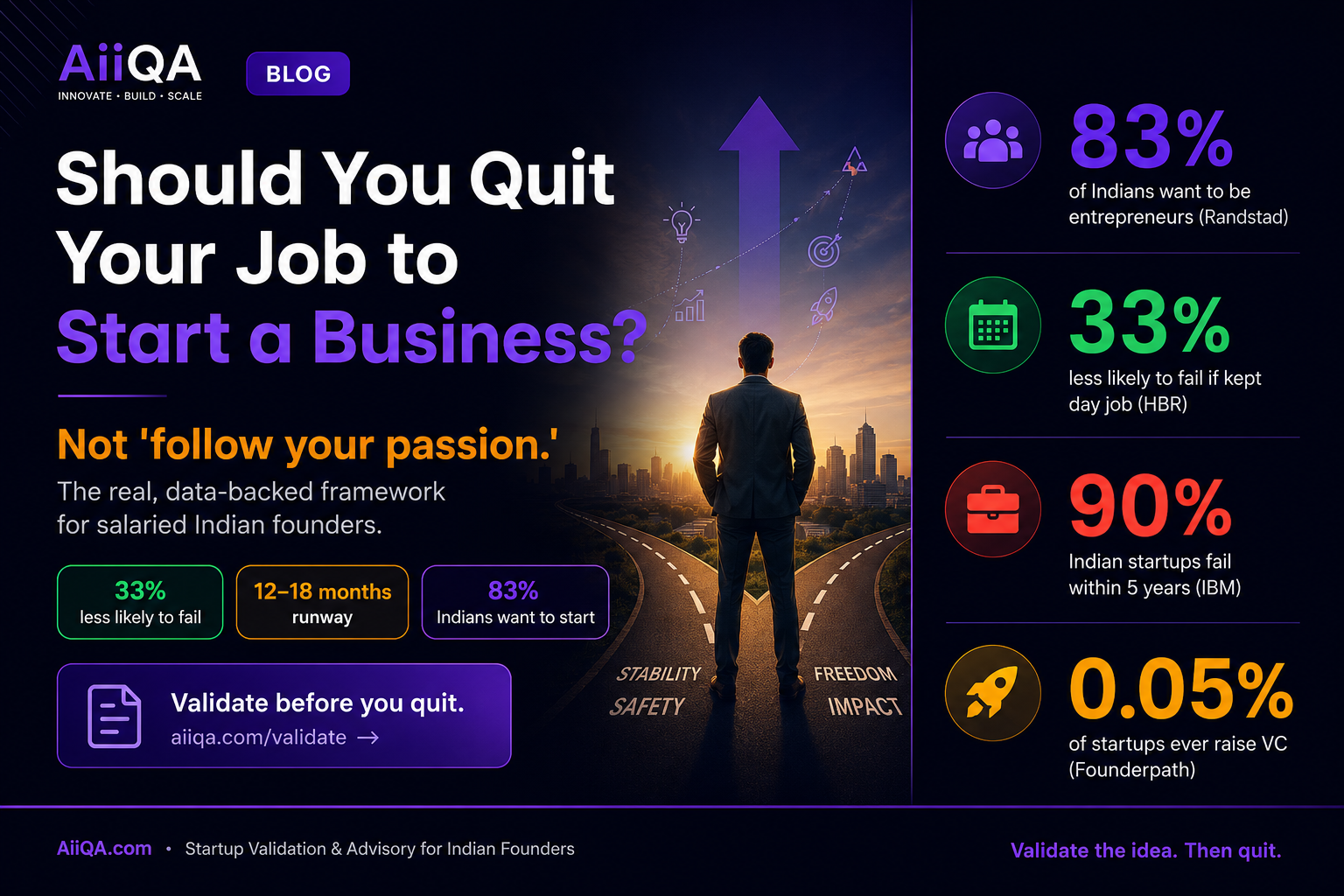
83% of Indian employees want to be entrepreneurs — the highest proportion of any country surveyed globally, against a 53% global average, per Randstad's workforce research. That number is not surprising to anyone who has spent time in India's startup ecosystem.
What is surprising is how badly most of the advice on this question is calibrated for the Indian founder's actual situation.
"Follow your passion." "Take the leap." "You'll regret not trying." This advice was written by people who either had unlimited savings, no family financial obligations, American-style unemployment benefits, or the kind of social environment that treats startup failure as a résumé credential rather than a family conversation.
Indian founders have none of those buffers. And they need a different framework.
This article gives you one — data-backed, India-calibrated, and honest about the costs of both paths.
The key statistics before you decide
- 83% of Indian employees want to be entrepreneurs — highest globally (Randstad)
- 90% of Indian startups fail within 5 years (IBM)
- 33% less likely to fail — founders who kept their day job while launching (Harvard Business Review)
- 40%+ of new entrepreneurs in 2025 launched while still employed
- 0.05% of startups ever raise venture capital (Founderpath)
- 12–18 months — realistic personal expense runway needed, not the 6 months most advice suggests
First: The Advice You've Been Given Is Wrong
"Follow your passion" is not a business strategy. It is a motivational poster pretending to be financial planning.
Passion does not validate market demand. Passion does not confirm that a paying customer exists. Passion does not cover your EMI when month seven of your startup has ₹0 in revenue and ₹3.5 lakh in expenses remaining.
The romanticised narrative — quit dramatically, work 20-hour days, fail and learn, succeed eventually — was built on a very specific set of conditions. A social safety net that catches you if it fails. An investor ecosystem that writes cheques on ideas. A culture that actively respects "I tried and it didn't work." A family situation that doesn't depend on your monthly salary.
None of those conditions exist in the same form for the salaried Indian professional thinking about this decision.
The average Indian founder faces: parents who depend on monthly contributions. A home loan EMI with a co-applicant spouse. No unemployment benefit if the startup fails. A social environment where "I tried a startup and it didn't work" is not always a neutral statement at the family dinner table. And a startup success rate where 90% of ventures fail within 5 years.
This does not mean don't start. It means start differently from how the advice tells you to.
The Data That Actually Matters
Entrepreneurs who kept their day jobs while launching their ventures were 33% less likely to fail than those who quit immediately, according to Harvard Business Review research on hybrid entrepreneurship. More than 40% of new entrepreneurs in 2025 launched their businesses while still employed.
This isn't about lacking conviction. It's about using your employment income strategically — as the funding mechanism for your early startup experiments, rather than treating it as the obstacle to be removed.
The romantic version of the quit story hides an uncomfortable arithmetic. Only 0.05% of startups ever raise venture capital, per Founderpath's analysis. Personal savings are the most common funding source for new companies. When you quit, you are not walking toward a funding round. You are walking toward a period — often 12 to 18 months — where your savings account is the investor, your salary was the last cheque, and every month of zero revenue is a month of runway consumed.
The question is not "am I brave enough to quit?" The question is "can my balance sheet survive my learning curve?"
⚠️ The number most people get wrong: Most advice says save 6 months of expenses before quitting. The realistic number for a first-time founder in India is 12 to 18 months — because your first idea probably isn't the one that works. You need runway for the pivot, not just the launch. And Indian founders have additional financial obligations the 6-month figure never accounts for.
5 India-Specific Risks the Generic Framework Ignores
The Indian founder's risk profile differs from the Silicon Valley blueprint in five specific, concrete ways. Each one changes the decision calculus.
Risk 1: The joint family financial obligation
Many Indian professionals — particularly those who are first-generation earners in their families — carry financial obligations that have no equivalent in the Western startup advice universe. Parents who depend on monthly contributions. Siblings whose education you're partly funding. A household where your salary is genuinely structural, not optional.
This is not a reason not to start. It is a reason to be precise about how much runway you actually have — which is your personal savings minus the ongoing obligations you cannot defer, not just your personal expenses.
Risk 2: The health insurance gap
In India, employer-provided health insurance typically covers the employee, spouse, children, and often parents. The moment you resign, that cover ends — usually on the last working day. A CFP who advises entrepreneurs describes this as the most consistently overlooked financial risk: someone resigns excited about a new venture, and then faces a medical event weeks later with no cover and unexpected expenses that destroy their runway.
Before you quit: purchase personal health insurance covering yourself and any dependents currently on your employer's policy. Budget ₹15,000–₹50,000 per year depending on family size and coverage. This is not optional. It is the bridge between two coverage situations that most founders only think about after they've already crossed.
Risk 3: The tax structure change
As a salaried employee, your employer deducted TDS automatically. As a self-employed founder, you become responsible for advance tax in four instalments — June 15, September 15, December 15, March 15. Miss them and pay 1% per month interest under Section 234B/234C. Your CA fees, rent (up to 30% if working from home), internet, phone, travel, and professional subscriptions become deductible — but only if you track and claim them correctly.
This is manageable. But it requires a CA who understands founder taxation before you resign, not after.
Risk 4: The EMI timeline
A home loan EMI doesn't pause while you find product-market fit. If you have a ₹40,000/month home loan EMI and you're burning through personal savings, your 18-month runway becomes an 8-month runway the moment you exclude non-negotiable obligations from the calculation.
Run the real number. Monthly expenses + EMI + insurance + family obligations = actual monthly burn. Divide your savings by that number. That is your real runway.
Risk 5: The social cost of visible failure in India
This risk is real, it is India-specific, and most advice pretends it doesn't exist because acknowledging it feels uncomfortable.
In many Indian families and professional networks, a startup that doesn't work is not received as "you learned something valuable." It receives a different interpretation — particularly if you left a good job to pursue it. That social pressure is not irrational. It reflects genuine concern from people who care about you. But it creates a form of psychological risk that compounds the financial one.
The way to reduce this risk is not to quit more dramatically. It is to quit with more evidence — evidence that the idea is validated, that paying customers exist, and that you are leaving toward an opportunity rather than away from a job.
The 6-Question Decision Framework
Stop asking "should I quit?" Start answering these six questions with data, not feeling.
| Question | The honest answer needed | What the answer tells you |
|---|---|---|
| 1. Have strangers paid you for this yet? | Not friends. Not family. Not "there's definitely demand." Actual cash from someone who found you without you begging them. | If yes — you have validated demand. If no — you have an assumption, not a business. |
| 2. What is your real runway? | (Total savings) ÷ (Monthly expenses + EMI + insurance + family obligations). Not total savings ÷ personal expenses. | If runway < 12 months — don't quit yet. Build the runway first. If 12–18 months — proceed with validated idea only. |
| 3. Are you running toward something or away from something? | Honest answer. A bad boss, a toxic workplace, burnout — these are valid reasons to leave a job. They are not reasons to start a business. | Running away → fix the job situation first. Running toward a specific validated opportunity → proceed. |
| 4. What is the cost of delaying by 6 months? | If you stay employed for 6 more months, do you lose a specific market window? Or does the opportunity exist regardless? | If no genuine time pressure → stay employed, validate, build runway. If real window is closing → quantify the cost vs the risk. |
| 5. Can this be meaningfully tested without quitting? | Most businesses have a smaller, testable core — a concierge version, a manual pilot, a pre-sale, a WhatsApp group of paying customers. | If you can test the hypothesis in evenings and weekends → test before quitting. If fulltime is genuinely required to even test → question why. |
| 6. Have you told your family the real plan — including the failure scenario? | Not the optimistic version. The realistic version: "If this doesn't work in 18 months, here is what happens." | If you can't say this out loud to the people affected by the decision — you haven't made the decision yet. You've made a wish. |
The Three Paths — Which One Is Right for You
There are three ways to make the transition from employment to entrepreneurship. They are not equally risky, and they are not appropriate for every situation.
Path 1: Side hustle first, then quit (recommended for most)
This is the path that Harvard Business Review data validates. More than 40% of entrepreneurs who launched in 2025 did it this way. Build the business in evenings and weekends. Get your first paying customer while still employed. Get your second. Get your third. When the side income is substantial enough to reduce the financial risk — or when the opportunity cost of staying employed clearly exceeds the risk of quitting — make the move.
This path is not for people who want a dramatic story. It is for people who want a business that survives.
The specific threshold: when your side hustle generates 30–50% of your monthly salary consistently for 2–3 months, you have market validation and partial financial cushion. That is the moment to evaluate a transition — not month one, when you have only an idea.
Path 2: Quit and build (high risk, specific conditions required)
Quitting cold turkey to build fulltime is not inherently wrong. It is appropriate under very specific conditions that most people advising you to "just take the leap" never specify.
Conditions that justify quitting before building
- Validated demand: Paying customers already exist — not just interested conversations
- Real runway: 18+ months of personal expenses saved, accounting for all obligations
- Market window: A specific, time-limited opportunity that genuinely closes if you wait
- Domain expertise: You have a specific insight into this market that employed competitors cannot easily replicate
- Health insurance: Personal policy purchased before resignation takes effect
- Family alignment: Everyone affected by the decision has heard the failure scenario and accepts the risk
If all six conditions are met — quit and build. If any one is missing — do not quit yet. Stay employed, address the missing condition, then revisit.
Path 3: The funded quit (small round, accelerator, or grant first)
A third path that is underused in India: securing a small amount of external validation — an accelerator acceptance, a grant, an angel cheque, a customer prepayment — before resigning.
An accelerator acceptance (Y Combinator, Surge, Antler India, 100X.VC, IAN) provides three things simultaneously: a stipend or small investment that partially addresses runway, external validation that reduces the social cost of the quit, and a structured programme that accelerates execution.
A customer who pays in advance — a B2B client who commits ₹5 lakh for a pilot — is funding the first stage of your company. That prepayment, structured correctly, buys you 3–4 months of full-time focus without consuming personal savings.
This path requires more setup before the quit. It also dramatically reduces the risk of the quit.
The Financial Readiness Checklist
Before quitting any salaried job to start a business in India, verify every item in this list — not most of them, every one.
| Checklist item | Minimum threshold | Why it matters |
|---|---|---|
| Personal expense runway | 18 months of all expenses including obligations | First idea usually isn't the one that works. You need time for iteration. |
| EMI and debt obligations | 18 months of EMIs covered in savings, or EMI paused/transferred | EMIs don't respect your growth stage. Missing them damages credit and adds stress. |
| Health insurance | Personal policy active from the date of resignation | Employer cover ends on last working day. The gap is a serious financial risk. |
| Family financial obligations | 12 months of parent/family contributions covered in savings | These obligations don't stop during the startup phase. They must be in the runway calculation. |
| Business capital | Separate from personal runway — enough to actually build the MVP | Don't consume personal runway for business expenses. They need to be different pots. |
| CA empanelled for self-employment taxation | Engaged before resignation | Advance tax instalments, GST registration (if applicable), deduction planning. |
| Emergency fund (separate from runway) | 3 months of expenses — completely liquid, not to be touched | Startups generate unexpected costs. The emergency fund is not the runway. It's the floor. |
| Notice period plan | 2–3 months notice used productively | Notice period is paid time to set up legal entity, open business accounts, register GST, and line up first customer. |
What You Must Validate Before You Quit
This is the section of most "quit your job" articles that is missing entirely. And it is the section most relevant to whether the business you're quitting for will exist in two years.
The decision to quit your job is a financial decision. The decision about what to build is a market decision. They are not the same decision. Most founders confuse them and make both at the same time — leaving a job to pursue an idea they haven't tested, spending their runway discovering that the idea was wrong, and running out of both money and time simultaneously.
The sequence that works is different:
- Validate the idea while employed. Before you resign, confirm that paying customers exist, that the problem is real and painful, that your specific solution is what they'd choose, and that the unit economics work at Indian price points.
- Build the minimum proof of concept as a side project. One paying customer from a side project while you're employed is worth more than 100 slide deck meetings after you've quit.
- Build the financial runway explicitly. With validation data in hand, build the savings, set up the tax infrastructure, purchase the health insurance.
- Then quit — toward evidence, not toward hope.
The validation step answers five questions that determine whether your startup has a real foundation or an expensive hypothesis:
- Is the problem real and painful enough that people actively seek solutions today?
- Who specifically experiences this problem — and can you name 20 of them?
- What are they currently doing to solve it, and why is that solution inadequate?
- Will they pay for your solution at a price that makes the unit economics work?
- Is the market large enough to build the business you're imagining?
These are answerable questions. They have data-based answers, not gut-feeling answers. And getting those answers while still employed — before your personal savings are on the line — is the most important investment you can make in your startup's survival.
At AiiQA, this is precisely what the startup validation report delivers: AI-powered market analysis, competitor mapping, customer segmentation, viability scoring, and a step-by-step MVP roadmap — all designed to answer whether your specific idea, in your specific market, at your specific price point, has a genuine path to being a real business.
The founders who validate before quitting don't eliminate risk. They enter the market knowing what they're testing, for whom, at what price — and with the confidence that the evidence supports the decision they're about to make.
Validate your idea before you resign — not after.
AiiQA's startup validation report gives you AI-powered market analysis, competitor intelligence, customer willingness-to-pay research, viability scoring, and a step-by-step MVP roadmap. Designed for Indian founders who want to know the idea is real before their salary stops arriving.
Validate Your Startup Idea with AiiQA — Before You Quit →
The Green Lights: When It Is Actually Time to Quit
Everything above is calibration for caution. Here are the signals that tell you the moment is genuinely right — not just emotionally compelling.
- Strangers are paying you. Not friends. Not family. Not "I'd definitely buy this." Real cash from people who found you without being recruited by you.
- Your job is actively costing the startup. You're turning down customer meetings because of work commitments. You're missing critical deadlines because you only have evenings. The opportunity cost of staying is demonstrably higher than the financial risk of leaving.
- Your runway calculation is honest and above 12 months. You've run the real number — with EMI, family obligations, health insurance, business capital — and you have 12 to 18 months.
- You can name your first 10 customers. Not demographics. Actual names of actual people or companies who have expressed willingness to pay and whose problem you've verified in conversation.
- Your family has heard the failure scenario and said yes. The real plan — including what happens if it doesn't work — has been spoken out loud to everyone affected.
- You've done the legal setup during your notice period. Company incorporated, bank account open, GST registered if applicable, CA empanelled. The business infrastructure exists before the last working day.
When these six signals are all present, the quit is not a leap of faith. It is a calculated transition from employed experimentation to fulltime execution on a validated opportunity.
That is a very different decision from "I have this idea and I'm going to figure it out." And it has a very different probability of succeeding.
For more on how to structure the technology and team decisions that follow the quit, see: Build vs Buy vs No-Code vs AI: The Ultimate Startup Decision Guide for 2026.
For the co-founder question that typically follows: Co-founder or Solo Founder? The Honest Truth Nobody Tells You.
The Honest Closing
The people who tell you to "follow your passion" are not wrong that passion matters. They are wrong that passion is sufficient.
The people who tell you to "stay safe" are not wrong that the risks are real. They are wrong that the risks are unchangeable.
The actual question is not "should I quit or stay?" The actual question is: "What specific evidence would make this decision rational rather than emotional — and how do I get that evidence before I resign?"
In most cases, that evidence is:
- A validated idea with paying customers
- A real financial runway that accounts for Indian obligations honestly
- A family that has heard the full plan — including the downside
- A legal structure ready to receive the business you're about to build fulltime
The sequence matters. Validate first. Build the runway second. Quit third. Build fourth.
Founders who follow that sequence don't have more courage than founders who quit before they're ready. They have better timing. And in startups, timing and evidence are worth more than courage and hope.
"The most expensive startup mistake isn't building the wrong thing. It's quitting your job to build the wrong thing — and discovering it was wrong with your savings on the line." — Praveen Yadav, AiiQA Innovation Pvt. Ltd.
Start with what you know. Validate what you don't. Build the evidence that makes the quit decision clear — before the quit decision is irreversible.
For the pivot signals to watch once you've launched, see: When Should a Startup Pivot? The Signs Most Founders Miss.
For what typically kills startups after the launch, see: Why Most Startups Fail: 17 Common Mistakes Every Founder Should Avoid.
The idea comes before the quit. The validation comes before the idea becomes real.
AiiQA's startup validation report gives Indian founders AI-powered market sizing, competitor intelligence, customer willingness-to-pay research, viability scoring, and a complete MVP roadmap — built to answer whether your idea is worth the risk of your salary, before you stop receiving it.
Validate Your Startup Idea Before You Quit →
Validate what you're building.
Get your free viability score, top risks, and honest verdict — in 3 minutes.
Get my free verdict
Praveen Yadav