From $22 billion to zero. A forensic breakdown of Byju's collapse — 7 lessons on growth without retention, $2.5B in failed acquisitions, 22-month filing delay, and what every founder must know before building.
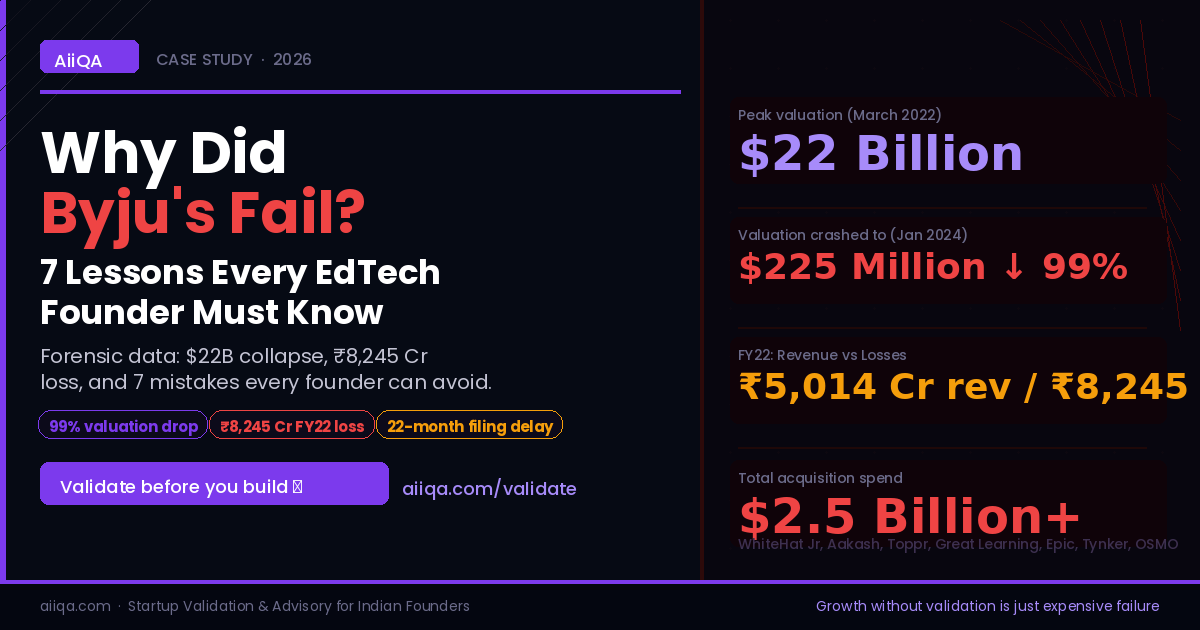
In March 2022, Byju's was valued at $22 billion.
It had 150 million registered users. 58,000 employees across 170 countries. Lionel Messi as a brand ambassador. Shah Rukh Khan on billboards. A jersey sponsorship on the Indian cricket team. And a founder who filled stadiums — not for concerts, but for mathematics.
By January 2024, the valuation had crashed to $225 million. A 99% decline in less than two years.
By October 2024, Byju's was defunct. Zero employees. Think & Learn, its parent company, entered insolvency proceedings. Prosus wrote its 9.6% stake to zero. BlackRock wrote its stake to zero. Investors who put money in at $22 billion got nothing back.
The founder, Byju Raveendran — a teacher from a small village in Kerala who had turned a coaching class into the world's most valuable edtech company — was ordered by a US bankruptcy court to pay $1.07 billion. Personally.
This is not just the story of one company's collapse. It is the most expensive startup case study in Indian history. And every founder building in education, consumer tech, or any category where pandemic growth felt like product-market fit needs to read it carefully.
The Numbers, First
Before the lessons, the forensic record. These are not opinions. These are the audited and reported figures.
| Year / Event | What Happened | The Number |
|---|---|---|
| FY2021 — Revenue | Operating revenue during pandemic boom | ₹2,280 crore |
| FY2021 — Expenses | What was spent to generate that revenue | ₹7,027 crore |
| FY2021 — Net Loss | The actual result | ₹4,588 crore loss |
| FY2022 — Revenue | Revenue doubled year-on-year | ₹5,014 crore |
| FY2022 — Net Loss | Losses grew faster than revenue | ₹8,245 crore loss |
| FY22 filing delay | When these numbers were made public | 22 months after the financial year ended |
| Marketing spend | Share of revenue spent on marketing | 69% of operating revenue |
| Acquisition spend | Total spent acquiring other companies | Over $2.5 billion (2020–2022) |
| WhiteHat Jr + OSMO losses | Two acquisitions' share of FY22 losses | 45% of total losses |
| Term loan | Debt raised in 2021 to fund acquisitions | $1.2 billion |
| FEMA violations | Enforcement Directorate accusation, 2023 | ₹9,000 crore alleged violations |
| Peak valuation (March 2022) | What investors were willing to value it at | $22 billion |
| Valuation (January 2024) | What investors revised it to | $225 million (99% decline) |
| Trustpilot rating (2023) | What customers thought of the product | 1.3 out of 5 |
Read that table carefully. Every row is a lesson. Together, they describe a company that was spending three times what it earned, hiding the evidence for twenty-two months, and calling it growth.
Lesson 1: Pandemic Growth Is Not Product-Market Fit
Between 2020 and 2022, Byju's grew explosively. Schools shut. Parents panicked. Students needed structure. Byju's had a product, a brand, and a distribution infrastructure.
Millions of families signed up — many for the first time, many under pressure, and many with every intention of cancelling when schools reopened.
And that is exactly what happened.
When schools reopened in 2022 and 2023, edtech platforms across India faced the same cliff. Unacademy — valued at $3.4 billion in 2021 — cut over 2,000 jobs through 2022 and 2023. Multiple smaller edtech startups shut entirely.
The pandemic forced trial. It did not build habit. It did not prove that students learned better, faster, or more affordably on Byju's than on any alternative. It proved that when people have no other option, they use whatever is available.
That is not product-market fit. That is captive demand.
The mistake Byju's made — and the mistake any startup that grows in a forced-adoption environment can make — was treating acquisition metrics as validation. 150 million registered users looked like confirmation. The question the company didn't answer rigorously was: how many of those users would pay, retain, and refer — if they had a genuine alternative?
That answer, when the alternatives returned, was not 150 million.
⚠️ The founder test: Before scaling on a growth wave, ask — would these customers pay and stay if the conditions that brought them to us disappeared tomorrow? If you cannot answer yes with data, the growth is circumstantial, not structural.
Lesson 2: Revenue Without Retention Is a Countdown Timer
Byju's FY22 revenue was ₹5,014 crore — a 119% increase year-on-year. That number looked extraordinary.
But the losses were ₹8,245 crore. The company was spending ₹1.64 for every ₹1 it earned.
The explanation for this arithmetic is revenue recognition: Byju's recognised multi-year course fees upfront, as a single annual figure. The actual user experience — whether students completed the courses, learned from them, renewed, or referred — was not visible in the reported numbers.
What was visible: by 2023, Byju's Trustpilot rating had fallen to 1.3 out of 5. Complaints centred on refund denials, aggressive sales calls, and courses that did not deliver on their promises. Customers who had paid were not happy customers.
Revenue that is not backed by genuine product satisfaction does not renew. It does not refer. It does not create word of mouth. And in education specifically — where the product is supposed to demonstrably improve outcomes — it actively creates the opposite: parents who warn other parents.
The lesson: revenue is the beginning of the analysis, not the end. The question is not "how much did we collect?" It is "how many of those customers would pay again, and why?"
Lesson 3: $2.5 Billion in Acquisitions Cannot Buy Product-Market Fit
Between 2020 and 2022, Byju's went on the most aggressive acquisition spree in Indian startup history.
WhiteHat Jr — ₹2,500+ crore ($300 million). Aakash Educational Services — approximately $1 billion. Great Learning. Toppr. Tynker. Epic. OSMO — $120 million. GradeUp. GeoGebra.
Total acquisition spend: over $2.5 billion. Much of it funded by the $1.2 billion term loan raised in 2021.
Not one of these acquisitions was cleanly integrated. Not one generated the synergies promised. WhiteHat Jr and OSMO alone contributed 45% of FY22's ₹8,245 crore losses.
WhiteHat Jr became its own crisis — a product later found to have made misleading claims about outcomes, generating significant regulatory and reputational damage. Aakash, the one exception with genuine brand value and classroom infrastructure, was largely left to operate independently.
The acquisition strategy revealed a fundamental misunderstanding of what acquisitions are for. They are not a substitute for building product-market fit. They are an accelerator for a business that already has it. Byju's was trying to buy the traction it had not earned organically.
And it was doing this with borrowed money, at a time when interest rates were at historic lows — and about to rise.
Lesson 4: When CAC Exceeds LTV, Marketing Spend Is Destruction
Byju's spent 69% of its operating revenue on marketing.
Shah Rukh Khan: ₹4 crore per year, from 2017 to 2023. Lionel Messi: $5–7 million annually for the social impact arm. Indian cricket team jersey sponsorship: ₹4.6 crore per bilateral match. FIFA World Cup sponsorship. IPL visibility.
The marketing worked, in the narrow sense: millions of people knew the Byju's name. Brand awareness was among the highest of any Indian startup.
But brand awareness is not customer acquisition. Customer acquisition is not customer retention. And customer retention is the only number that makes the unit economics of a subscription education product work.
The brutal reality: Byju's customer acquisition costs exceeded the lifetime value of its average customer. When CAC is higher than LTV, every new customer you acquire destroys value. More marketing spend does not fix this. It accelerates the destruction.
Spending 69% of revenue on marketing while losing ₹8,245 crore is not ambition. It is evidence of a business model that does not work — dressed in celebrity endorsements.
Lesson 5: Aggressive Sales Is a Signal, Not a Strategy
Byju's sales tactics became one of the most documented and discussed corporate scandals in Indian startup history.
Sales teams were trained to target parents during school holidays when anxiety about children's education was highest. Sessions ran for hours. EMI options were presented as "free" when they were not. Refund requests were denied or made deliberately difficult. Families from lower-income backgrounds were pressured into purchases they could not afford.
This was not an isolated incident or a rogue team. It was a systematic approach to customer acquisition — optimised for conversion, not for customer satisfaction.
The consequences were predictable. A Trustpilot rating of 1.3 out of 5. Hundreds of consumer forum complaints. Social media campaigns from parents. Regulatory scrutiny. A brand that had spent billions on celebrity endorsements being publicly associated with predatory selling.
Here is the signal buried in this story: companies resort to aggressive, high-pressure sales tactics when the product cannot sell itself. When a customer genuinely experiences value, they don't need to be pressured into buying. They come back. They refer others. The sales process is easy because the product has already done the selling.
Aggressive sales is not a distribution strategy. It is a symptom of missing product-market fit — hidden behind a conversion metric.
Lesson 6: Governance Is the Foundation, Not a Formality
In January 2024 — twenty-two months after the financial year ended — Byju's filed its FY22 audited results.
Twenty-two months.
Listed companies in India are required to file within six months. Byju's, though private, had made commitments to lenders and investors that depended on timely disclosure. The delay was not administrative. It was a governance failure of historic proportions.
Before those numbers were finally revealed, Deloitte — one of the world's largest audit firms — resigned as Byju's auditor. Three board members resigned. BDO, the firm that eventually filed the results, raised a "material uncertainty" flag about the company's ability to continue as a going concern.
In October 2023, India's Enforcement Directorate accused Byju's of FEMA violations totalling ₹9,000 crore. In 2023, the company defaulted on a $40 million interest payment on its $1.2 billion term loan. Goldman Sachs and other lenders sued.
Investors who had committed capital at $22 billion could not get basic financial information. When they finally got it, it showed a company losing ₹8,245 crore on ₹5,014 crore of revenue.
Governance is not paperwork. It is the mechanism that gives investors, lenders, and customers confidence that the numbers mean what they say. When governance fails, everything else follows — because nobody can trust anything the company says.
Prosus, Byju's largest external investor, eventually wrote its 9.6% stake to zero. Not because the market changed. Because the company could not be trusted.
Lesson 7: Debt Raised in Good Times Must Be Survived Through Bad Ones
In 2021, Byju's raised a $1.2 billion term loan — the largest unrated loan ever taken by an Indian startup — from overseas investors when global interest rates were near historic lows. The capital was used to fund the acquisition spree.
By 2022, global interest rates rose sharply. The cost of servicing $1.2 billion in debt increased materially. The acquisitions that were supposed to generate synergies were generating losses instead. Revenue was being recognised upfront but not renewed. The post-pandemic demand normalisation was reducing inflows.
The term loan became unserviceable. In June 2023, Byju's missed a $40 million interest payment. Lenders sued in Singapore courts and US courts. A court-appointed agent eventually took control of certain US-based assets.
The lesson is not that debt is bad. The lesson is that debt taken to fund unvalidated growth — acquisitions made for scale rather than synergy, marketing spend that exceeds LTV, a burn rate justified by a pandemic-era growth curve that was never going to sustain — becomes fatal when market conditions change.
Capital is not a strategy. It is a resource. And resources deployed against a broken model run out faster than resources deployed against one that works.
The Company That Did It Right: PhysicsWallah
While Byju's burned, another Indian edtech company was quietly doing the opposite of everything Byju's did.
Alakh Pandey started PhysicsWallah as a YouTube channel, teaching JEE and NEET preparation in Hindi for students who couldn't afford Kota coaching fees. The product was free. The value was real. Students came because the teaching worked — not because they were sold to.
When PhysicsWallah launched its paid platform, it priced it affordably — specifically targeting the student who needed preparation but couldn't pay Byju's prices. Retention was high because the value proposition was honest: affordable, effective exam preparation that students could actually use.
In 2022, PhysicsWallah raised $100 million and achieved unicorn status. In 2024, the company pursued an IPO at a $5.2 billion valuation — profitable, disciplined, and growing from genuine product retention rather than marketed acquisition.
The contrast is complete. Same category. Same Indian student market. Opposite outcomes.
The difference was not ambition. Byju Raveendran was deeply ambitious. The difference was validation — building a product that delivered genuine learning outcomes at a price that the actual Indian student could afford and sustain, rather than a premium product sold aggressively to families who often couldn't.
What Indian EdTech Looks Like After Byju's
The sector is recovering. But it is recovering on different terms.
The direct-to-consumer online K-12 market in India is estimated at approximately $2–3 billion in actual captured revenue — against the $90 billion+ figures that were being cited at Byju's peak. The total addressable market was always real. The willingness to pay premium prices for digitally-delivered education, at the scale Byju's needed to justify its valuation, was not.
The investors who have returned to Indian edtech in 2025 and 2026 have returned with a different checklist. Not MAU. Not registered users. Not revenue figures that include multi-year upfront payments from pressured customers. They are asking about cohort retention, verified learning outcomes, and unit economics that work at sustainable price points for Indian families.
Those are the right questions. They are just the same questions that should have been asked at $22 billion.
What Byju's Means for Every Founder, Not Just EdTech
The Byju's story is not specific to education. It is a case study in the most common startup failure mode, scaled to an extraordinary size.
It is the story of a company that mistook a forced-adoption moment for product-market fit. That confused revenue growth with business model validation. That spent on marketing when it should have been validating unit economics. That acquired when it should have been retaining. That delayed governance when governance was the only thing that could have saved investor trust.
At AiiQA, the founders who come to us after building for six months without traction are not unlike Byju's in structure — they built before they validated, they confused acquisition metrics for retention metrics, and they are now asking the questions they should have asked before the first rupee was spent.
The difference is scale. And the difference between Byju's scale of error and an early-stage founder's scale of error is one thing: how much capital was available to sustain the mistake before reality arrived.
Byju's had $22 billion worth of investor patience. Most founders have a runway of 12 to 18 months.
That means most founders don't have the luxury of learning these lessons the expensive way. They have to learn them before they build.
Before you build, validate the fundamentals Byju's never validated at scale.
AiiQA's startup validation report answers the questions that matter before you spend a rupee on development, marketing, or hiring: Is the demand real? Will they pay at this price? Will they stay? Who are the competitors, and what's your actual differentiation?
Validate Your Startup Before You Build →
The Honest Summary
Byju's was not destroyed by bad luck.
It was not destroyed by the pandemic ending, or by rising interest rates, or by aggressive lenders, or by an unfair press.
It was destroyed by a systematic, sustained choice to optimise for the appearance of success rather than the substance of it. To report revenue before validating retention. To acquire before integrating. To market before the product could justify the marketing. To file financial statements twenty-two months late rather than face the conversation the numbers would have started.
Every one of those choices was made by someone. And every one of those choices had a corresponding moment where a different choice was available.
The seven lessons in this article are simply those moments, named clearly enough that the next founder can recognise them before they make the same choice.
The most expensive lesson in Indian startup history is now available for free. The only question is whether the next generation of founders will read it.
Build on evidence. Not on assumptions that look like traction.
AiiQA's validation report gives founders AI-powered market analysis, honest competitive intelligence, real viability scoring, and a unit-economics-first MVP roadmap — before a single rupee is committed to development, marketing, or hiring.
Validate Your Startup Idea with AiiQA →
Validate what you're building.
Get your free viability score, top risks, and honest verdict — in 3 minutes.
Get my free verdict
Praveen Yadav