Top 10 EdTech companies, college discovery platforms (CollegeDekho, CollegeDunia, Shiksha, Career360), 7 sector gaps, and the real opportunities for EdTech founders in India in 2026.
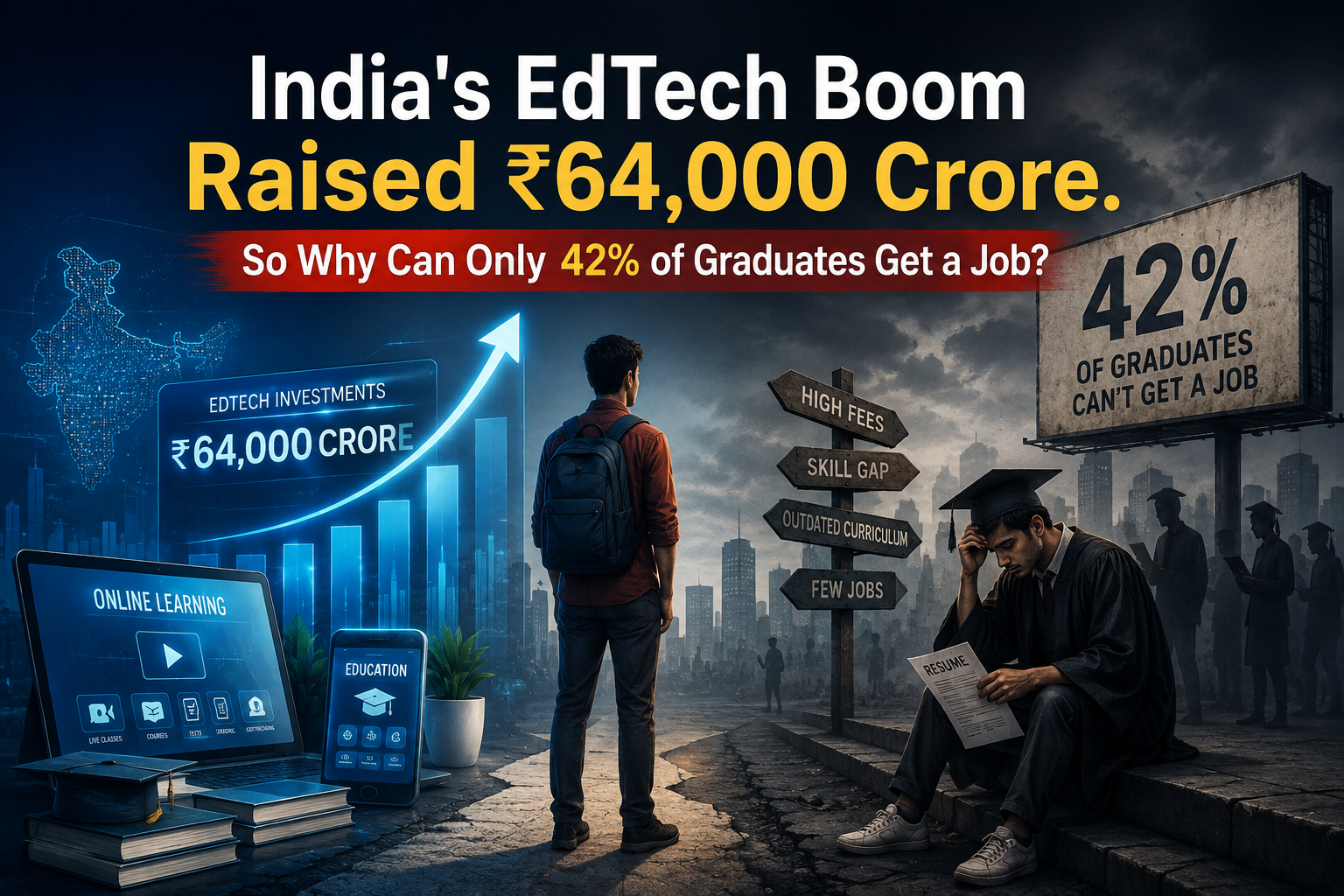
India's EdTech sector is worth ₹64,875 crore as of 2026, according to IAMAI and Grant Thornton Bharat. It is projected to reach $29 billion by 2030. It has produced 10 unicorns, attracted investment from Sequoia Capital, Tiger Global, and Tencent, and reached hundreds of millions of registered learners.
And only 42.6% of Indian graduates are actually employable — a figure from the India Graduate Skills Index 2026.
That gap — between the scale of EdTech investment and the poverty of graduate outcomes — is the most important story in Indian education right now. It is also the clearest signal of where the real startup opportunities lie.
This analysis, based on AiiQA's work with 500+ early-stage Indian founders and publicly available sector data through August 2026, maps the complete EdTech landscape: who is winning, who collapsed, how the four college discovery platforms actually make money, and the seven specific problems that ₹64,000 crore has not yet solved.
Sector snapshot — India EdTech 2026
India's EdTech market is the world's second-largest, valued at ₹64,875 crore ($7.5 billion) in 2026 and projected to reach $29 billion by 2030. As of August 2026, the sector has produced 10 unicorns, including PhysicsWallah, upGrad, and Unacademy. The direct-to-consumer K-12 segment is estimated at $2–3 billion — significantly below the $90+ billion figures cited during the 2020–22 venture capital boom. Only 16.67% of Indian institutions achieve strong graduate placement outcomes, per TeamLease EdTech (2026).
The ₹64,000 Crore Contradiction
India's EdTech investment did not fail to reach students. It failed to make them employable. The India Graduate Skills Index 2026 found that only 42.6% of Indian graduates meet employer skill requirements. The India Skills Report 2026 (jointly produced by ETS, CII, AICTE, and AIU across 100,000+ candidates) puts overall employability at 56.35% — an improvement from 54.81%, but still evidence that the majority of India's graduates are entering the workforce inadequately prepared.
The reason this happened despite a decade of EdTech growth is structural, not accidental.
The largest EdTech platforms are optimised for acquisition metrics — registered users, app downloads, revenue booked upfront — rather than for learning outcomes. When you measure success by how many students signed up rather than how many students got jobs, you build a very different product.
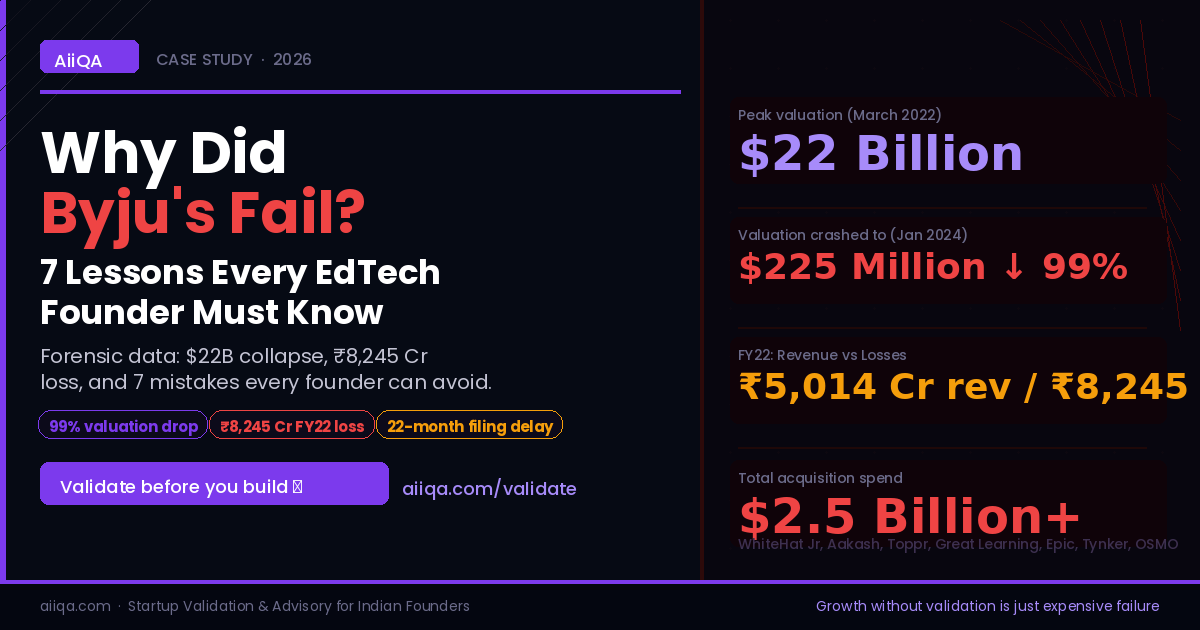
BYJU's — India's most funded EdTech company — is the most extreme example of this misalignment. At its peak, it had 150 million registered users and a $22 billion valuation. By October 2024, it was defunct, with insolvency proceedings underway and its founder ordered by a US bankruptcy court to pay $1.07 billion personally. A forensic breakdown of every financial decision that led to that outcome is available in our analysis: Why Did Byju's Fail? 7 Lessons Every EdTech Founder Must Know.
The correction has forced a reckoning. As of 2026, investors examine revenue quality, learner retention, placement outcomes, and hybrid delivery models before committing capital. The growth-at-all-costs era in Indian EdTech is definitively over.
💡 The metric that matters now: TeamLease EdTech's 2026 report found that fewer than 16.67% of Indian colleges achieve what it defines as strong placement outcomes — more than 75% of students placed within six months of graduation. Content access is no longer the constraint. Guidance, skill relevance, and employer alignment are.
Top 10 EdTech Companies in India Ranked (2026)
The top EdTech companies in India as of 2026 are PhysicsWallah, upGrad, Unacademy, Great Learning, Simplilearn, Vedantu, Eruditus, Aakash/Allen Digital, Coursera (post-Udemy merger), and — as a cautionary reference — BYJU's. Rankings reflect current operational status, revenue, and market influence rather than historical valuation peaks.
| Rank | Company | Segment | 2026 status | Why it matters |
|---|---|---|---|---|
| 1 | PhysicsWallah | K-12, JEE, NEET | IPO Nov 2025 · $3.36B · ₹1,082 Cr Q3 FY26 | Proved affordable + hybrid + outcomes beats expensive + online-only |
| 2 | upGrad | Professional upskilling | Unicorn · $1.2B+ · 14M learners | Career-outcome-linked degrees and programs at ₹50K–₹5L |
| 3 | Eruditus | Executive education | $3.2B valuation · Global | Harvard/MIT/ISB credentials at ₹2–15L — premium that delivers ROI |
| 4 | Aakash / Allen Digital | JEE/NEET test prep | Profitable · Hybrid dominant | 30+ year brand trust + physical classroom anchor |
| 5 | Great Learning | Post-grad professional | Under upGrad · 4,500+ employers | Stanford/MIT tie-ups + employer network = placement credibility |
| 6 | Simplilearn | Tech certification | ₹556 Cr FY25 · GSV 150 list | Pivoting to sustainability — losses cut alongside revenue correction |
| 7 | Coursera + Udemy | Global skills platform | 290M learners · +9% YoY | B2B enterprise model outperforms B2C individual sales |
| 8 | Unacademy | Exam prep + K-12 | Restructuring · 2,000+ jobs cut | Squeezed by PW below and Aakash above — mid-market is the danger zone |
| 9 | Vedantu | Live K-12 tutoring | Unicorn status removed Jan 2024 | WAVE tech is strong — business model still finding footing |
| 10 | BYJU's | K-12 + test prep | Defunct — Oct 2024 | The cautionary reference every EdTech founder must study |
"The EdTech companies thriving in India in 2026 sit at one of two price extremes: ultra-affordable with genuine outcomes (PhysicsWallah at ₹999/year) or ultra-premium with validated credentials (Eruditus at ₹15 lakh per program). The expensive middle — premium pricing without demonstrated outcomes — is where the graveyard is." — Praveen Yadav, AiiQA Innovation
This bifurcation has a structural explanation. Per RAYSolute's Indian EdTech Market Analysis 2026, the top 10–15% of Indian households account for nearly 85% of organised EdTech revenue. Building a ₹1–5 lakh course and claiming "260 million students" as the addressable market is arithmetically false. PhysicsWallah's IPO success validated one truth that the BYJU's era tried to ignore: affordable products with proven learning outcomes are a far more durable Indian business than premium products sold through pressure tactics.
College Discovery Platforms: The Conflict Nobody Talks About
India's four major college discovery platforms — CollegeDunia, CollegeDekho, Shiksha, and Careers360 — operate primarily as lead generation businesses that earn from colleges, not from students. This creates a structural conflict: the student trusts the platform for guidance, but the platform's revenue depends on matching students with colleges that pay the most per lead, not colleges that best fit the student's goals.
How do these platforms actually make money
- CPL (Cost Per Lead): The college pays a fixed fee each time a student submits an inquiry. Platforms optimise listings to maximise inquiry volume from paying colleges.
- CPS (Cost Per Student): The college pays a commission each time a student enrolls through the platform. Creates an incentive to encourage enrollment at paying colleges regardless of student fit.
- Display advertising: Colleges pay for banner placements, featured listings, and sponsored content — creating paid visibility that students often cannot distinguish from organic rankings.
| Platform | Founded | Revenue model | FY25 financials | Who pays them | Trustworthiness for students |
|---|---|---|---|---|---|
| CollegeDunia | 2013 | CPL + CPS + display ads | ₹192 Cr revenue (FY24) · Profitable · Bootstrapped | Colleges (per lead + per admission) | Medium — student reviews are genuine, but listings favour paying colleges |
| CollegeDekho | 2015 | Admission commission + education loans + study abroad | ₹221.6 Cr revenue · ₹151 Cr loss (FY25) · $78M raised | Colleges + institutions + loan providers | Low-medium — multiple revenue streams from the same student create compounded conflict |
| Shiksha | 2008 | Pure lead generation (CPL) | Est. ₹60–70 Cr · InfoEdge-backed | Colleges exclusively | Low — pure CPL model, no independent ranking element |
| Careers360 | 2009 | Display advertising + subscriptions + independent content | Est. ₹50 Cr · Independent operations | Advertisers + subscribers | High rankings are independently researched, not purchased |
Careers360 is the partial exception. Its college rankings are independently researched — not purchased — which is precisely why it carries far higher editorial credibility than its traffic volume might suggest. The conflict between platform incentive and student interest is most acute at CollegeDekho, which simultaneously earns from colleges (admission commissions), from financial institutions (education loan referrals), and potentially from study abroad agencies. The student navigating this landscape rarely understands that every "recommendation" has a revenue dimension.
The consequence of this structural misalignment appears in the placement data. Per TeamLease EdTech 2026, fewer than one in six Indian colleges achieve strong graduate placement outcomes. Students are being guided — by well-funded, SEO-dominant platforms — toward colleges that paid for visibility, not colleges that deliver outcomes.
⚠️ What this means for students: When CollegeDekho or Shiksha shows you a "recommended" college, ask one question first: Does this platform earn a fee when I click, apply, or enroll at this college? The answer, in almost every case, is yes. Careers360's independently researched rankings are the closest thing the Indian market has to genuinely student-aligned guidance.
The Two EdTech Business Models That Actually Work
The EdTech business models generating sustainable revenue in India in 2026 are ultra-affordable subscriptions with genuine learning outcomes (the PhysicsWallah model) and ultra-premium employer-recognised credentials (the Eruditus and upGrad models). Everything between these two extremes — mid-market pricing without clear outcome linkage — is where platforms are structurally under pressure.
| Model | Example | Price range | What student pay for | Why it works |
|---|---|---|---|---|
| Ultra-affordable + hybrid + outcomes | PhysicsWallah, Aakash, Allen Digital | ₹999–₹50,000/yr | Exam results, rank improvement | The outcome is measurable (JEE/NEET rank). Affordable for the mass market. Hybrid delivers accountability. |
| Premium credential + employer recognition | Eruditus, Great Learning, upGrad | ₹50,000–₹15 lakh | Career transition, salary increase, credential | University brand (MIT/ISB) justifies the premium. The employer recognises the credential. ROI is calculable. |
| B2B enterprise subscription | Coursera, Udemy, Simplilearn | ₹5,000–₹2L per employee | Team upskilling, compliance training | Corporate buyer pays, not individual. Larger contracts. Lower CAC. Stickier relationships. |
| Mid-market subscription without outcome linkage | Unacademy, Vedantu (under pressure) | ₹5,000–₹80,000/yr | Video content + live classes | Squeezed by affordable alternatives below and outcome-linked premium above. Structurally challenged. |
This pattern mirrors what AiiQA observes across all consumer-facing Indian startups: the middle market is the most dangerous position in India. Too expensive to be the price-sensitive student's default. Too cheap to carry the credibility of premium. Unacademy's restructuring and Vedantu's valuation correction are both mid-market problems, not EdTech sector problems.
For a broader view of why India-specific pricing strategy differs fundamentally from Silicon Valley assumptions, see our analysis: India's Startup Ecosystem vs Silicon Valley: What Indian Founders Can Stop Copying.
6 EdTech Trends Reshaping India's Sector in 2026
The six most significant shifts in Indian EdTech as of 2026 are: AI-powered adaptive tutoring, vernacular-first content, phygital (hybrid) learning dominance, outcome-linked program models, B2B institutional sales, and employer co-designed micro-credentials.
1. AI tutoring is moving from a feature to a baseline expectation
PhysicsWallah's Alakh AI, Embibe (backed by Reliance), and a growing cohort of AI-native startups are deploying adaptive learning paths that personalise in real time. Research published by AIPRM in 2026 found that students using AI-powered instruction systems scored 62% higher on assessments. By 2027, a platform without an AI tutoring layer will be as disadvantaged as a platform without mobile support was in 2015.
For EdTech founders evaluating where to deploy AI, our analysis of genuine versus overhyped AI opportunities in India provides a clear filter: AI Startup Ideas in India for 2026: What's Real, What's Hype.
2. Vernacular content is no longer optional — it is the market
The next 300 million Indian learners will not engage primarily in English. NEP 2020 mandates mother-tongue instruction across school education. Sarvam AI's full-stack Indic language model (supporting 10 Indian languages) and Krutrim's infrastructure are making vernacular AI tutoring technically feasible at scale for the first time. Platforms building English-first products are explicitly choosing to serve the minority while the majority remains underserved.
3. Phygital has replaced pure-play online as the dominant model
PhysicsWallah's offline centre expansion — growing even as the company runs a successful digital platform — validates what the market had been signalling since 2022. Per RAYSolute's Indian EdTech Market Analysis 2026, the phygital model (physical + digital) "respects the Indian parent's need for trust, tangible outcomes, and value for money" and has replaced pure-play online as the dominant viable approach in Indian K-12 EdTech. Any EdTech product built on the assumption that Indian students prefer fully online learning is building for a user behaviour the market has systematically rejected.
4. Outcome linkage has become a commercial requirement, not a differentiator
Post-BYJU's, Indian EdTech investors and consumers have aligned on one new requirement: show me what happens after the course. ISA (Income Share Agreement) models, placement guarantee programs, and revenue-share structures are growing because they solve an information asymmetry problem — the platform now has skin in the student's outcome. Masai School, Newton School, and Scaler have demonstrated that outcome-first positioning commands both premium pricing and higher retention.
5. B2B institutional sales have better unit economics than B2C
Selling to schools, colleges, and corporations rather than individual students addresses the fundamental constraint of Indian consumer EdTech: low willingness to pay at the household level. A corporate training contract at ₹50 lakh serves 500 employees. A student subscription at ₹5,000 serves one. The CAC-to-LTV ratio is dramatically more favourable in institutional sales. As of 2026, India has 1.5 million+ schools and 40,000+ colleges with no serious AI tooling for curriculum delivery, assessment creation, or learning analytics. This is the sector's largest underexplored B2B opportunity.
6. Micro-credentials are disrupting degree-length programs
Employers in India's technology, digital marketing, and data sectors are increasingly hiring on the basis of NASSCOM, Google, AWS, and Microsoft certifications rather than traditional qualifications. A 6-week course with an employer-recognised credential is becoming more hireable than a 2-year distance MBA from an unknown institution. This shift is creating an entirely new EdTech product category: short, stackable, employer-validated credentials that can be completed in weeks and added to a verifiable digital skills passport.
The 7 Gaps That ₹64,000 Crore Has Not Solved
The biggest unsolved problems in Indian EdTech as of 2026 are: student-paid career guidance, vernacular AI tutoring, blue-collar vocational skill development, employer-aligned curriculum design, AI tools for teachers and institutions, affordable professional upskilling for Tier-2 professionals, and transparent college discovery without pay-to-play listings.
Gap 1: Genuine career guidance paid by students, not colleges
India's 15 million+ college-bound students annually need an advisor whose incentive aligns with the student's outcome. CollegeDekho, Shiksha, and CollegeDunia are paid by colleges — making genuinely student-aligned guidance a market gap worth building for. A platform earning ₹499–₹2,999 per student for an AI-powered, data-driven college pathway report has no conflict of interest to manage.
Gap 2: Vernacular AI tutoring for competitive exams
An AI tutor that explains JEE problems in Hindi, NEET biology in Tamil, and UPSC current affairs in Telugu. The infrastructure now exists (Sarvam AI, Krutrim). The vertical applications — specifically for India's largest exam categories — do not. 400 million+ students in Tier-2 and Tier-3 cities are underserved by the current English-dominant AI tutoring landscape.
Gap 3: Blue-collar and vocational skill development with job placement
India has 500 million+ blue-collar workers in the informal sector. Government schemes (PMKVY) are chronically underfunded and poorly implemented. No private EdTech company has built a scalable vocational platform — for electricians, plumbers, welders, beauty professionals, logistics workers — with measurable placement outcomes. The segment is enormous. Existing solutions are inadequate.
Gap 4: Employer co-designed curriculum that fills actual hiring gaps
India faces a projected shortfall of 14–19 lakh tech-skilled professionals, including 1.5 lakh AI/data specialists, 80,000 IoT engineers, and 1.7 lakh cloud architects (Nasscom-Zinnov). EdTech courses are built around what universities teach, not what employers need. Platforms that co-design curriculum with employers — and track placement into the specific roles they designed for — solve a problem that no current platform addresses systematically.
Gap 5: AI tools for teachers and educational institutions
1.5 million schools and 40,000 colleges in India have almost no good AI tooling for teachers. Lesson plan generation, question bank creation, adaptive assessment, and progress analytics at classroom scale — none of this exists at scale for the Indian institutional market. NEP 2020's digital mandate creates both the regulatory push and the government procurement pathway.
Gap 6: Affordable professional upskilling for Tier-2 India
A 35-year-old professional in Patna, Nashik, or Bhopal who wants to transition into data analytics or digital marketing cannot afford upGrad at ₹1–5 lakh. PhysicsWallah solved this for exam prep. Nobody has solved it for professional upskilling. A platform delivering 6–8-week, ₹10,000–₹30,000 employer-linked courses for Tier-2 professionals addresses the largest underserved segment in Indian professional education.
Gap 7: Transparent college discovery without paid listings
A college ranking platform that earns from the student (not the college) for genuinely unbiased, outcome-based guidance — placement data, faculty quality, infrastructure, actual student outcomes — rather than revenue-optimised SEO listings. Careers360 partially addresses this. The segment needs a platform that goes further: AI-powered, student-paid, outcome-verified, and explicitly designed to eliminate the CPL/CPS conflict of interest.
💡 Before entering any of these gaps: Validate whether the specific customer in your specific segment will pay for your specific solution before building. The Indian EdTech sector is littered with well-intentioned products that solved real problems for customers who weren't willing to pay for them. See our guide: How to Validate a Startup Idea Before Building an MVP.
5 Lessons for Every EdTech Founder in 2026
Lesson 1: Content is a commodity. Outcomes are the product.
Every JEE concept, every UPSC strategy, and every data science framework is available for free on YouTube. The EdTech founders who succeed in 2026 are those who can answer: "What verifiable result will the student have at the end — and how do we prove it?" This applies to every segment from exam prep to executive education. If the answer is "they'll have completed our course," that is not an outcome. That is a process.
Lesson 2: Price for the actual Indian customer, not the market size slide.
The top 10–15% of Indian households account for 85% of organised EdTech revenue. Building a premium product while claiming the entire addressable student population is the arithmetic error BYJU's made and paid for catastrophically. PhysicsWallah's ₹999/year model and Eruditus's ₹15 lakh programs both work. The expensive middle — ₹20,000–₹80,000 without clear outcome linkage — is structural quicksand.
Lesson 3: Who pays you determines who you serve.
When colleges pay (CollegeDekho, Shiksha), the platform serves colleges. When students pay (PhysicsWallah, PW's AI tutor), the platform serves students. When employers pay (Coursera enterprise), the platform serves employers. Before building, answer this precisely: whose cheque are you cashing, and does your product's incentive align with that customer's genuine interests?
Lesson 4: Validate the gap before building the course.
Every gap in this article — vernacular AI tutoring, blue-collar vocational skills, student-paid career guidance — sounds like a market opportunity. Whether it is one depends on three things: Is the problem real and painful enough to pay to solve? Is the customer willing to pay at a price that works for your unit economics? And is there a distribution path that doesn't cost more to acquire customers than they're worth? These questions are answerable before you build. At AiiQA, every founder who validates before building makes better technology, pricing, and team decisions. See our full framework: Build vs Buy vs No-Code vs AI: The Ultimate Startup Decision Guide.
Lesson 5: Phygital wins. Pure-play online doesn't — at scale, for India.
The single biggest operational lesson from the 2022–2026 EdTech correction in India is that physical touchpoints are not a concession to the market. They are a structural requirement. Indian parents want to see where their child is learning. Indian students learn better with accountability anchors. Any EdTech product that treats offline as a cost centre rather than a trust channel is ignoring what the market proved at extraordinary expense between 2020 and 2024.
For founders wondering whether their startup is experiencing an execution problem or a hypothesis problem — the difference between "we need to pivot" and "we need more time" — see our framework: When Should a Startup Pivot? The Signs Most Founders Miss.
Identify your EdTech opportunity — then validate whether it's real before you build it.
AiiQA's startup validation report delivers AI-powered market sizing, India-specific competitor analysis across the full EdTech landscape, customer willingness-to-pay research, viability scoring, and a step-by-step MVP roadmap. Built for Indian founders who want to solve what the sector actually needs — not what the previous funding cycle rewarded.
Validate Your EdTech Startup Idea with AiiQA →
India's EdTech sector has solved one problem at an extraordinary scale: access to educational content. Every student with a smartphone can now access more learning material than any previous generation in Indian history.
It has not solved the problem that actually matters.
The gap between what students learn and what employers need. The conflict between what college discovery platforms recommend and what genuinely serves a student's future. The absence of guidance that is paid for by students rather than subsidised by the institutions students are supposed to be choosing between.
The founders who build for these gaps — with business models where their revenue depends on the student's outcome rather than the college's marketing budget — will define Indian EdTech's next decade.
The founders who build more content platforms will fund the next round of case studies about what not to do.
"The content problem in Indian education is solved. The guidance problem, the outcome problem, and the alignment problem are not. The EdTech opportunity in 2026 is not more content. It is better accountability." — Praveen Yadav, Founder & CEO, AiiQA Innovation Pvt. Ltd.
Before building in this sector, validate whether your specific idea addresses a real gap or replicates what already exists. The difference between the two is not always obvious from the outside — but it is always visible in the customer conversation.
Build for what the sector actually needs — with data, not assumptions.
AiiQA's startup validation report gives Indian EdTech founders AI-powered market sizing, competitor intelligence across the full sector landscape, customer willingness-to-pay analysis, viability scoring, and a step-by-step MVP roadmap — so your EdTech startup is built on evidence, not on what the last funding cycle rewarded.
Validate Your EdTech Startup Idea with AiiQA →
Validate what you're building.
Get your free viability score, top risks, and honest verdict — in 3 minutes.
Get my free verdict
Praveen Yadav