BYJU'S went from a $22B valuation to insolvency, and 60% of Indian edtech startups failed with it. This deep-dive breaks down why — a timing and market-sizing failure, not a product one — and what founders building in 2026 should actually take from it.
In 2021, BYJU'S was worth $22 billion — India's most valuable startup and the poster child for the country's edtech boom. By 2023, it was fighting insolvency proceedings, owing lenders and vendors, and laying off thousands of employees. By 2025, its name had become shorthand for everything that went wrong in Indian edtech.
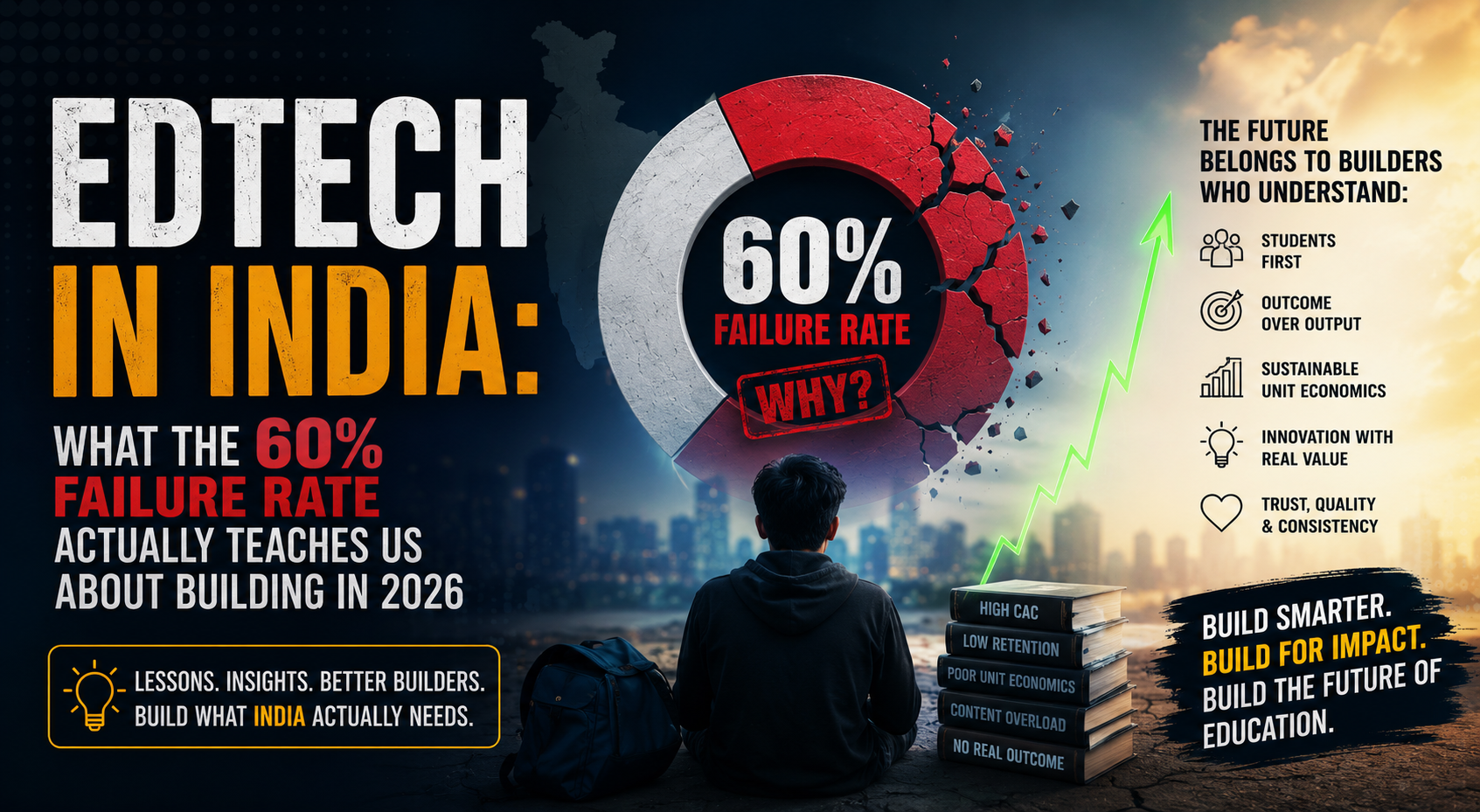
BYJU'S didn't fail alone. Across India, edtech startups have failed at a rate of roughly 60% — one of the highest failure rates of any sector in the country, worse even than the brutal ~90% five-year failure rate most Indian startups already face. Sector funding fell nearly 78% in 2025 compared to 2024, and investor confidence still hasn't recovered.
The easy takeaway is "edtech is dead." That's wrong, and it's also not useful. The real story is what actually killed most of these companies — and it's a lesson every founder building in 2026, in any sector, needs to sit with. We've covered this pattern across Indian startups more broadly, but edtech shows it in its most extreme, most instructive form.
The Number Behind the Headlines
The Indian edtech story looked unstoppable during the pandemic. Investors poured billions into the sector between 2020 and 2022, chasing a total addressable market that pitch decks routinely quoted north of $90 billion. The real, direct-to-consumer online K-12 market turned out to be closer to $2–3 billion — roughly 11% of what founders and VCs told each other it would be.
That gap between the story and the reality is where most of the failures actually happened. Not in bad classrooms, not in bad teachers, not even in bad apps. In a market size that existed for eighteen months of school closures and was mistaken for a permanent shift in how India educates its children.
From FOMO to FOGS: Why Parents Stopped Trusting Edtech
Indian parent psychology moved through two very different phases in five years. Between 2020 and 2022, it was FOMO — fear of missing out. Every parent with a smartphone and a school-age child was being sold the idea that without a subscription, their kid would fall behind. Sales targets rewarded volume over outcomes, and edtech sales teams got a reputation for pressure tactics that bordered on predatory.
By 2024–2026, that fear had curdled into something else entirely: FOGS — fear of getting scammed. BYJU'S aggressive sales practices, inflated enrollment numbers, and unclear learning outcomes became the story parents told each other at school gates. Once trust breaks at that scale, no amount of marketing spend buys it back quickly. Every edtech company launching in 2026 is selling into a market that has been burned once already — whether they personally did anything wrong or not.
This Wasn't a Product Failure. It Was a Timing and Market-Sizing Failure.
Here's the part most retrospectives on Indian edtech get wrong: they blame the product. Bad UX, weak content, poor teacher quality. Some of that is real. But the deeper failure was structural, and it happened before a single line of code got written.
Most edtech founders and investors between 2020 and 2022 looked at a temporary spike — school closures forcing every child in India online at once — and modelled it as a permanent demand curve. It wasn't. Once schools reopened, the artificial urgency disappeared, and a huge share of "users" reverted to what they'd always wanted: in-person learning with a screen as a supplement, not a replacement.
That's a timing problem, not a product problem. You can build the best-designed learning app in the country and still fail if you build it at the wrong moment, for a market that's about to shrink back to its real size. The founders who got hurt the worst weren't necessarily the ones with weak products — some had genuinely good content and strong teaching talent. They were the ones who raised, hired, and scaled against a demand curve that peaked before their Series B closed, and had no framework for catching that shift early.
This is exactly why AiiQA's Score Breakdown treats timing as one of six weighted dimensions — alongside market size, competition, execution risk, problem urgency, and regulatory risk — rather than an afterthought buried in a paragraph. An idea can score well on execution and still fail because the window it was built for was already closing. Timing isn't a footnote you check once at the start; it's a variable that can flip a "Build" verdict into a "Pivot" verdict within eighteen months, and most founders never re-run the test.
What Actually Killed the Unit Economics
Even edtech companies that got the demand question roughly right ran into a second wall: unit economics that never worked in the first place. Customer acquisition costs climbed as every player chased the same shrinking pool of anxious parents. Sales cycles for B2B and institutional edtech stretched long, tying up cash for months before a single rupee of revenue landed. And retention — the metric that actually determines whether a business compounds or bleeds out — stayed weak, because "time spent on the platform" and "course completion" turned out to be poor stand-ins for whether a child was actually learning anything.
The result, in company after company, was negative LTV-to-CAC math dressed up as growth. Venture capital covered the gap for a few years. When funding tightened, the gap became visible, and the gap was the business.
What's Surviving: The Phygital Pivot
None of this means edtech is finished in India. It means the pandemic-era assumptions are finished. The companies still standing in 2026 share a pattern worth paying attention to.
The clearest signal is the rise of "phygital" — physical-plus-digital — models. PhysicsWallah is the most visible proof point: a hybrid approach that pairs offline centres parents can walk into and trust, with digital content that extends the reach and cuts the cost. It respects something pure online-only models missed entirely — Indian parents want tangible, verifiable outcomes, not just an app icon.
Beyond the hybrid shift, the survivors share a few other habits: they're building for measurable learning outcomes instead of time-on-platform vanity metrics, using AI for real personalisation rather than a chatbot bolted onto a video library, delivering content in regional languages mapped to actual state board curricula, and deploying capital with far more discipline than the 2020–2022 cohort ever did.
None of these habits is edtech-specific, either. They're what happens when a founder validates demand against reality instead of against a fundraising narrative — and it's the same pattern showing up in the fintech sector after its own 75% failure rate among VC-backed startups in 2025. Different sector, same root cause: a story that outran the market it was describing.
The Real Lesson for 2026 Builders
If you're building in edtech — or honestly, in any sector where the last few years produced a demand spike that looked bigger than it was — the lesson isn't "avoid this space." It's "find out whether the demand you're building for is real and durable before you spend eighteen months building for it."
That's a validation problem, and it's solvable in days, not years. A structured evaluation should tell you, before you write a business plan: is this market actually the size people are telling you it is right now, not in 2021? Is the urgency behind it temporary or structural? What would have to be true for the timing to actually work in your favour? AiiQA's Opportunities and Score Breakdown sections exist specifically to answer these questions with reasoning attached — not a vibe, not a guess, and not a three-year-old TAM slide that nobody re-checked.
How to Validate Your Edtech Idea Before You Build
Before you write a single line of code on your next edtech idea, run it through a short gut-check:
- Is the demand you're building for still growing today, or did it peak with a temporary event (a pandemic, a policy change, a viral trend)?
- Can you name three families or institutions who would pay for this right now — not "would consider it," but pay?
- Does your model depend on parents trusting an unfamiliar brand with zero physical presence, in a market where that trust just broke?
- Have you priced your customer acquisition cost against a realistic — not aspirational — market size?
If you're not confident in the answers, that's exactly the gap a structured AiiQA report is built to close: a real score across six weighted dimensions, a risk analysis, a go-to-market plan built for how India actually buys education, and a 7-day sprint to get from uncertain to decided. Edtech isn't dead. Building on assumptions nobody re-checked is.
Start with AiiQA and know before you build.
Validate what you're building.
Get your free viability score, top risks, and honest verdict — in 3 minutes.
Get my free verdict
Praveen Yadav